Weather determines what you put on in the morning, while climate determines what’s in your closet. Consider what someone living in Hawaii might have in their closet compared to what you have in yours.
In other words, the weather is different every day and can vary greatly from one day to the next, but climate is an average of the weather over a long period of time.
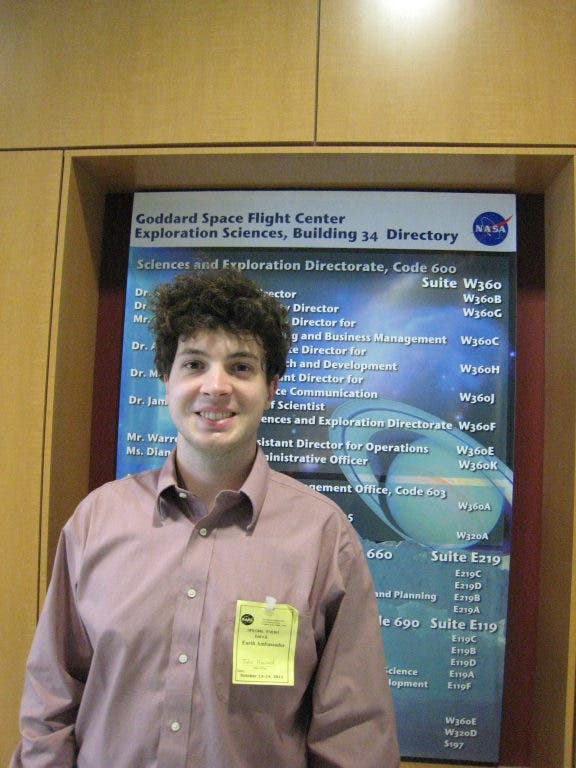
Even as the subject of climate change seems to have moved out of the American conversation, at NASA's Goddard Space Flight Center in Maryland last week, twenty informal science educators gathered to learn about climate science and climate change from NASA scientists who study it every day.
Find out what's happening in Edinafor free with the latest updates from Patch.
Edina resident John Howard was one of the 20 who were selected as “Earth Ambassadors” by NASA. Howard grew up in Edina, went to St. Olaf College and now volunteers with Edina’s Energy and Environment Commission and an organization called Cool Planet, which encourages kids to get involved in caring for the environment.
President Dwight D. Eisenhower established NASA (the National Aeronautics and Space Administration) in 1958. Many people associate NASA solely with space exploration, but NASA—with the International Space Station and its satellites orbiting Earth—is in a unique position to study our home planet. From space, their cameras and instruments can take photographs and measurements we couldn’t possibly acquire with our feet on the ground.
Find out what's happening in Edinafor free with the latest updates from Patch.
One such satellite, named Aura, was launched in 2004 and is part of a program dedicated to “monitoring the complex interactions that affect the globe using NASA satellites and data systems.” Satellites like Aura allow scientists to study how our climate is changing and how different systems, like air temperature, clouds and ocean temperature, among others, work and interconnect.
NASA’s simple message to their Earth Ambassadors was this: Climate change is real and due, in a large part, to human behavior, like burning fossil fuels (oil and coal) and burning down rainforests. These activities add Carbon Dioxide (CO2) to the atmosphere. Scientists see multiple pieces of the puzzle all moving in the same direction: a warmer Earth.
Depending on where you live, you may see temperatures go up or down, since ocean currents and other variables contribute to climate. Overall, the science shows that the Earth’s temperature has gone up significantly, far out of the range of normal cycling, since the beginning of the industrial age when humans first started burning fossil fuels.
Due to economics (people keep close track of money), scientists know almost exactly how much coal and oil are being burned and can calculate how much CO2 goes into the air as a result.
NASA’s models predict that if we keep burning fossil fuels at the rate we are today that the climate will probably change even more dramatically, and some parts of the world will experience severe droughts while others are destroyed by catastrophic flooding, as polar ice caps (land ice) melt and sea levels rise.
One NASA scientist said that at this point, the climate has already changed and we will have to learn to adapt to living in a warmer world, although it’s not too late to slow the change and avert more severe consequences.
The scientists weren’t there to offer suggestions (or even hope) to the Earth Ambassadors, but only scientific data and analysis. However, one of them said "if each of us does something, the sum of our actions will make a difference."
Another said "it’s important to be a skeptic, but a denier is someone who looks at the data and won’t change their mind, regardless of what the data says."
NASA, and people like John Howard, will be working to educate the people about the realities of climate change. The public will have to decide for themselves whether they want to be skeptics or deniers.