Politics & Government
Tuskegee Airman Joseph Gomer Wows Library Crowd
American hero Joseph Gomer, a member of the renowned Tuskegee Airmen, told stories of bravery, disappointment and resilience at the Dakota Library's Galaxie branch in Apple valley this weekend.
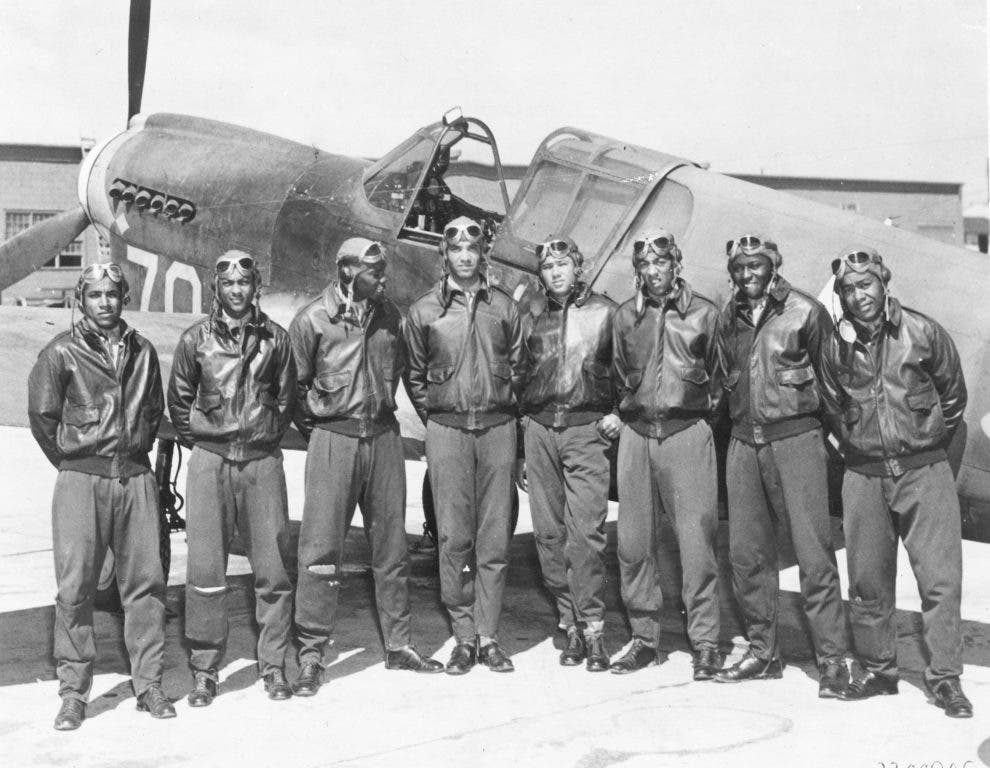
“It’s a pleasure to be here”, said retired Air Force Major Joseph Gomer (92) to a standing room only crowd at the library’s atrium. “Then, at this age, it’s a pleasure to be anywhere.”
Gomer, who grew up in Iowa Falls, IA, in one of only two black families in town, and got his flying license before his driver’s license, was a pilot for the 332nd fighter group during World War II. The famous 'Tuskegee Airmen', now back in the media spotlight because of the movie 'Red Tails', fought their way through Europe, and proved that African-Americans make excellent fighter pilots, just like their white counterparts.
But it was not easy, said Gomer, whose lecture was interrupted by numerous ovations. “Let’s face it, we were a segregated air force. And when we came home, we were still segregated.”
Find out what's happening in Inver Grove Heightsfor free with the latest updates from Patch.
While stationed in Europe, Gomer shared a tent with three other pilots. None of them made it out alive. And Gomer, too, had some close calls.
Once, he said, his plane was badly shot up over the Adriatic Sea by a German fighter, whose bullets missed his external fuel tank by inches. “I look out at my left wing, and it had holes in it from one end to the other. If he was a better shot, I wouldn’t be here today.”
Find out what's happening in Inver Grove Heightsfor free with the latest updates from Patch.
When he landed safely at his base in Italy, Gomer’s mechanic handed him a matchbox containing shrapnel from the German shells found in his plane, as a souvenir.
“I didn’t think much of it at the time, but all those years later, it starts to get to you. You realize how lucky you are to still be around.”
But Gomer also recalled beautiful sunsets, and other spectacular sights from the cockpit of his P51 Mustang. “You’d fly off over Vesuvius. All that red lava spilling out – it was beautiful.”
At the library, a veteran bomber crewman got up to thank Gomer for the times the Tuskegee Airmen escorted his own B24 on its missions to Nazi Germany. He recalled seeing their red tails, but said that he didn’t know they were black at the time.
That happened often, said Gomer. But for all their bravery in combat, the black pilots still did not get the respect they deserved from many white airmen.
“They didn’t realize who escorted them. We had this one pilot – we saved this aircraft, and when he came around to thank us, and saw nothing but black faces, he left.”
Combat with the Nazis was not personal, said Gomer. “Everything was business. We were out to do our jobs, and they did theirs.”
What was personal to Gomer, was the racism he encountered when he made it back home after the war. It started before he even left Europe, when he tried to board a military train in Naples, Italy, on his way back to the U.S., and was ordered to the end of the line by an American Captain.
“That was the low point. That hurt even worse than the German shrapnel. It took me years to even talk about that. Fighter pilots are supposed to have killer instinct. I didn’t have that until I was ordered to the end of the line. If I had felt towards the Germans the way I felt towards my fellow Americans that day, the war would have been a lot shorter.”