Health & Fitness
Bucket List: Himalayas
A "bucket list" is defined as a list of things one wants to accomplish prior to dying, or kicking the bucket. Mine led me to the Himalayas in April 2011 for some high altitude trekking.



A "bucket list" is defined as a list of things one wants to accomplish prior to dying, or in other words, kicking the bucket.
I hadn't put much hard thought into the concept until a few years ago when my favorite team made it to the Super Bowl and I debated with myself for a week before pulling the trigger and going to the game. It was a great experience (my team won) and I was glad that I spent the money and time to go. It was a 'once in a lifetime' experience and I made it happen.
There are always reasons not to do something, so sometimes the hardest thing is simply making the decision.
Find out what's happening in Maple Grovefor free with the latest updates from Patch.
My wife and I took a trip to Alaska last year for a great week-long cruise, an that was something I'd always wanted to do. These two events are what started me thinking more about the idea of a bucket list and what I really wanted to achieve or see in my lifetime. About the same time as the cruise, several things came into focus and I realized that one of my bucket list items was to travel to Nepal and Tibet to see the countries and do some trekking near Mount Everest.
My interest in Everest, the highest mountain in the world, has little to do with climbing, as I have no interest in strapping on crampons and a harness with the intent of putting myself in agony and harm's way along the path to the summit. Like some, I initially got interested in Everest about a decade ago when I read Jon Krakauer's classic Into Thin Air, a book about a series of climbing tragedies on Everest in May 1996. It's probably important to note that I read this over several spring break days while sitting on a warm beach where the coldest thing around was the bucket of cold Modelo's by my side.
Find out what's happening in Maple Grovefor free with the latest updates from Patch.
After that read, I started following the annual spring climbing expeditions on several websites every year (the best weather window for climbing Everest is in late May). I also started reading about the history of the mountain and was particularly interested in the early British expeditions of the 1920's. It's incredible that these men, with little more than a 'stiff upper lip' and clothing and equipment that is primitive when compared to what is available to climbers today, attempted to climb this mountain peak 29,035 feet above sea level. It took all of their first expedition simply finding a possible climbing route, as there were no maps of the area. No one at the time had climbed anywhere that high. The summit has approximately 30 percent of the oxygen available at sea level and many climbers of the day didn't think a summit was physically possible.
After unsuccessful expeditions in 1921 and 1922, two of the climbers, George Mallory and Sandy Irvine, disappeared into one of the biggest mysteries in mountaineering history. Last seen strongly headed to the summit at about midday on June 8, 1924, they failed to return and were assumed lost. The debate continues to this day on whether or not the two men made it to the top. The various theories and ideas make for some interesting reading, but it's likely a mystery that will never be solved. Climbers, however, found Mallory's frozen body thousands of feet below the summit in 1999, but his camera was missing. However, also missing was a picture of his wife that he promised to leave at the summit. Irvine's body remains to be discovered, despite several attempts over the last decade.
While reading the history, I also became interested in Tibet and its culture and people. The first time I saw a picture of the Potala Palace, I knew it was a place that I someday wanted to visit.
Although my wife had no interest in going with me to Nepal and Tibet, she was very supportive even though it would be three weeks away from home. I spent several weeks researching the various options and selecting a good organization - SummitClimb. There are only about a dozen climbing and trekking groups that offer Everest, and SummitClimb specifically offered what I was looking for in terms of traveling across Tibet and then trekking on Everest. I submitted my application and a down payment (not a cheap trip) about four months prior to the trek. Then I started working out a lot more, as well as buying clothing and equipment needed for the trek.
I did a lot of worrying during the 100+ days that I counted down towards my departure date. I worried about how my family would be without me for three weeks (they were fine); whether or not I was working out enough (I was, but you can't train for high altitude); and if I had the right clothing on my packing list (generally I did). There were a lot of planning details to take care of, such as purchasing specialized trip insurance (mandatory); coordinating travel to a destination 12,000 miles around the globe (it's almost directly opposite of Minnesota on the globe, so I one can fly west or east); registering my trip online with the State Department; and monitoring the situation in Tibet for issues where the Chinese might close the region because of unrest.
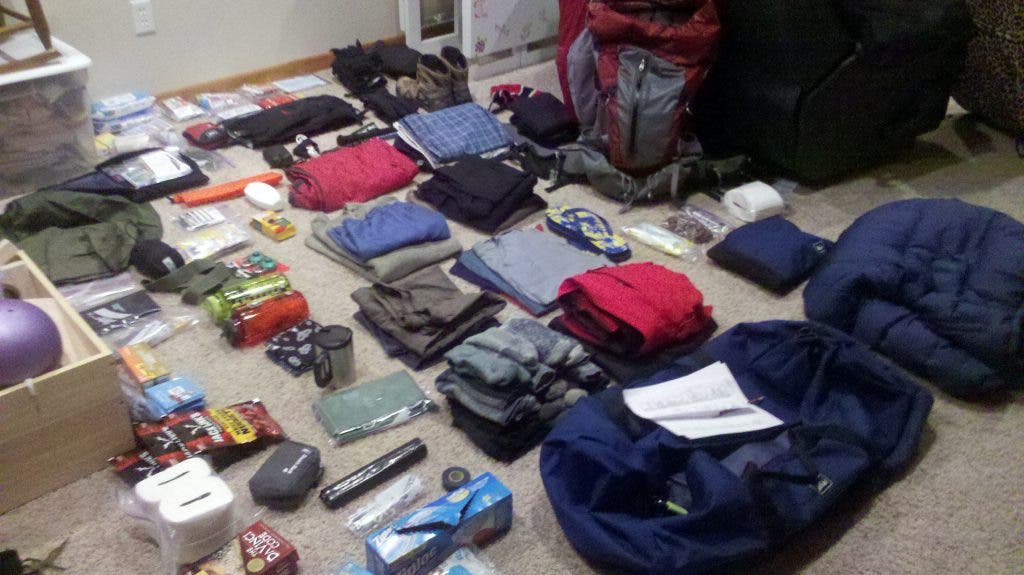
I'm a detail-oriented person, so I used multiple checklists to ensure I accomplished all of my pre-trip tasks and secured all of the necessary items. About a week prior to departure, I carved out a section of the basement and started laying out my gear. The day prior to departure, I checked items off my lists as I proceeded to get ready for final packing into two large duffel bags and a rucksack.
Please check back for many more posts covering my three week trekking adventure.
Up next: a lot of hours as I travel to my initial destination - Kathmandu, Nepal.