Politics & Government
Minnesota 1, Trump 0
What we and the rest of America can learn from Trump's retreat.

February 16, 2026
The winter of 2026 will go down in state history as among our finest hours.
Find out what's happening in Minneapolisfor free with the latest updates from Patch.
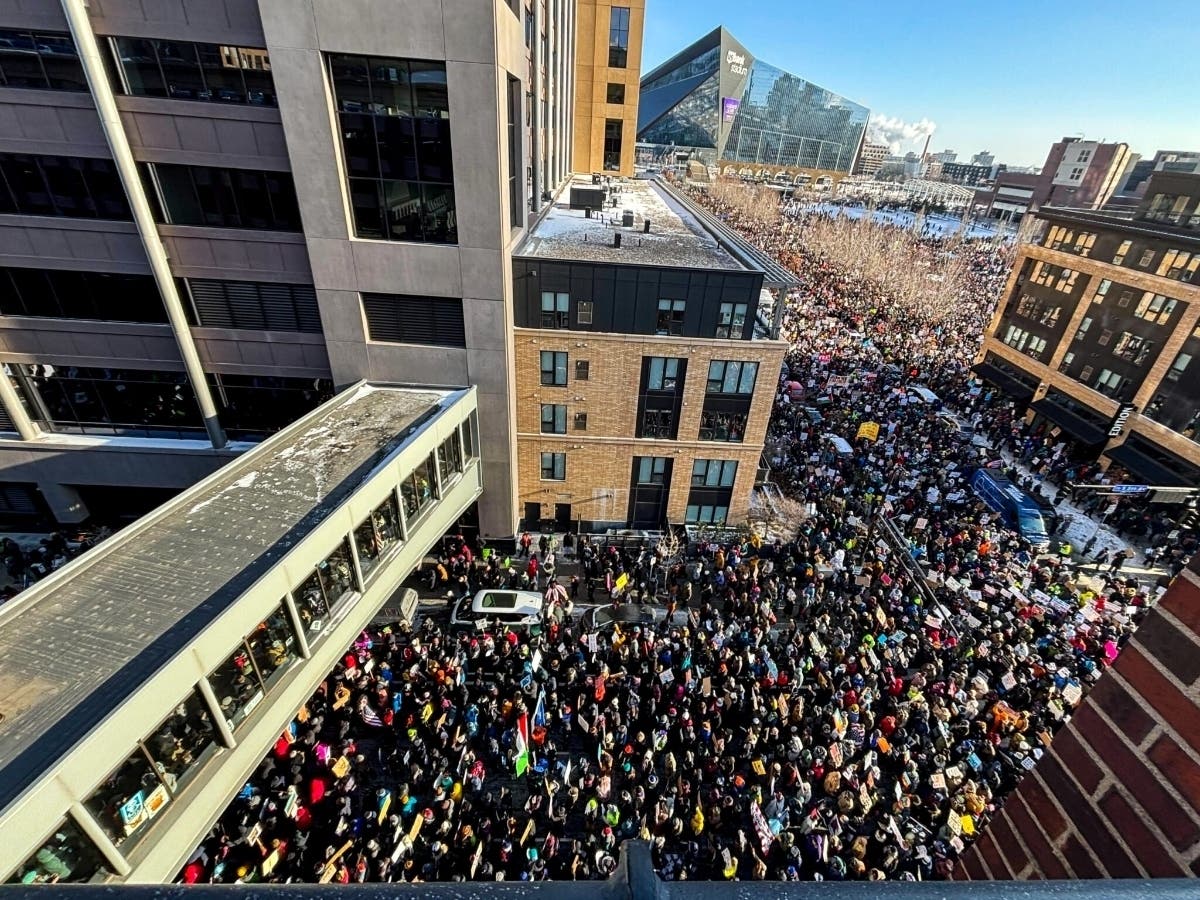
What happened here will be studied by social scientists and historians as one of the great victories of nonviolent resistance in recent times. Minnesotans showed that brutality and sheer numbers could not overcome communities that were united in their opposition to the usurpers.
People are right to be skeptical about whether the Trump administration’s immigration crackdown here is ending, as announced Thursday by $50,000 man and border czar Tom Homan.
Find out what's happening in Minneapolisfor free with the latest updates from Patch.
But I’m confident they are leaving for a simple reason: They’re losing.
What happened and why it happened offer important lessons for our future and for democracy defenders across the country, so let’s focus for a minute before we dance on the grave of the authoritarian attempt:
The resistance was communitarian. By now it’s almost cliche: Minnesotans — and especially Minneapolitans — were looking out for their neighbors, be they immigrants or the people protecting them. Neighborhoods came together again as they did after the police murder of George Floyd and the chaos that followed, all during a pandemic. The lesson here is to get to know your neighbors.
The sense that we’re all in it together motivates great acts of both charity and courage.
The resistance was libertarian. When I talked to friends and family around the country, I put it in these terms: Imagine that 3,000 masked, heavily armed outsiders were roaming around your community, routinely racially profiling people, including off-duty police (!); detaining immigrants here legally — including young children — and shipping them across state lines; smashing the car windows of observers and arresting them before releasing them without charges; and, of course, shooting and killing two American citizens and injuring an immigrant in a case of mistaken identity. When you put it in these terms, Americans around the country got it.
The resistance was nonviolent. (Mostly.) When authoritarians are employing brutality, armed resistance feels justified. Second Amendment enthusiasts might even say constitutional. But it often leads to a spiraling cycle of violence and repression, e.g., the Troubles in Northern Ireland.
Bullhorns, whistles, chants, shouts, songs, mockery and marches were more effective than violence could ever be.
This is not a new or untested strategy. As the Rev. Dr. Martin Luther King Jr. said during his Nobel Prize acceptance speech: “Nonviolence is not sterile passivity, but a powerful moral force which makes for social transformation.”
The feds’ support, meanwhile, collapsed when they engaged in indiscriminate violence.
The nonviolent resistance helped win the battle for public opinion, which was crucial. An NBC poll showed that two-thirds of Americans believe the Trump administration’s immigration tactics have “gone too far,” with similar numbers in Minnesota, according to another poll.
We too often think of authoritarians as omnipotent, acting with impunity in the face of all resistance. Nothing President Donald Trump says or does seems to matter. But this is not true, and that attitude of despair is precisely what the authoritarian needs. Authoritarians have frequently been defeated in the face of mass resistance, from the Eastern Bloc to Latin America. Once the authoritarian loses popular legitimacy, it’s only a matter of time before the regime collapses.
Our strong institutions were an important bulwark. Outsiders who kept bleating about “paid protesters” have clearly never stuffed themselves with hot dish and baked goods at a Minnesota PTA meeting, caucus, hockey game or church event on a subzero night.
Indeed, as Madison McVan reported this week, churches (and let’s add mosques and synagogues) were crucial to providing material and spiritual support to immigrants and those defending them.
Minnesota ranks highly — 2nd in the nation in one survey — in indices of social capital, i.e., family unity, social support and volunteerism. If you feel like we’ve taken a beating in recent years — the killing of Floyd and unrest and rioting that followed, the looting of our safety net programs, the assassination of former House Speaker Melissa Hortman — you’re right, but our strong institutions have helped us remain resilient.
Our big corporations were not part of that institutional infrastructure. They were silent, and then mealy-mouthed. The days of corporate noblesse oblige are over, especially when the authoritarian demands unquestioning fealty from them.
The judiciary stood up to the authoritarian attempt. Attorneys for immigrants worked under impossible conditions to defend constitutional rights and due process.
More than a dozen federal prosecutors quit in disgust.
And, federal judges refused to be cowed. In scorching orders — from appointees of just about every recent president, including a protege of conservative icon Antonin Scalia — many refused to countenance the legal chaos and unconstitutional usurpation the federal government unleashed here. They provided a near daily drumbeat of evidence of the Trump administration’s lawlessness. This severely undercut the administration’s message that Operation Metro Surge was a “law enforcement operation” when anyone could see it was a politically-motivated, performative show of aggression.
During one hearing, Judge Jerry Blackwell — who was the lead prosecutor of Floyd’s killer, Derek Chauvin — reminded the federal government’s lawyers of the seriousness of the executive branch’s insubordination in failing to release detainees, as he’d ordered: “The DOJ, the DHS, and ICE are not above the law. They do wield extraordinary power, and that power has to exist within constitutional limits.”
Minneapolis Police Chief Brian O’Hara was a PR bonanza for the resistance, even though many Minneapolis activists loath MPD. I learned from O’Hara’s many local and national media appearances, for instance, that there’d been three homicides in Minneapolis as of late January, and two of them were committed by the feds. Considering the traditional blue wall of silence, you’d expect O’Hara to refrain from criticizing the feds, but he landed punches instead. (No permanent friends, and no permanent enemies: a political maxim worth considering.)
Although this moment was far bigger than party politics, there’s a few things worth mentioning:
Some Republicans provided important bipartisan messaging. I’m sure there are others, but Sens. Jim Abeler, Zach Duckworth, and Julia Coleman and Reps. Marion Rarick and Nolan West gave fellow Republicans and Republican-leaning independents a subtle signal that it was OK to question the constitutionality and effectiveness of Operation Metro Surge.
By contrast, Vichy Republicans, like U.S. Rep. Tom Emmer, turned against fellow Minnesotans and gave aid and comfort to the authoritarian outsiders. Grudges aren’t healthy, but we shouldn’t forget. Now they’ll receive their just deserts because the Democrats will likely win in November.
Which means those Republicans will be just another in the long line of Trump’s marks.
A lot of Democrats paused their endless factional disputes, or as one militant leftist posted on X last month: “Liberals, leftists, moderates, socialists, communists, and f*cking all the rest have an opportunity here to come together and fight fascism. That means, for the moment, FOR THE F*CKING MOMENT, to not be a dumb*ss b*tch about factionalism and old beefs. Just for now. For a bit.” (I’m sure this very column will bring the requisite calumny from said factions — see item #8 — but that’s all to the good, as it signals a return to normalcy.)
Finally, respect localism. When the feds chased a man at high speeds through my neighborhood Wednesday, which led to a three-car wreck, I found myself in a state of agitation and contempt for the usurpers that was only matched previously by the killings of Renee Good and Alex Pretti.
It hits different when it’s your own neighborhood. Which, I realize, is morally provincial. After all, other neighborhoods have been dealing with this on a daily basis for two months. (Some communities have suffered under repressive policing for much longer.)
And, for that matter, other nations have been dealing with rulers’ boots on their necks — including proxies of the United States government — for years, and, in some cases, decades.
So my final takeaway is that we ought to be extremely humble when we seek to impose our will on other people, communities, states, and nations.
Now, let’s spend the weekend toasting and dancing in the streets.
The Minnesota Reformer is an independent, nonprofit news organization dedicated to keeping Minnesotans informed and unearthing stories other outlets can’t or won’t tell..