Politics & Government
Teacher Strike Debate—Then and Now
Sen. Hann is sponsoring legislation that would remove a teacher's ability to strike. It's not the first time this debate has played out at Minnesota's state Capitol.

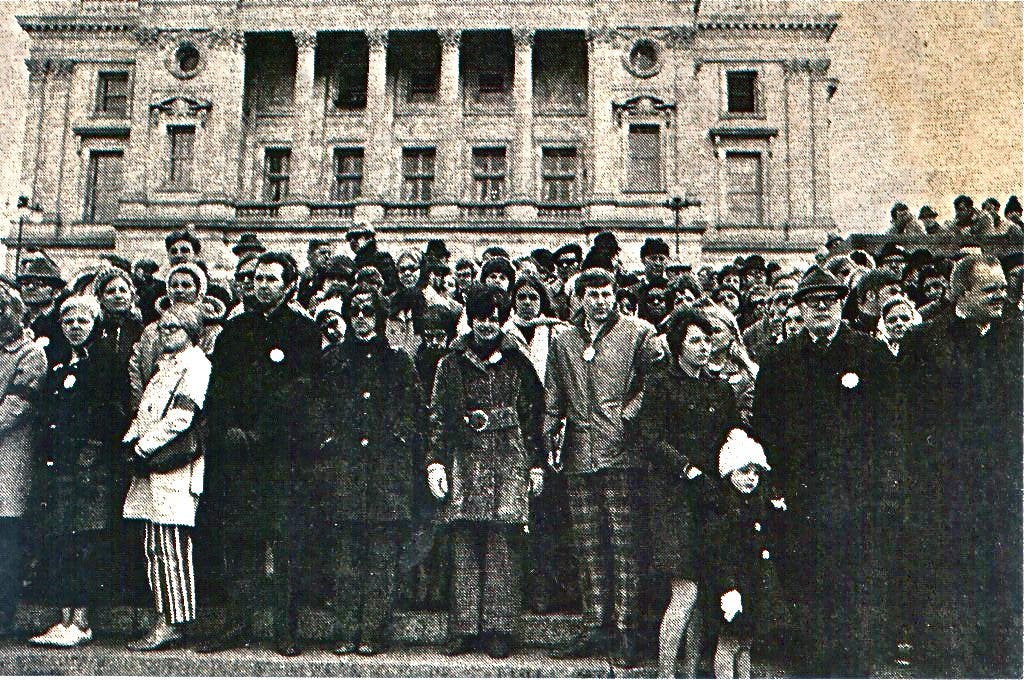

In 1970, Minnesota’s unionized teachers were prohibited by law from striking. But Local 59 of the Minneapolis Federation of Teachers called a strike anyway, insisting teacher pay was not a living wage. For weeks, Twin Cities’ teachers walked the picket lines in front of the state Capitol in St. Paul.
George Kimball was one of those teachers.
“The wages were so low. I had five children at that time and we could barely survive,” Kimball remembered. “We couldn’t take it anymore.”
Find out what's happening in Minnetonkafor free with the latest updates from Patch.
The strike prompted the state Legislature to enact Minnesota’s Public Employees Labor Relations Act—the law that currently protects teachers’ ability to strike.
Now lawmakers in St. Paul want to change that. Assistant Senate Majority Leader, David Hann (R-District 42), who represents parts of Minnetonka, is leading the charge, sponsoring a bill, which forbids teachers from striking. Hann said the goal of this legislation is to remove the benefit that a threatened-strike imposes on a contract negotiation.
Find out what's happening in Minnetonkafor free with the latest updates from Patch.
“You have to change the structure, the laws that have empowered employee groups to have the advantage to determine not only finance but also policy,” Hann, a former school board member, said of the proposal. The measure also limits teacher contract negotiations to the summer months when schools are not in session.
The proposal was crafted by the Minnesota Association of School Administrators, a group representing 350 of Minnesota’s school superintendents. Although working to pass the bill, Charlie Kyte, MASA’s Executive Director, told Minnetonka Patch the group doesn't intend to strip power from teachers in favor of school administrators but to eliminate the divisive dynamic that a strike possibility creates during teacher contract negotiations.
“We think it gives us a more fair equation,” Kyte said. “It’s about removing the acrimony from the process so it’s more professional [and] finding a better way of resolving the differences.”
But decades after walking the picket lines to secure the ability to strike, Kimball, who retired from teaching in 1987, reacted to details of the measure with shock: “My heart stopped this morning when I heard it.”
Last Monday, Hann’s bill passed along party lines, 8-5, in the Government Innovation and Veterans Committee. On Wednesday, the Education Committee, on which Hann sits and whose chair, Sen. Gen Olson (R-Medina/Lake Minnetonka), is a co-author of the legislation, heard testimony on the bill.
“We are trying to create a structure where the focus is on education. We don’t want kids getting pulled into the disputes among adults—when the work of educating kids becomes secondary,” Hann said.
It’s an argument Kimball isn’t buying. He said the ability to strike ensures better teacher wages and that with better teacher wages, comes better teachers.
“Without good contracts, there would not be the pool of outstanding people going into the field of teaching— that affects kids,” Kimball said. Teachers unions also are worried that without the ability to strike, teacher salaries will continue to fall.
Minnesota teachers have dropped in the nation’s teacher salary rankings—to 20th in 2009. In numbers published on the Minnesota Department of Education website, the average salary for a Minnesota public school teacher last year was $52,431—up just $17 from the year before.
And Kyte insisted that this bill is not focused on helping school administrators meet their bottom line.
“This is not a solution to balance budgets, this is a solution to come to a better civil process. We think the state should be investing more heavily in the education system,” Kyte said. “We say to the teachers, ‘Let’s work together to get more revenue to run our schools.’
If passed into law, the measure would take effect in July 2013, and would reclassify Minnesota’s teachers as "essential employees" similar to firefighters, police officers and school superintendants. The “essential employee” label will prevent teachers from striking.
Education Minnesota, the state’s largest teacher’s union representing 70,000 educators, said Hann’s proposal is in line with Wisconsin's hotly debated law that removes collective bargaining rights for public employees, including public school teachers.
“This measure is just one of many efforts in the current Legislature to silence the voices of teachers by bringing Wisconsin-style attacks on collective bargaining to Minnesota,” Education Minnesota President Tom Dooher said.
MASA rejects Education Minnesota’s comparison, saying it supports collective bargaining.
“They are reaching to extremes- that’s the emotional argument,” Kyte said. “We don’t see it as trying to strengthen the hand of the school boards.”
Hann responded, “(Minnesota teachers) still have collective bargaining rights but they just may not strike.”
But without strike ability, teachers, including Kimball insisted, “There would be no point in collective bargaining.”
Arbitrators from the state Bureau of Mediation Services would decide any impasses between teachers and administrators. But Deborah Schmedemann, a labor attorney and professor at the William Mitchell College of Law, said arbitration doesn’t often benefit teachers.
“Striking alters the economic power,” she said. “Striking is more substantial than arbitration.”
Schmedemann also said that opinions on whether arbitration or striking is more effective vary widely among labor experts. In fact, MASA told Minnetonka Patch that it’s their belief that arbitrators do err on the side of teachers during negotiations.
Kimball, who said he’s disheartened by MASA’s support of the bill, insisted that most teachers are disinclined to strike, saying: “It’s rarely used, it’s really a last resort.” Minnesota has had three teacher strikes in the past 15 years.
Kyte’s response: “A strike is a much better card held than played.” And when it is played, according to Kimball, it’s not an easy road for striking teachers.
“It was a very difficult time. I borrowed some money and got a job working with the DNR for eight hours a day. Then after work I would go picketing,” Kimball said. “But the life of the Minnesota teacher became better.”
Today, one of those Minnesota teachers is Kimball’s daughter, Mary Benson, currently a teacher at . She was in middle school during the 1970 strike. Looking back now, she said watching her dad stand up for teacher’s rights was one of the moments that inspired her to become an educator herself.
“That really stuck in our heads, the whole idea of treating people fairly,” Benson said. “And now to take away that right, the only leverage we have, that’s crazy.”
And Benson has a dog in this fight—her role in the Minnetonka schools isn’t limited to teacher—she’s also president of the Minnetonka Teachers Association.
Get more local news delivered straight to your inbox. Sign up for free Patch newsletters and alerts.