Schools
Want to Raise a Drug-Free Child? Try this Minnetonka Book Club.
Tonka CARES is holding weekly meetings to discuss ways to keep Minnetonka's school children away from drugs, alcohol and tobacco.

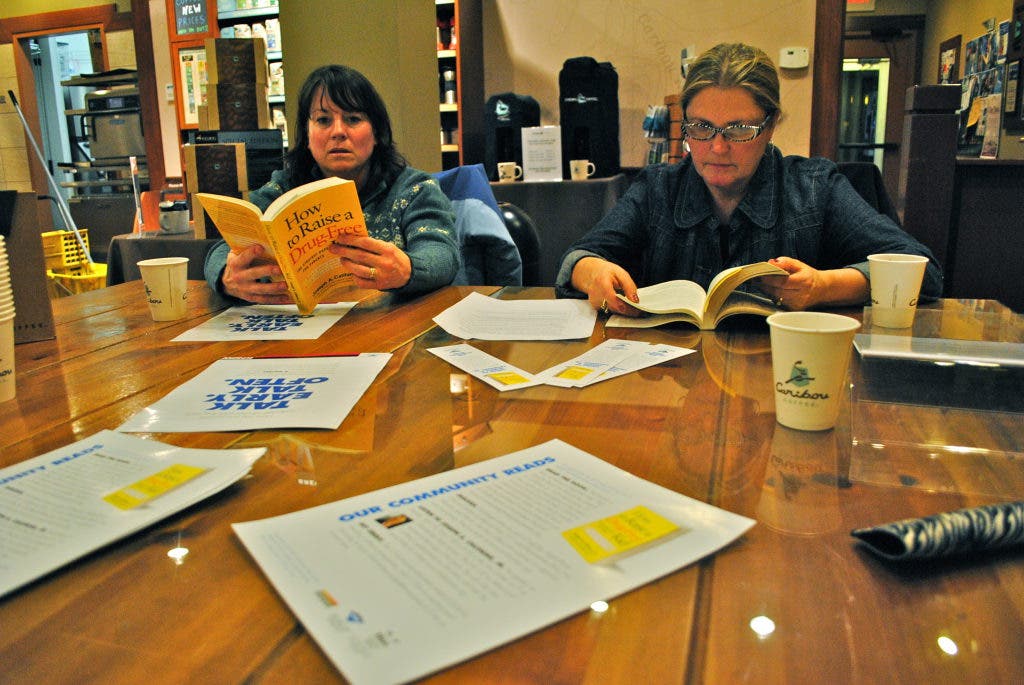


It's 7 p.m. on a cold Tuesday night in Minnetonka. Outside the Caribou Coffee at Highway 101 and Minnetonka Boulevard, a row of minivans and SUVs sit parked. Inside, a small group has gathered near the back of the shop, at a large square table marked, ‘reserved.’ A few of the women present are delighting in a free sample of Caribou’s newest selection, ‘spicy hot cocoa.’
“Ohhh. This is good,” says one of the women to Steve London, Caribou Coffee manager and host of the evening's event.
“Mmmm. It is!” seconds another, after taking a sip from a tiny sample cup.
Find out what's happening in Minnetonkafor free with the latest updates from Patch.
And while it may look like a social gathering, filled with conversation destined to remain in the ‘small talk’ category-- polite and airy—in reality this is a group whose members have come here to take up a much more sobering topic: keeping Minnetonka's children off drugs, alcohol and cigarettes.
“Parents need to confront some of the scary things in their kids’ lives,” says Lee Drolet, Principal at Minnetonka’s , and the evening's facilitator. “The most important thing is not being afraid to be a parent.”
Find out what's happening in Minnetonkafor free with the latest updates from Patch.
This group of local moms- and one dad-are here for Minnetonka’s ‘Our Community Reads’ book club. For the past eight years, , a community drug and alcohol prevention program working specifically with the Minnetonka school district, has chosen a book which they believe every Minnetonka school parent should read. This school year it’s Joseph A. Califano, Jr.’s book, "How to Raise a Drug-Free Kid - The Straight Dope for Parents.”
“This is the manual on prevention and intervention,” says Shirley Snyder, parent education program manager with Tonka CARES, referring to the book. “This is a sort of support group. We talk with parents about whatever is on their minds.”
Minnetonka’s ‘Our Community Reads’ book club is going on every Tuesday night in February and March. Tonight, Feb. 15, Jennifer Heinzen and Jennifer Greenwood, from 's PTO, will lead the discussion.
But on Feb. 8 at 7 p.m. on the dot, it was Principal Drolet who calls everyone's attention, ending the half-hour social portion of the evening, and kicks off the night's candid conversation.
“Have any of you read the book yet?” she asks the group. Hands go up, a few of them twisting left to right mid-air, indicating the book had sort-of been read. One mom spontaneously fesses up to breaking what could arguably be the cardinal rule of any book club-- not only hadn't she read it, but she didn't even own a copy of the book! Post-admission, at least one person at the table wonders if Principal Drolet would issue a book club detention slip for the half-done homework. But no judgement is made on these students' reading-- or rather non-reading. You see, it's just not that kind of book club.
In fact, organizers encourage any Minnetonka school parent to attend one of these events- book read or not. Funded by various Minnetonka parent teacher organizations, Tonka CARES purchased 400 of the Califano books to give to district parents as part of the ‘Our Community Reads’ program. To date, 40 books remain.
Drolet simply grabs one of many copies of the bright yellow paperback, which are strewn around the large wooden table, and hands it over to the bookless mom. Then, back on task, Drolet, using a pair of zebra print reading glasses, borrowed from Snyder, reads a passage from her own doggy-eared copy of the book, “Califano says that a child who gets through age 21 without smoking, drinking alcohol or doing drugs is virtually certain to never abuse.”
With that fact unleashed, hanging in the air for parents to digest, Drolet looks up at them and asks, “If trying to keep kids free of drugs, alcohol and smoking until 21 is the goal, do you think it’s realistic?”
At first silence, then comments from the group begin, one on top of another.
Holly Barbosa’s two children, ages eight and nine attend . She starts, “Yes. We should show our kids that it’s not acceptable--”
“—and educating them about what it’s doing to their bodies and what it can mean for their whole lives.” Sue Miller-Bird quickly chimes in. Miller-Bird is also the parent of two children at Excelsior Elementary.
Snyder pauses the conversation and takes an opportunity to give these parents some context. She says experimenting with a drug or with alcohol means only trying it only once—more than once equates to using. Drolet concurs, nodding in agreement.
A quick look around the table reveals a handful of parents wearing some very serious-looking expressions.
“We’re replacing fear and anxiety with solutions here, real life things to implement with your families,” Drolet reassures everyone seated. The comment seems to be most calming to the three mothers of elementary school kids in the group.
But the moment is not lost on London who, referring to his daughter, a grad, interjects, “Oh, I’m so glad we don’t have to do this anymore, we got her through college!” And while everyone laughs along with London, the parents here are surely just a bit envious of his freedom from some of their current worries.
“Drugs may be as close as a parent’s medicine cabinet. Think about availability," Drolet says at one point. “Kids see marijuana as less harmful than alcohol.”
“Try to dissuade them of that,” Snyder quickly adds.
“You’re kidding? That’s amazing,” Barbosa exclaims, seemingly shocked.
It’s just a snippet from an hour-long conversation filled with eye-opening information for parents as well as reassurance for them that enforcing the rules instead of being a child’s best friend, is the right approach.
“Sometimes your kids will set you up to enforce a boundary,” Snyder says. “Pretty much every parent is told that they are the only one checking in on their kids. You’re not.”
According to data released last year, a lot of Minnetonka kids may think they are the only ones not using. In a 2010 student survey, nine out of 10 Minnetonka High School students believed that most of their peers use alcohol once a month or more. In reality however, most MHS students do not use alcohol-- seven out of 10 students reported that they had not used alcohol in the 30 days leading up to the survey.
Parental action, including making kids aware of how few of their peers are actually using, is key according to Snyder. In his book, Califano also puts a lot of weight on parents-- saying that they have the greatest influence to solve the drug and alcohol problems of our nation.
In their own efforts to prevent teen drug and alcohol abuse here in Minnetonka, educators Drolet and Snyder turn this hour into an opportunity to empower the parents present with tools which they can use to keep their own children away from drugs, alcohol and tobacco.
“Trust but verify. Talk early and talk often. Set boundaries with love.” Drolet repeats slowly, making sure the group has digested three well-known Califano quotes which she insists are both easy to remember and highly effective.
Although it was serious in nature, it was not a conversation lacking in laughter and smiles. Besides numerous comments back-and-forth on the "yummy" cocoa, the hour was peppered with many humorous parenting stories.
“I didn’t necessarily like to do it, but I spent a lot of time shopping with my daughter,” Drolet shares in an exasperated tone while explaining that getting a child alone, doing something they like, can often lead to them opening up.
Snyder follows up with her suggestion for getting a teenage boy to talk-- she says that in effect, trapping them a long car ride to the place of their choice, works wonders.
“There’s nothing else to do,” she says to the chuckling group, acknowledging that sometimes parents need to go to somewhat ridiculous lengths in an effort to communicate with their children.
The overall mood is encouraging. The messages are positive and the parents comment on how much they are learning. As the hour was winding down, both Drolet and Snyder remind the group just how important it is that dads take active roles in the lives of their children.
“I see a lot more moms than dads at school,” Drolet says.
Although somewhat compelled to do so as the lone father in the group, London responds, “I would hope fathers have been emancipated enough to have a role, it’s not just a mother’s responsibility.” And judging from the heads nodding enthusiastically in agreement, these moms agree.
At 8 p.m. sharp, the candid conversation is wrapped up and the group is dismissed. Books are swiftly closed and put back in purses, jackets are thrown on and a few more samples of the spicy hot cocoa are taken for the road. Their night of learning over, this group of parents heads out to their cars and home to the real-life reasons why this book club exists-- Minnetonka's school children-- who are hopefully already in their jammies.
***
Author of "How to Raise a Drug-Free Kid - The Straight Dope for Parents,” Joseph A. Califano, Jr. will speak to parents on Tuesday, April 12 at 7:00p.m. at Minnetonka High School.
A father of five and grandfather of eight, Califano is the founder and chairman of The National Center on Addiction and Substance Abuse at Columbia University. Califano has held various United States government positions and served from 1977 to 1979 as U.S. Secretary of Health, Education, and Welfare, where he launched the nation's anti-smoking campaign.
Get more local news delivered straight to your inbox. Sign up for free Patch newsletters and alerts.