Health & Fitness
Solo Trip to the BWCA Turns Up Richfield Connections on a Remote Portage In the Northwoods
This is a report about my mid-July 2011 solo canoe trip to the Boundary Waters Canoe Area Wilderness in Northern Minnesota taken from my notes that I wrote along the way.


{This is a detailed report about my mid-July 2011 solo canoe trip to the Boundary Waters Canoe Area Wilderness in Northern Minnesota, taken mostly from notes that were kept along the way}
Day 1: July 17
Driving Day (Richfield, MN to Grand Marais, MN; 271 Miles)
It’s HOT! Temps were pushing 90 degrees with unbearable humidity, but I kept the air conditioning off so that I would better acclimate to the heat while camping. I'm took I-35 north and made my traditional stop at Midway Road just outside of Duluth to fill up water bottles at the public well with the best water in the state (so I am told). Back on the freeway and on to downtown Duluth where I took some time trying to find a Radio Shack or camera store for some gear I thought about on the drive. I found neither one that were actually open, but I did see a guy passed out on the sidewalk in downtown Duluth. With the intensity of the heat being a concern for anyone outside that day, paramedics were already arriving on the scene as he would not last long laying on the sidewalk in that hot weather.
That sight was a bit interesting, even for Duluth.
So not finding what camera gear I needed, I settled on a alternate plan to go without and hopped on the 61 expressway to Two Harbors. I came to a stop at the first stoplight. It was still unbearably hot and humid and the lack of breeze due to being stopped at the light made me wonder if it was going to be this hot all the way up the North Shore. When I hit the north side of Two Harbors it was like I drove through a wall of cold air. Temps dropped on the car’s thermometer to 72 degrees and it became very foggy on the roadway and over the lake. In fact, you could not really see the lake in most places now. Still humid, just much colder. This is more like it I thought. I could get used to these temps. I could even roll up the windows and not get hot inside the car for the rest of the drive.
It was strange to see all the cars lined up along the side of Hwy 61 near all the state parks. Silly government shutdown. Driving through Lutsen which means it’s time to tune into 90.7 North Shore Public Radio for the scoop on weather and conditions on the Gunflint Trail. I know I am getting close now. Twenty minutes later, I’m pulling into Grand Marais to get any last minute items that I will need for the next 3 days in the North Woods.
First stop in Grand Marais is the Beaver House (which is a fishing store). I’ve been reading about their famous Beaver Flicks so I picked up a few of those along with some Canadian night-crawlers. I’m assured that the crawlers will be fine without refrigeration, given a couple Beaver Flicks for free, and I’m on my way to walk around downtown Grand Marais and shoot some photos of the foggiest conditions I have ever seen on the North Shore. I grabbed a slice of pizza at the Sven and Ole’s stand on the sidewalk outside their store and wandered down to the Gun Flint Tavern for a great meal, a cold hoppy beverage, and to take one last look at my maps and packing list before I head up the Gunflint Trail.
Find out what's happening in Richfieldfor free with the latest updates from Patch.
I still have no idea where I am sleeping tonight. I don’t want to spend money for a hotel and the bunkhouse at Rockwood Lodge was completely booked with larger groups that were heading in the following morning like me. I also didn’t want to unpack my gear to make camp at a campground because repacking and organizing in the morning would give me a later start.
A note about dinner: If you have not been there, the Gun Flint Tavern is great! I’m always blown-away by at least one new thing there each time I go and this time it was the gyro. Everything was completely fresh and full of flavor, as always. Whatever you get, try the blue corn chips with the sauce they put on them. Wow! They also have some great beers on tap. I went with a Bell’s Two Hearted because they happened to be out of Surly Furious on this particular day.
With a full belly, I decide it is time to head up the Gunflint Trail and relax close to the Rockwood Lodge so that I can be ready to go first thing in the morning. Rockwood Lodge is about 30 miles up the Gunflint Trail and I get there with plenty of time before sunset. The owners, Mike and Lin, have a sign on the door indicating that they are off having dinner. So I have a choice, do I wait or go explore? Well, I had never been to the end of the Gunflint Trail so here I go! 25 miles more northwest to the end of the trail and I saw some cool things along the way. Some forest affected by a recent fire and the Laurentian Divide were two highlights along the way. No moose though.
Back at Rockwood, I decide to go for walk around the resort I have also decided since I want to get up as early as my body will let me, I will be sleeping in the back of the VW Beetle at the resort so that i can maximize my padding time the next day. I woke up at 4 a.m. to some pretty heavy storms that left the resort and surrounding areas really soaked. I couldn’t get any sleep after the storm so I was up and out of the car at 6 a.m. and the the resort was already bustling with activity.
Find out what's happening in Richfieldfor free with the latest updates from Patch.
Highlights from Day 1 included: Gun Flint Tavern and seeing Canada (from the U.S.).
Day 2: July 18
Entry Day!! (Lakes: Poplar, Meeds, Caribou, Horseshoe; 6.5 miles)
Even though I planned to get on the water as early as possible, a few larger groups had the same idea so getting things like the canoe and permit ready took a little longer but it was no big deal. I also ended up striking up conversation with the resort owner, Mike, and other the paddlers along Rockwood’s beautiful shore on Poplar Lake. Mike offered a kayak paddle for the solo canoe I rented and told me I would move faster with it. I love just being in the North Woods and time spent with like-minded folks in this environment is time well spent to me so I wasn’t worried that I didn’t actually get on the water until 7:30 a.m.
In hindsight, I easily consider the kayak paddle in my top 5 most appreciated pieces of gear for my solo BWCA trip. The first thing l noticed was that the kayak paddle really propelled me across the water efficiently. It took about 10 minutes to get used to, including a yell from shore from Mike telling me I didn’t have to raise the blades so far out of the water, but with the calm waters and the ease of the kayak paddle I was to my first portage without much difficulty at all. The first portage would prove to be a little more difficult due to the heavy rains in the hours before sunrise.
While there was not much standing water on the portage, everything including rocks, roots, and grass were still wet and very slippery. People hike in all kinds of footwear (heck, I even saw a girl portaging in Adidas flip-flips this trip), but a good pair of boots came in essential on this trip. I have a photo of the boots I used. They were surplus U.S. military boots from Afghanistan with Vibram soles and drainage holes on the sides. They got very wet loading and unloading the canoe at portages but dried very fast at camp which is even more appreciated when you go to put them on the next day. If you have dry conditions, some portages may able to be done in almost any footwear. However, if you happen to find yourself in some wet conditions or difficult terrain, good soles and quick drying uppers will be your safest and most comfortable option.
This portage was going to be my longest of the trip at 290 rods, or 9/10ths of a mile, and got me officially inside the BWCA and onto Meeds Lake. I took two trips because I was unable to carry the canoe and all of my gear at the same time. I had one large main pack and a second smaller food pack in addition to my PFD (life-jacket), and paddle. From there is was a short paddle to my next portage, which I admit I had a hard time finding. In my excitement to finally be in the BWCA, I was rushing a bit more than I should have. This lead to a very small error on the map which ended me up being about 200 or so feet away from the actual portage on the shoreline. Then I ended up mistaking a small break in a swamp for the portage and unsuccessfully tried to walk it with my main pack. I realized I was not on any trail and began to fear that if I went much further I would not be able to locate the canoe again so I and headed back, soaked up to my waist, and frustrated about my predicament. To top it off, I was in an area that was thick with bugs, I was hot, and a little unsure how I was going to find the correct portage to the next lake I needed to get to. I loaded the canoe back up, found a shady spot along the shore, and decided to have a drink of water and collect my thoughts.
For the first time in four canoe trips to the BWCA I actually pulled out my compass for it’s intended purpose. You may never have to use it, but when I really needed it, I’m thankful I had it with me. I actually carry two compasses; one orienteering style tethered to an inside pocket on my main pack because then I always know it’s there. The other one is a compact fold up compass that stays in my pocket. I mostly take it out when I am bored or just curious where the sunrise and sunset are going to be in relation to my campsite. With this compass I was able to realize that the portage was in another small bay near by. Could I have found it without a compass? Eventually, I’m sure I would have. But this little experience helped me realize that a compass is essential equipment anytime you are in unfamiliar territory, even if you think you know where you are going.
With this short portage found and completed, it was time to make my way through a little section between Meeds and Caribou, which were unnamed on my map. It was kind of a fun section of paddling as tall plants lined a path just wide enough for the canoe at times. It was a short and easy section that was very beautiful and offered a bit of shade compared to the open water of large lakes.
Another 14rd portage to get out of this section and in to Caribou Lake and I was once again flying across the open water using the kayak paddle that Mike at Rockwood suggested. I did drink the last of my water about midway through Caribou and thought I would just press on to camp before refilling. Again, I was too eager to get to camp and in hindsight this was a really dumb idea, especially considering the heat and humidity.
Did I mention it was extremely hot and very humid?
I headed southeast towards the portage to Horseshoe Lake and didn’t really have much trouble at all finding it. When I got to the portage and began to unload I noticed some other canoes approaching slowly and I waived them in for some conversation and also so they didn’t have to roast in the sun while I portaged my stuff. [*Etiquette in the BWCA when you approach a portage that is being used is to wait in your canoe just off of shore from the portage until the group before you has finished using the portage.]
It’s a group of about six middle-aged women and while we are unloading and walking the portage one of them asks me where I am from. “Richfield”, I reply.
“Minnesota?” replies the woman a bit more focused on me now. “Yes," I say.
“We are from Richfield United Methodist Church; we’re here on a women’s retreat!” she excitedly tells me.
Let me just throw this in, Richfield United Methodist Church is about 2 miles down the road from my house and, as I told these women, I grew up in the Methodist church near my parent’s house so we had a lot to talk about as each of walked the portage at two times to get each of our pieces of gear across. They take a lot of BWCA trips with both adults and youth and they even have a pet-friendly outdoor service on Sunday’s in the summer so I told them I thought I would check it out. They mentioned their church had two groups of women currently in the BWCA. In the end, the pastor invited me to their church. I would run into their other group on a different day, but more on that later.
I was parched, so before reloaded the canoe with my gear I unpacked my filter and filled my water bottles. While a few people take a risk and take their drinking water directly from the lake to their mouth, a good filter or purifier is essential in my opinion. I don’t want to gamble with getting the runs in the wilderness, and if you ever bring kids to the BWCA, you are going to want to make sure their water is safe, right? More than just remove microorganisms that can make you as sick as a dog on the trail, a purifier also removes color and odor from water. And unlike a standard filter, it also removes viruses, which are rare in the BWCA. This feature would come in handier outside of the United States, and mainly gives me peace of mind that the water I am drinking is completely safe, no matter what source (or puddle) I pull it from.
I paddled through most of Horseshoe to the southeast most campsite on the lake. I had read that this site had great sunsets and I love a great sunset so I unloaded, secured the canoe, and started thinking about eating something. As I began to settle in and the adrenaline of the first day wore off I started to feel dizzy and a bit ill in general. I figured it was due to heat and dehydration so I pretty much laid in my hammock, drank water, and wrote in my journal for the afternoon.
This campsite was just off a very weedy and shallow area, pretty close to some other swampy areas. Nobody would paddle by or even come close enough to see the entire time I was at this site. When you are alone, you expect silence, but it was anything but silent. The lake was alive with the constant sounds of woodpeckers, songbirds, and loons. I even watched a huge dragonfly dive into the water over and over hunting, I presume. I’d never seen that before.
This site had more than it’s share of flies and mosquitoes. While abundant, they only got beyond tolerable at dusk. Essential for keeping the bugs tolerable was something that I brought along as kind of an experiment. My dad brought back a kaffia from his tour in Afghanistan and I decided to treat it with permetherin {bug repellent designed to be used on clothing} and use it to repel bugs. It turns out that it worked for that purpose and it also came in handy for many other things. It would block the sun when I was laying in the hammock, shade my knees in the canoe so they didn’t get anymore sunburned, it was a great fly swatter, head and ear covering when the sound of buzzing mosquitoes got out of control, and a scarf to keep bugs off away from my face.
It was too hot to go out in the sun and fish and it felt too hot to do anything else. It was also too hot and would take too much effort to build a fire in my condition. I was glad I had a camp stove along and that I finally managed to cook dinner; shells and cheese.
I set up the tent and I was only able to hang the food pack in a less than perfect location due to the lack of suitable branches and abundance of conifer trees. Hiked to the latrine for the first time of the day, which was up a hill, and then I slept very well.
Day 3: July 19
Relax Day (Lakes: Horseshoe and Caribou; 2.5 miles)
I would guess it was 6 a.m. when I woke up. It wasn’t too hot yet so I made some coffee and had beef jerky for breakfast, tried some fishing, and took some pictures. I was feeling a little better than the evening before so I got motivated to pack up camp and paddle to a different campsite. I figured I would put myself closer to my exit to make my last day easier, and that turned out to be a really good idea. More on that later.
I paddled my way back to the north end of Horseshoe where I portaged to Caribou again and settled on a site along the north shore of that lake. I contemplated not even setting up my tent and sleeping in the hammock because it was so comfortable laying in it and relaxing, but I thought the bugs would be too bad. It didn’t even cross my mind that it could rain.
When the heat of the afternoon began to warm things up, I just felt like laying in the shade again. A few times, I just sat in the water just off the shore of camp to cool down. It felt wonderful and I had tons of energy and motivation for about a half-hour after each time before I would get hot and lazy again. I used these opportunities to fish, cook dinner, and set up the tent. I paddled out in front of camp and dropped a line in the water. I caught a small northern. A little too small to eat, so I let it go.
Watched a beautiful sunset this night. Never found a suitable tree to hang the food pack again, despite hiking around and looking so I just stashed it near the shoreline which is a bit of a gamble but I didn't have much food left and my options were limited. I went to bed and slept really well until I woke up to a brilliant light show in the sky around my tent. This went on for an hour or so and I managed to fall back to sleep before I was awoken by some very close lightening strikes and some very heavy rainfall. It was a full blown thunderstorm, but I had no worries at this point until I woke up once again, it was still raining and blowing as hard as before...and my feet were wet.
Day 4: July 20
Pack up wet and get out!! (Lakes: Caribou, Lizz and Poplar; 2.4 miles)
There was no going to back to sleep anymore as I investigated the situation caused by the wind and rain. Out one side of the tent where my main pack was laying under the shelter of the vestibule, there was a few inches of standing water. Out the other side, none yet. I quickly moved my main pack through the tent to the dry vestibule on the other side and get dressed quickly in an attempt to keep some of my other gear dry. Note: This is a bad time to realize that your rain gear is in your food pack which is not near your tent. Bummer. {Lesson learned:Keep rain gear in the tent at night.}
A half-hour or so later, the sun was rising and the rain was letting up so I ran for my food pack so I could put on my rain gear and assess what had happened in the storm. Just a few feet north of my tent; 8-12 inches of standing water. Path to the latrine; flooded. With rain still coming down, I pack up a wet camp, eat some beef jerky for breakfast, and load the canoe. I decided to stop at the next closest camp site across the lake to check on how that group fared in the storm and I found the other half of the Richfield United Methodist Church women’s group that I had run into on my way in. We exchanged stories about last night’s thunderstorm and I pushed off their rock to head north towards Lizz Lake and out of the BWCA. The portage to Lizz was nearby to my site, just a 5 minute or so paddle. The portage, however, would be a little more challenging.
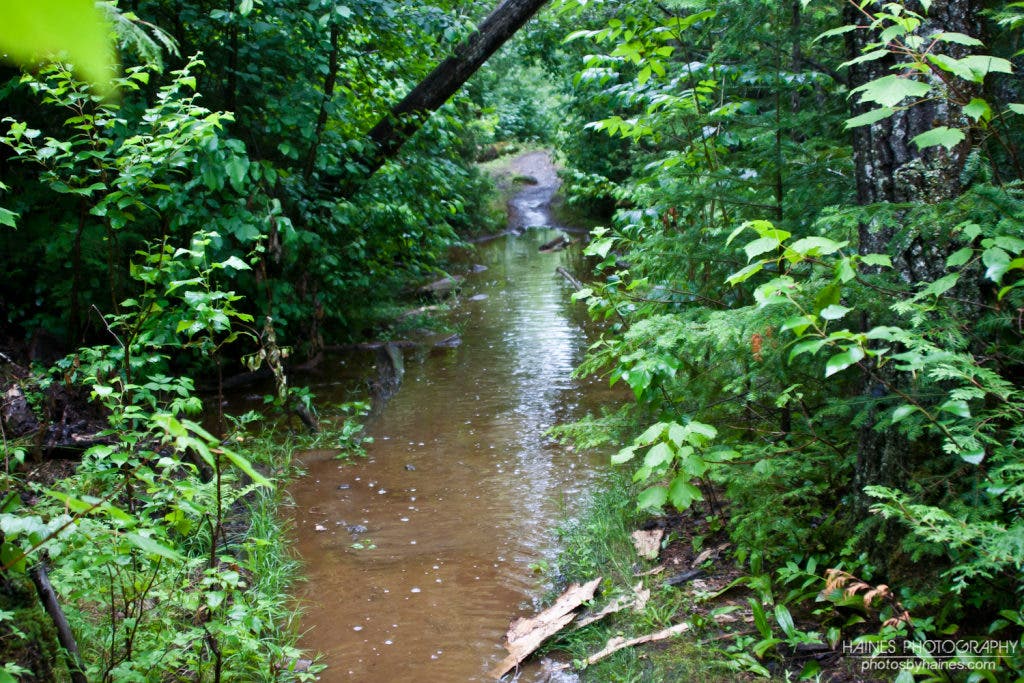
To say the 68 rod portage to Lizz was wet would be an understatement. There was still significant amounts of running water coming down the elevated portions of the trail and water pooled so deep in parts that downed logs were freely floating in the water. Once again, I was thankful for the boots I had on my feet. I never felt like I would slip and fall, even in deep mud with a canoe on my head, on this section of wet hiking.
When I got to Lizz, I noticed that the water was significantly higher than it had been on my way in. Even though there is somewhat of an old wooden dock or loading area at this portage, I voluntarily hopped into waist-deep water to load my canoe in an attempt to wash myself of some of the mud I had accumulated on walking the previous portage...twice.
Lizz is a long slender lake with not much wind. Typically, I don’t find this to be an overly interesting lake but on this occasion as I was paddling already soaked, in rain gear, hungry, and really dirty, I was able to photograph the first Loons of the whole trip! I had seen loons previously on this trip, but never was close enough to get a good photo. This was an adult with a baby that was still fuzzy and had not developed the black and white coat that they are noted for like their parent. Totally made me smile!
When you cross the half-way point of Lizz you officially are out of the BWCA, not that you could tell until you get to Poplar lake anyway. The portage is a straight forward, and rather easy, 50 rods to Poplar.
Poplar can be windy, especially the closer to the middle you get. I had no problem initially while close to shore so I decided to save some time and paddle directly across the middle. I planned on a little more wind taking this course, but I had a hard time controlling the canoe and would get pushed off course by the wind quite a few times.
I arrived back at the shore of Rockwood Lodge on Poplar Lake around noon and I was greeted by Mike, Lin, and their summer employee, Della. Mike told me that they got 5 inches of rain in a three hour period the previous night. I told him I believed it.
I purchased one of the famous $5 Rockwood showers and I felt like a million bucks after that. I chatted with the crew at Rockwood for a bit and then it was time to settle up on the canoe and drive back down the Gunflint Trail. It’s always a beautiful drive and even though I love the outdoors, the air conditioning felt wonderful!
I stopped in downtown Grand Marais to drop off my trash and hit the Gun Flint Tavern for a wonderful $5 lunch sandwich and a hoppy beer. As always, I never miss a chance to enjoy the views of Grand Marais one last time before the long drive home. Snapped a few photos from the rooftop deck of the restaurant and I called it a trip.
Can’t wait to get back with my daughter this summer.
Trip Info:
Entry Point #48 - Meeds Lake
Google Map of the route.
1 rod (rd) = 16.5 feet (or roughly the length of a canoe)
320 rods = about 1 mile
{David Haines is a freelance photojournalist and local portrait and event photographer. Find out more by visiting his website or through the Haines Photography fan page on facebook.}