Written by Kim Crumb, with help from John Doble
It was a family dinner in 1987, we had just finished eating and were talking a bit about world affairs. I was in consumer electronics, and there had been a terrible toll on American over the last decade. So many jobs had been moved to Asia.
Being on the “front lines,” I had pondered the future implications it appeared to me that if we continued to trade, without updated rules, that there would be unrelenting pressure for the standards-of-living of the trading countries to equalize for production costs to match. Looking at our great country, the only question was: would our quality of life decline, or would theirs grow?
Find out what's happening in Richfieldfor free with the latest updates from Patch.
25 years later, and the answer is in: “it's both.” A recent AP Report delineates how devastating the effects of globalization have been on American worker's incomes. “In 2011, 12.6 percent of adults in their prime working-age years of 25-60 lived in poverty. But measured in terms of a person's lifetime risk, a much higher number — 4 in 10 adults — falls into poverty for at least a year of their lives.” The risk of falling into poverty for people aged 35-45 has grown from 17% in 1969 to 23% today. For those 45-55, it has gone from 11.8% to 17.7% over the same period.
People have been arguing for years now that our economic “partners” haven’t been taking American jobs; we were just moving to a “service economy.” Well, that service economy has seen wages and the quality of life fall since the 1970’s, and the economy is so messed up that after the Great Recession we’ve been left to fight over budgetary scraps.
Find out what's happening in Richfieldfor free with the latest updates from Patch.
We are so deep into the politics-of-scarcity now, and those at the top are promoting divide-and-conquer tactics to polarize the people while they stash money in their Cayman Island accounts. How does this play out? You see people advocating for “smaller government,” but never for themselves, just for others. Yes, people have long thought that this hardship would never come to THEIR door. I'm reminded of the old saying “Ye shall reap, what ye shall sow.” Slowly but surely, the “other” that was thrown-under-the-bus repeatedly over the last 30 years, now is becoming that previously unthinkable “us.”
From that same study I referenced previously:
—“ For the first time since 1975, the number of white single-mother households living in poverty with children surpassed or equaled black ones in the past decade, spurred by job losses and faster rates of out-of-wedlock births among whites. White single-mother families in poverty stood at nearly 1.5 million in 2011, comparable to the number for blacks. Hispanic single-mother families in poverty trailed at 1.2 million.
—Since 2000, the poverty rate among working-class whites has grown faster than among working-class nonwhites, rising 3 percentage points to 11% as the recession took a bigger toll among lower-wage workers. Still, poverty among working-class nonwhites remains higher, at 23%.
—The share of children living in high-poverty neighborhoods — those with poverty rates of 30% or more — has increased to 1 in 10, putting them at higher risk of teenage pregnancy or dropping out of school. Non-Hispanic whites accounted for 17% of the child population in such neighborhoods, compared with 13% in 2000, even though the overall proportion of white children in the U.S. has been declining.”
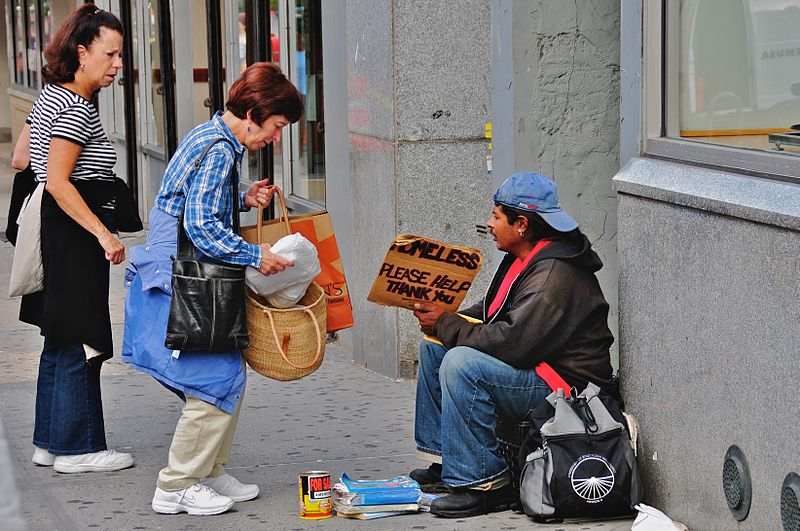
It’s time to admit that the poor are no longer strangers that we see on TV, but the neighbors next door, as well as family members and friends. A lot of economic and political damage has been done, but it's not too late to do something, to change our policies and give workers a fair shake in this country.
We can raise the minimum wage to a living wage, for example. If that had kept up with inflation, since the 60's? it would be about $16 an hour now, and our “safety net” programs would have far less “customers.” If you want to see less people on food stamps, for example, having wages be above poverty levels is one way.
This holds especially true for in-home care workers that take care of the elderly and disabled. At two million strong, it is one of the largest occupations in the country and will grow tremendously as the Baby Boomers age, yet few of them earn more than your average part-time fast food cashier. Moreover, most care workers are women or minorities – black women alone make up 1/3 of all care workers – and already suffer from wage discrimination. We can raise a significant number of people out of poverty by simply paying the people who take care of our loved ones enough to live on.
How about changing our global trade agreements so they not so one-sided, throwing American workers out onto the street? We could have a law that says “If you want to sell here, you will proportionately employ here.” If you want to “take out,” you must also “put in”... what could be more fair than that? If you're getting wealthy off our great country, don't you owe it something? Even if you don't care about fairness, this is the only way to put genuine economic meaning in the word “sustainable.” And that's what I want for our great country and our “everyday” citizens... a prosperity that sustainable. We'll have to be willing to do what we've avoided facing so far: to take a stand for the Common Good, for our great “We The People” country.