Health & Fitness
In His Roseville Yard: Plague of the Dandelions
Chip Small admits to fighting a losing battle against the dandelions, but has serious reservations about spraying herbicides on his lawn.

Ah, the dandelion, that harbinger of summer. Imported from Europe, this weed has made itself right at home across North America, and my backyard looks like it might be the epicenter of this plague.
I made a passing reference to my dandelion infestation in my last post, and in doing some reading in response to a reader’s question, I came across this tidbit on the University of Minnesota’s Sustainable Urban Landscape Information Series website1: “Too often the term ‘sustainable lawn’ has been associated with lawns allowed to become neighborhood weed patches.” Touché. I’m not sure if my lawn is “sustainable,” but it’s coming dangerously close to “weed patch” status.
I’ve pulled out the weeding fork a few times in the past few weeks with great ambitions, but only managed to create a few bald spots in my lawn, which didn’t do much to improve the aesthetic value.
Find out what's happening in Rosevillefor free with the latest updates from Patch.
I estimated that, weeding two hours a day, I could get the dandelion population under control in a week or two. But even if my back held up, I simply don’t have that kind of time to dedicate to this crusade. As parents of small children, and as renters, lawn care tends to fall pretty low on our priority list (with apologies to our wonderful neighbors).
Herbicides, of course could be the answer. University of Minnesota Extension recommends a selective post-emergent herbicide such as 2,4-D, which is best applied in the early fall (when the herbicide is most effectively transported into the taproot) but can also be effective when applied in the spring2. It is important to read the label and follow the directions, to maximize the effectiveness and minimize the collateral damage.
Find out what's happening in Rosevillefor free with the latest updates from Patch.
I have two main reservations about using pesticides on my lawn. The first is that my children spend hours each day playing outside. On a per-pound basis, children drink more water, eat more food, and breathe more air then adults, all of which magnify their exposure to toxins. Their developing brains and bodies can suffer irreversible damage from pesticide exposure3.
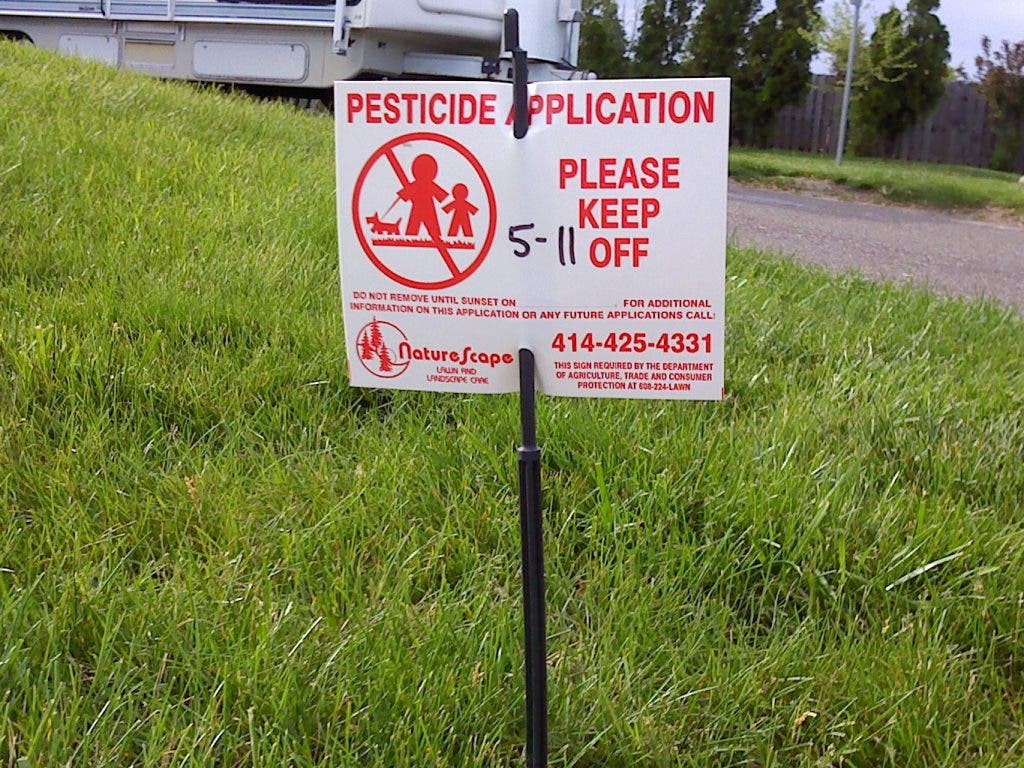
The small signs warning us that lawns have been chemically treated and to keep children and pets away are so ubiquitous that it becomes easy to ignore them, but the dangers are real.
My second (and admittedly secondary) reservation is that, as an aquatic ecologist, I am aware that pesticides applied to lawns inevitably end up in streams, lakes, and rivers.
Last year, the U. S. Geological Survey issued a study4 in which 27 urban streams across the country were repeatedly sampled for eight common herbicides, five insecticides, and several degradation products of these chemicals. One of these study streams was Shingle Creek in Minneapolis. All of these pesticides were detected in Shingle Creek, with the common herbicide atrazine having the highest concentration, around 0.13 micrograms per liter. This concentration is well below the U.S. Environmental Protection Agency’s limit for atrazine in drinking water of 3 micrograms per liter.
However, atrazine—along with many other synthetic compounds—is an endocrine disruptor. Professor Tyrone Hayes, at U. C. Berkeley, has shown that atrazine levels as low as 0.1 micrograms per liter can cause tadpoles to develop both male and female gonads5. These pesticide concentrations in Shingle Creek were similar to the other urban streams in the study, and I would suspect that our streams here in Roseville aren’t very different.
Based on an increasing number of research findings, it seems probable that the cocktail of pesticides in our streams and lakes is having an affect on the bugs, frogs, and fish that live there, but this is an emerging field of science, and isolating the effects of specific chemicals in the environment is a difficult undertaking.
The chemical industry has enormous political clout, and many states (including Minnesota) have passed laws prohibiting local governments from banning the use of pesticides6. Therefore, it’s up to individual citizens to make informed decisions about the chemicals that we add to our environment, keeping in mind that the lifespan of the herbicide we apply may outlast that of the dandelion for which it was intended.
The best solution I’ve heard to the dandelion problem is from our neighbors down the street, who pay their kids a penny for every dandelion they pull with roots intact. When our boys are another year or two older, we’ll have it made, at least until they demand a raise.
Notes:
1Sustainable Urban Landscape Information Series:
www.sustland.umn.edu/maint/weed.htm
2Horticulture Yard and Garden Brief: Controlling Dandelions
http://www.extension.umn.edu/yardandgarden/ygbriefs/h511dandelion.html
3See www.panna.org/children for more information.
4Ryberg, K.R., Vecchia, A.V., Martin, J.D., and Gilliom, R.J. 2010. Trends in pesticide concentrations in urban streams in the United States, 1992-2008: U.S. Geological Survey Scientific Investigations Report 2010-5139, 101 p.
http://pubs.usgs.gov/sir/2010/5139/
5“Pesticide atrazine can turn male frogs into females.”
6The documentary film A Chemical Reaction: The Story of a True Green Revolution chronicals the struggle of residents in a small town in Canada to ban lawn pesticides.
http://pfzmedia.com/#/images/stories/screen/small/HomeDepot3.jpg