Schools
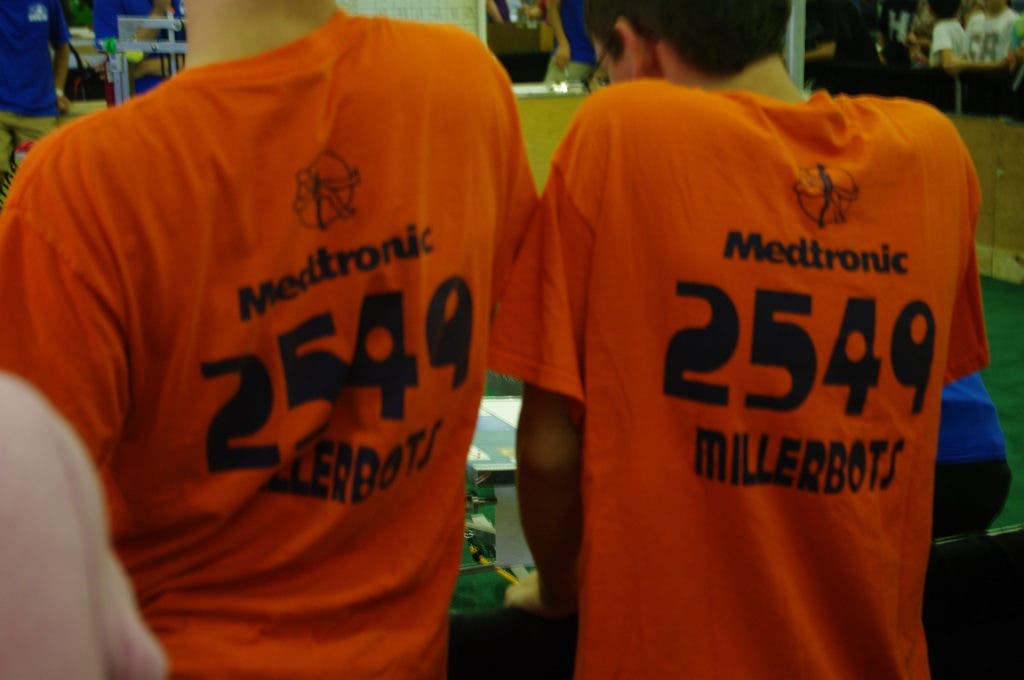
Meet The Millerbots
Washburn High School's robotics team demonstrated their robot's skills at the State Fair on Thursday.




The machine clacked and hummed as it skittered back and forth across the floor, searching for inflatable circles, triangles to hang on a rack at one end of the small arena. Its wedge-like shape, bright orange and shiny metal frame, and plastic wheels suggested a prototype Mars rover, rather than something built by a gang of high school students.
Coming upon one of its targets, the angular beast reached out with a long, articulated appendage, snapping at the balloon with jaws mounted on it's end like some space-faring aluminum plesiosaur. Grasping the shape and raising it high, the robot surged forward, trying to pin the re-purposed beach toy to a wall of horizontal pegs. Missing its first attempt, it backed up and readied for another charge, but it was too late: a buzzer sounded, announcing the round was up, and it was time to move on to a different challenge.
The robot may not have been able to put the last inflatable toy on the rack in time, but the fact that it was able to at all without any mechanical or software glitches is impressive. Its creators in robotics club, the Millerbots, knocked the machine together in less than five months after receiving a kit containing its basic parts.
Find out what's happening in Southwest Minneapolisfor free with the latest updates from Patch.
Built for a national robotics competition sponsored by FIRST, a non-profit founded by Segaway inventor Dean Kamen, the robot according to Gabe Cole-Brant, one of the Millerbots manning the controls at Thursday's State Fair demonstration.
"No-one expected us, the seventh-place alliance (each team is randomly paired with two others to operate with during the tournament) to beat the first place alliance at all," said Cole-Brant.
Find out what's happening in Southwest Minneapolisfor free with the latest updates from Patch.
Preparing for the competition, said Cole-Brant's teammates Tyler Meister and Serena Sellars, involved long hours after school and on Saturdays researching, building, and testing.
Students even have to search out sponsorships from local corporations—just like a start-up firm would have to do, coach and physics teacher Peter Grul pointed out—to pay for specialty equipment that can give their creation a special edge.
"Build time is very stressful," said Meister.
"You don't have time to have the design in place before you have to start cutting aluminum," added Grul.
Get more local news delivered straight to your inbox. Sign up for free Patch newsletters and alerts.