Sports
Researcher Brings Concussion Study to St. Louis Park
Purdue's Eric Nauman spoke at St. Louis Park High School last week.
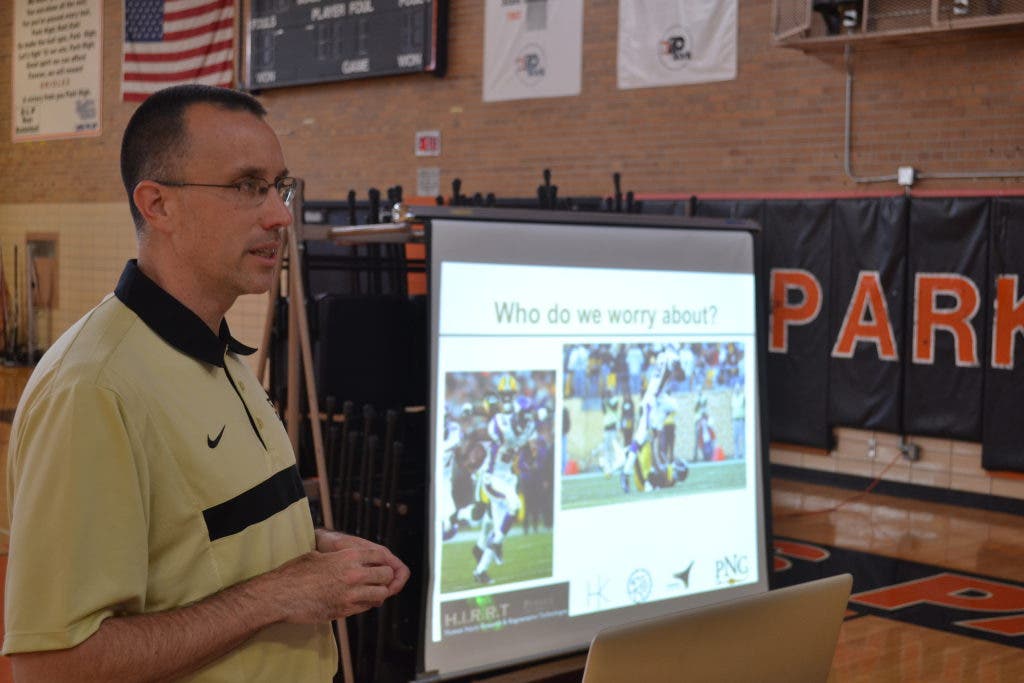
Eric Nauman's favorite football player is Minnesota Vikings cornerback Antoine Winfield, a player he says tackles with his arms and doesn't lead with his head.
Nauman, a researcher at Purdue University, is a leading scholar on head injuries to athletes, one of the hottest topics in youth sports the past few years. Nauman spoke to a small crowd at last week, explaining the results of a study he conducted that found high school athletes who took regular blows to the head often suffered mental setbacks—even without signs of a concussion.
"Unfortunately, what tends to get the biggest reaction from the sideline is the loudest hits, and you can make the loudest hits with your helmet," Nauman said. "But we saw that frequent hits to the head could be worse than a few big blows."
Find out what's happening in St. Louis Parkfor free with the latest updates from Patch.
St. Louis Park's high school football helmets are tested and repaired every two years, and helmets are automatically retired after 10 years, athletics director Andy Ewald said. Any player showing concussion symptoms must get clearance from the school's athletic trainer, Ewald added.
The Orioles are in their first year using a popular software program for diagnosing head injuries called imPACT, which measures a player's memory and reaction time at the beginning of the season. It lets players gauge if a blow to the head has impacted their brian function.
Find out what's happening in St. Louis Parkfor free with the latest updates from Patch.
The program is made available to all football, boys hockey and girls hockey players. Ewald said coaches focus on teaching safer ways of tackling and checking.
"If you're using the proper technique, it's not foolproof, but it goes a long way to minimizing things like head injuries," he said.
Nauman was brought to St. Louis Park by the Purdue Alumni Association's Minneapolis chapter. His study outfitted 21 players with helmets and sensors and recorded every blow to the head. Using the imPACT test and brain scans, Nauman found that several players had lowered mental activity even if they didn't show concussion symptoms.
The talk came three days after the family of Derek Boogaard—a former Minnesota Wild hockey player who died May 13—donated his brain to concussion research. Boogaard suffered a concussion in December that ended his season. The Hennepin County Medical Examiner's Office determined that his death was caused by a mix of alcohol and the painkiller oxycodone.
The NFL has lobbied for all 50 states to tighten their concussion laws after the suicide of former player Dave Duerson, who worried he had sustained brain damage in his career. The Minnesota Legislature is also considering a bill that would require players who show signs of a concussion to get medical clearance before returning.
"People used to just say, 'Oh you got your bell rung,' and looked at it kind of jokingly or as a badge of honor to keep playing through those things," Ewald said. "Now it's taken more seriously, especially because of the high profile cases in the pros and college ranks, and that trickles down. With a safety issue, it's good that it trickles down."
Nauman's study was featured in a Sports Illustrated cover story in November. He said he hopes to expand the study to include womens soccer, as he wants to examine how brain injuries affect women and how common they are in less contact-intensive sports.
Nauman said he doesn't want to get rid of contact sports, but hopes the increased awareness will reduce head injuries in the future.
"Do these studies mean the end of football? No," Nauman said. "But I think we're going to start seeing some real change."