Schools
State’s Concussion Law Aims to Protect Student-Athletes—First of Three Parts
MSHSAA is now outlining the regulations and procedures with the new state law regarding sports-related concussions.
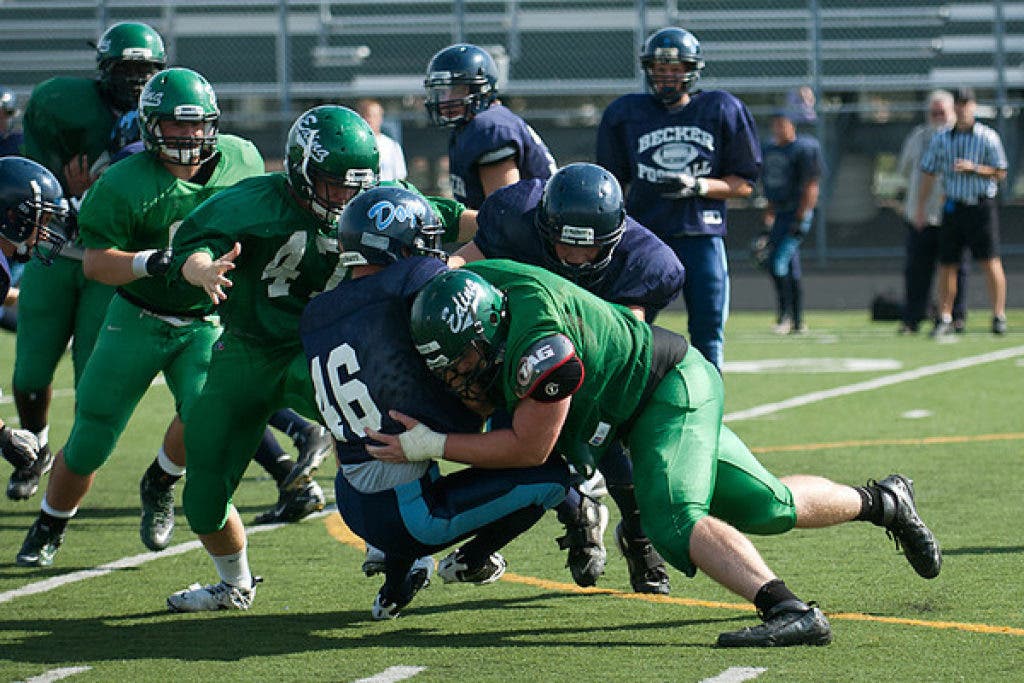
Dan Lohse remembers the instant and massive headache.
The Vianney senior wide receiver from High Ridge reached for an overthrown pass during an early season game. A helmet-to-helmet collision occurred with a cornerback.
“I actually played the rest of the game,” Lohse said. “At first, I didn’t think anything of it, but when it became the fourth quarter and I had the same headache, I knew something was wrong.”
Find out what's happening in Arnoldfor free with the latest updates from Patch.
Lohse's injury is among the estimated 300,000 sport-related brain injuries that occur annually in America, according to the Brain Injury Resource Center. This summer, Missouri lawmakers made the Show-Me State one of 30 states with a law aimed at protecting young athletes from further brain injuries by returning to play too soon.
A concussion is a brain injury, states MedlinePlus, a website managed by the U.S. National Institutes of Health and the U.S. National Library of Medicine.
Find out what's happening in Arnoldfor free with the latest updates from Patch.
Concussion symptoms range from confusion, memory loss, nausia, seizures and muscle weakness, MedlinePlus said. More serious concussion complications include bleeding in the brain, emotional withdrawal or behavior changes.
People can die from brain swelling, if they have a second concussion while experiencing symptoms from the first concussion, the website said.
(*Note: This is part one of a three-part series. Please check back on Thursday for part two.)
The Interscholastic Youth Sports Brain Injury Prevention Act requires that the Missouri State High School Activities Association (MSHSAA) send informational packets about concussions to athletes and parents.
Also, concussed athletes must sit out from practice or games for at least 24 hours. An athlete may return after an evaluation by a licensed health care provider trained in concussion management.
Recognizing the problem before this summer, MSHSAA had implemented concussion programs more than two years ago.
“We’ve been doing almost exactly what we’re doing now for the last two-and-a-half years,” MSHSAA Associate Executive Director Harvey Richards said.
“We’ve already sent out concussion material. We’ve been educating coaches. It’s just that now because of its popularity—and I hate to use that word, but—because of the forefront of the NFL making its presence, making it on all the TV stations, and because other state’s had passed bills, you see, the other states follow in line,” he said.
Indeed, another 13 states have legislation pending.
Richards said MSHSAA was providing these services because a sports medicine advisory committee with which the association is affiliated.
“They had already been keeping up with the fact that concussions were becoming more of a serious issue,” he said.
“And the fact that research was starting to show the long-term negative effects of concussions at an early age, that’s when they really started to look at what we had to do in practices and at games.”
The challenge Richards is facing now returns to the law itself.
“We now have to go through paragraph-by-paragraph, word-by-word, of what the law says and put out the regulations and procedures that would be in place,” Richards said.
For example, Richards is among those determining the definition of a concussed athlete.
“We have to put all those things in place, and who has to take care of it, and what organizations have to be in charge of those things,” Richards said. “We’ve met twice, and we have a third meeting coming up soon, and we hope to have these rules taken care of by Dec. 31.
"So even though the bill is passed and the law is in effect, the guidelines for everything, we’re still working on that.”
MSHSAA is also working on collecting data on concussions at the high-school level, as required by the law. Richards cautions the data will only reflect the number of concussions reported.
“What everyone should be asking is how many reported concussions are there versus how many concussions, because we know for sure that some concussions go unreported,” he said.
ArnoldPatch Editor Michael de los Reyes contributed to this article.