Politics & Government
Active With The Activists: Unionized UNH Workers Take Message To Trustees
UNH has offered a $1,000 raise across all pay grades, followed by 2% annual increases, which does not keep up with the cost of living.

Arnie Alpert spent decades as a community organizer/educator in NH movements for social justice and peace. Officially retired from the American Friends Service Committee since 2020, he keeps his hands (and feet) in the activist world while writing about past and present social movements. You can reach him at arnie.alpert@indepthnh.org.
DURHAM, NH — Members of unions representing University of New Hampshire graduate students and faculty made their cases for fair contracts during a University System Board of Trustees meeting Friday at UNH in Durham.
Find out what's happening in Across New Hampshirefor free with the latest updates from Patch.
The Graduate Employees Union (GEU), affiliated with the United Auto Workers, was certified in 2024 after winning an election 455 to 8. But more than two years later, they are still without a first contract. The tenure-track faculty, organized with the American Association of University Professors (AAUP), have been working under a contract that expired a year ago and say progress towards a new one is stalled. Both unions and the university say salaries are a major sticking point.
Sam Crawford, a sociology PhD candidate, said he makes about $24,000 a year from his work as a graduate employee with the university. That’s less than half the pay needed for a one-person household in Strafford County, according to the MIT Living Wage Calculator.
Find out what's happening in Across New Hampshirefor free with the latest updates from Patch.
Crawford says the union is realistic about the university’s resources.
“There's just not enough money for them to give every graduate employee $55,000 a year,” he said. “We recognize that.”
Instead, the union is calling for an increase to about $30,000 a year, an amount they believe is reasonable.
But so far, UNH has offered only a $1,000 raise across all pay grades, followed by 2% annual increases, an amount which would probably not even keep up with the cost of living. Moreover, Crawford said, the grad students have not gotten any raises during the two years they’ve been negotiating.
Faculty grievances are similar. Following negotiations in April, the faculty union reported, “The administration’s salary offer has not changed. Their position, first set out in their November counterproposal, remains: 0% in the first contract year, followed by 1% in each of the following four years.”
“We have always been woefully underfunded by the state of New Hampshire,” said Cliff Brown, a sociology professor and former president of the UNH AAUP. “That's been a constant.”

Sam Crawford, a sociology PhD candidate, talks with UNH President Elizabeth Chilton Friday at UNH. ARNIE ALPERT photo
The faculty union update said that while they came to the table ready to make progress, “UNH administration reaffirmed their fiscal priorities that result in faculty divestment and reduce the academic opportunities, mentorship, and instructional quality students depend on.”
With no tentative agreements and no progress on salaries or health care after a year of negotiating, workplace conditions are “crumbling,” said Paula Salvio, a professor in the education department and another AAUP past president.
“Faculty and graduate student working conditions are student learning conditions,” emphasized Catherine Moran, a past president of the UNH Lecturers Union, which represents non-tenure track faculty and is currently working under its third collective bargaining agreement. “If we want to retain good students, we want to recruit great students, we want to keep great faculty, we've got to have strong contracts in place, and we've got to have trust and collaboration and true shared governance,” she said. The lecturers’ contract will expire next year.
Crawford said GEU members had been at the two previous trustees’ meetings and found that negotiating sessions were more successful after visible shows of support by members and allies. It was the union’s objective to be heard, not necessarily to be disruptive, he said.
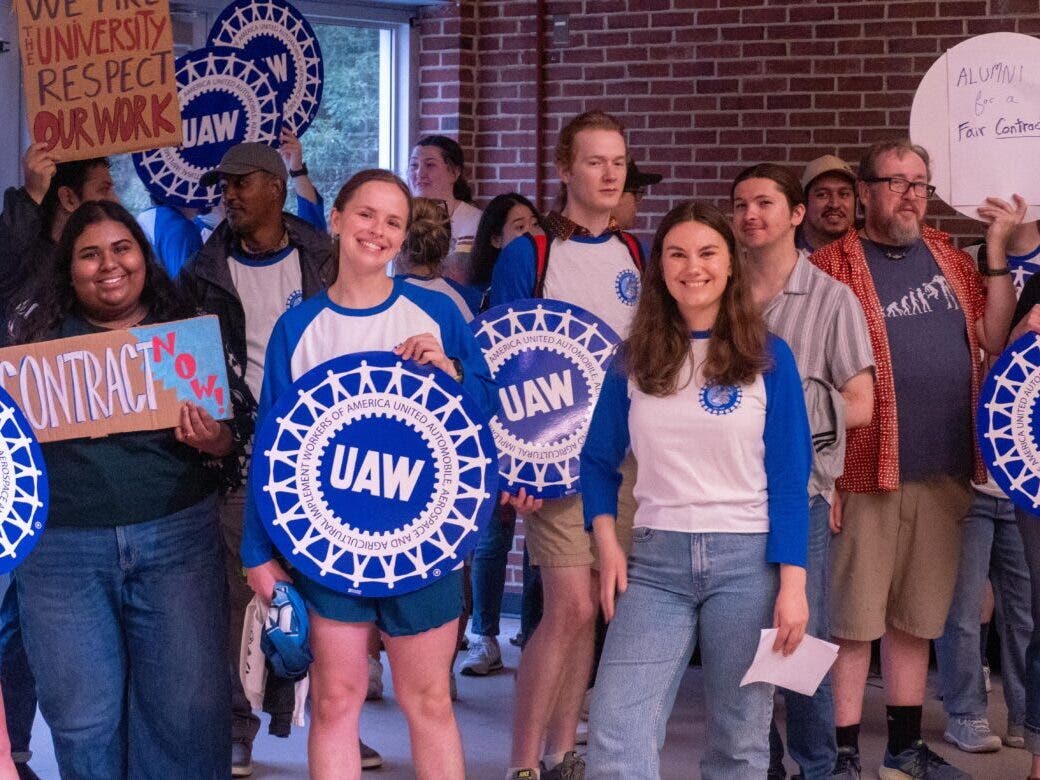
Union members and supporters poured into the Granite State Room in the Memorial Union Building at 9 a.m. as the Trustees meeting was scheduled to start. With trustees seated behind a U-shaped array of tables and sign-holding union members standing around the outside perimeter of the large hall, Board chair Michael Pilot said he would allow the GEU and AAUP unions to address the board for two minutes each.
First up was Audrey Robison, a PhD student in Space Physics. “Everything the university does comes from the people who work here, and for too long we've been underpaid, lacking support,” she told me prior to the meeting. “The better you treat the grad students, the better the university will do.”
Standing a bit nervously at a lectern set up at the opening of the U-shaped tables, Robison told the trustees, “We understand that the university is facing real financial issues. We understand that the university's financial stability affects all members of the UNH community, and we understand that the choices made today will affect UNH's long-term standing, but we, too, deserve a stable financial future.”
“We are proud of this work and our contributions to UNH,” Robison continued. “However, our pride does not support our families. Our excellence cannot pay bills.”
“We are still waiting for a fair offer,” she said. “We have come here today to ask all of you to urge UNH administrators to offer us a fair contract, so that we can work together towards our common goal of strengthening UNH without the fear of financial insecurity.”
AAUP president Julia Rodgriguez’ statement addressed broad issues rather than the specifics of her union’s contract proposals. Faculty union concerns, she said, “revolve around the lack of clearly articulated long-term planning over the last couple of administrations, management waste and miscommunication, an absence of transparency and accountability, and finally a redirection of resources away from instructional costs and away from classrooms. These concerns directly impact student experience, which is why we're all here, which we must improve if we are to improve the fiscal health of the system.”
Rodriguez asked to directly address the board about those issues at a future meeting and to postpone any discussions of restructuring the university system until after they have engaged in dialogue with the teaching staff.
“I don't see any daylight between what you stand for and what we stand for,” board chair Pilot said in response. “We are all fighting for the same thing.”
“We’re investigating changes to our governance structure, which is causing us to rethink how we conduct our business at the Board of Trustees, and we will take that up and talk about that in a very serious way, and I thank you for offering that,” he told Rodriguez.
“Okay, thanks for coming,” Pilot wrapped up the session. “Now we're going to get on the rest of our agenda.” At that, most of the union activists left the hall.
While the trustees may have influence, the unions are negotiating with UNH administrators, not the University System’s board. Whether the absence of daylight between their perspectives makes any difference will be shown at future negotiating sessions.
The state’s Public Employee Labor Relations Board has certified five unions made up of UNH employees. In addition to the grad students, the faculty, and the lecturers (AFT Local 6770), the law school faculty are unionized with the National Education Association. UNH police officers are part of the Teamsters.
The most recent addition is the formation of Clinical Faculty United, which is part of the Lecturers Union following a unanimous vote of eligible members in March. This unit is made up of faculty who teach courses with clinical components in fields such as nursing and occupational therapy.
According to UNH News Director Tania DeLuzuriaga, the administration recently reached an agreement with the Law School faculty. “While this needs to be ratified by the union membership and the University System Board of Trustees, the contract represents a shared commitment to equitable compensation for all employees and a recognition of the challenges we are facing together,” she said. “UNH remains hopeful that this agreement will serve as a model which can facilitate agreement on our outstanding contract negotiations.”
DeLuzuriaga said the administration has continued to meet regularly with the GEU and the AAUP and is negotiating in good faith. “In both instances,” she acknowledged, “salary raises remain a key factor.”
“Both faculty and the teaching and research assistants need the security and the commitment from the university and the university system to have a fair and decent contract, so that they're very clear on what their working conditions are, and that both management and faculty and staff are working in concert to make the university the best place it can possibly be,” commented the Rev. Dr. Gail Kinney, who was present at the meeting along with several other members of the NH Faith and Labor Alliance. “It’s time to get it done.”
This article first appeared on InDepthNH.org and is republished here under a Creative Commons license.