Politics & Government
Bradley: Yes, New Hampshire, An Income Tax Is On The Ballot In 2026
Former Senate President: If approved, NH will quickly become just like every state around us — a high-tax hell people seek refuge from.

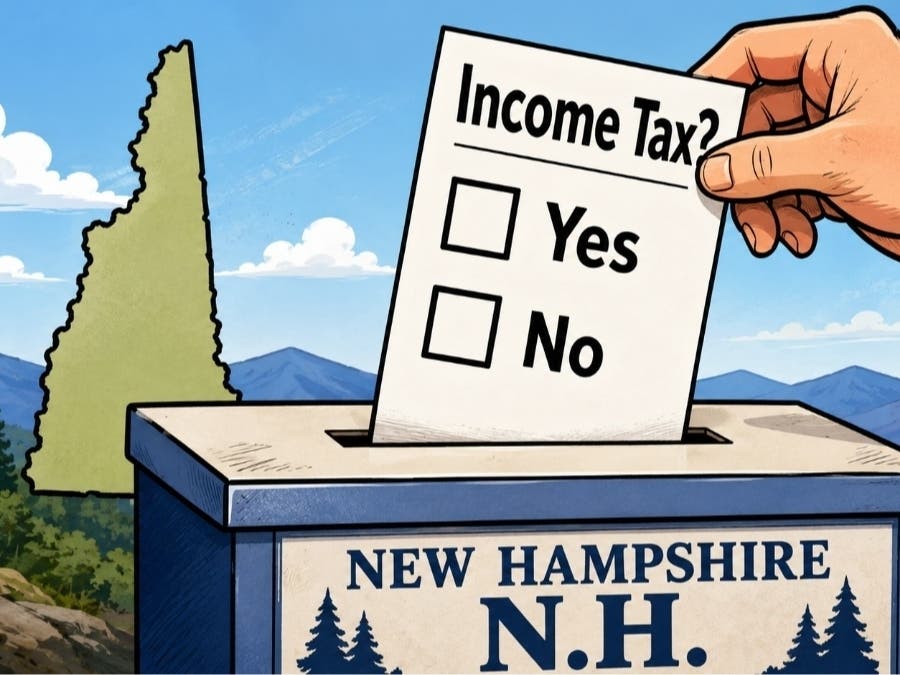
With elections four months away, political debate is heating up. An income tax is on the ballot because Democrats have made promises to lower property taxes that they absolutely cannot keep without an income tax.
So, while Democrats may claim to oppose an income tax — as surely as the sun rises in the east — they will spend us to an income tax.
Find out what's happening in Across New Hampshirefor free with the latest updates from Patch.
It’s no secret voters have long opposed an income tax and a sales tax. According to recent polling, 71 percent of voters continue to oppose an income tax.
However, for starters, Democrats want to comply with a recent Supreme Court order mandating an additional $536 million in annual funding for public education.
Find out what's happening in Across New Hampshirefor free with the latest updates from Patch.
It should be noted that the legislature has increased funding by $420 million over the last three budgets, and over 10 years, funding will increase by 31 percent.
To pay for $536 million, Democrats want to increase business taxes back to a level that was the third-highest in the nation. Ten years ago, the legislature recognized that New Hampshire’s third-highest-in-the-nation rate of business taxation was a severe disadvantage to attracting, retaining and growing good jobs for working families. Business taxes gradually dropped, the economy took off, and over that period of time, revenue has exceeded expectations by $762 million. Much of that revenue growth fueled the large increase in funding for education.
Democrats also want to reinstitute the income tax on interest and dividends, which was repealed. Retirees and seniors in New Hampshire have benefited. With that change in tax policy, New Hampshire achieved a significant distinction: the third-lowest state and local tax burden in the nation. That’s right: According to the Tax Foundation, New Hampshire residents pay the third-lowest overall state and local tax burden — which includes property taxes.
So, with demands for $536 million in new funding for public schools, taxes are on the ballot.
Democrats are attempting to convince voters how easy it will be to raise business taxes back to previous levels with no consequences, bring back the income tax on interest and dividends, and, for good measure, increase the rooms and meals tax. HB 503 in 2025 proposed exactly that.
While HB 503 failed, it’s valuable to look at its fiscal analysis. HB 503 was projected to raise $348 million, which is $188 million short of meeting the court’s education funding mandate. But more importantly, that $348 million revenue projection is unrealistically rosy.
People and businesses are leaving high-tax states. Even Gov. Gavin Newsom has realized that fact, and he is asking California voters to reject a wealth tax.
If New Hampshire reverses direction on taxes, businesses and people will leave, and tax revenue will not meet expectations.
To meet the court mandate, not only will higher business taxes, a higher rooms and meals tax, and a return of the income tax on interest and dividends be necessary — but to fill the minimum $188 million funding gap, which is likely far greater, larger tax hikes will be necessary. The most likely tax-hike candidates: an income tax and a new state property tax.
Andru Volinsky and other leading Democrats have figured this out and proposed, on the State House steps no less, implementing a 3 percent income tax and a $ 3-per-$1,000-of-valuation new state property tax. A $ 3-per-$1,000 state property tax could, for many homeowners, increase their property tax by $1,800 on a home valued at $600,000. Volinsky, to his credit, is being honest — funding the court mandate means an income tax and a state property tax.
This is the extraordinary dilemma of the court funding mandate and why voters should take with more than a grain of salt any Democrat who claims it can be done easily. It will require many new or higher taxes: business taxes for starters, then a state property tax and an income tax.
And that is before taking into account the wild spending blitz proposed by Democrats in the New Hampshire Senate over the previous two years. Democrats actually proposed a spending spree — not just $536 million — that topped out at $1.75 billion, with barely a word about how to pay for it. If that’s not a direct road map to an income tax and a state property tax, what is?
Republicans not only blocked this spending blitzkrieg, but they also passed HB 1815, legislation that could produce a rational response to education funding without an income tax or state property taxes.
HB 1815 states that education funding is a shared state and local responsibility while better defining educational requirements.
High property taxes are a dilemma, but here is what can be done — without an income tax or state property tax.
First, there needs to be recognition about the large amount of funding Concord has sent to cities and towns over the last three budgets: an increase of $420 million for education funding and over $750 million for cities and towns from the 30 percent dedication of the rooms and meals tax to local communities. This state funding should be directly helping property taxpayers — but how it gets used is up to local officials.
Second, there also needs to be recognition of New Hampshire’s enviable overall tax status. Other states would love to have our third-lowest state and local tax burden. In fact, other states in the Northeast have an income tax and a sales tax — and their property taxes are higher than New Hampshire’s, according to the Tax Foundation.
Lastly, the legislature recently passed a tool for voters to slow the rate of growth of local education property taxes. On the November 2026 and 2028 ballots will be a provision that will allow the broadest spectrum of voters to establish a tax cap. This is the ultimate in local control.
We also need to be aware of the enviable position New Hampshire is in: lowest poverty rate in America, fifth-highest median family income of any state, and second-most livable state in America.
The way to lower property taxes is to continue to generate strong revenue and dedicate it to education funding, as Republicans in the Legislature have done.
If, on the other hand, we jump on the Democrats’ tax and spending bonanza, we will inevitably kill the New Hampshire Advantage of no income tax. New Hampshire will quickly become just like every state around us — a high-tax hell that people and businesses seek refuge from. Flight from New Hampshire will be real versus today’s “Welcome to New Hampshire.”
Gov. Kelly Ayotte says it best: “Don’t MASS up NH!”
Former state Sen. Jeb Bradley (R-Wolfeboro) served as president of the New Hampshire state Senate. He wrote this for NHJournal.com.
This story was originally published by the NH Journal, an online news publication dedicated to providing fair, unbiased reporting on, and analysis of, political news of interest to New Hampshire. For more stories from the NH Journal, visit NHJournal.com.