Politics & Government
Connecticut Lakes Headwaters Tract May Be Sold; State Has First Refusal, Citizens Panel Told
The 146,400-acre forest, which is privately owned, could be sold by Aurora Sustainable LLC, which has an offer on the table.

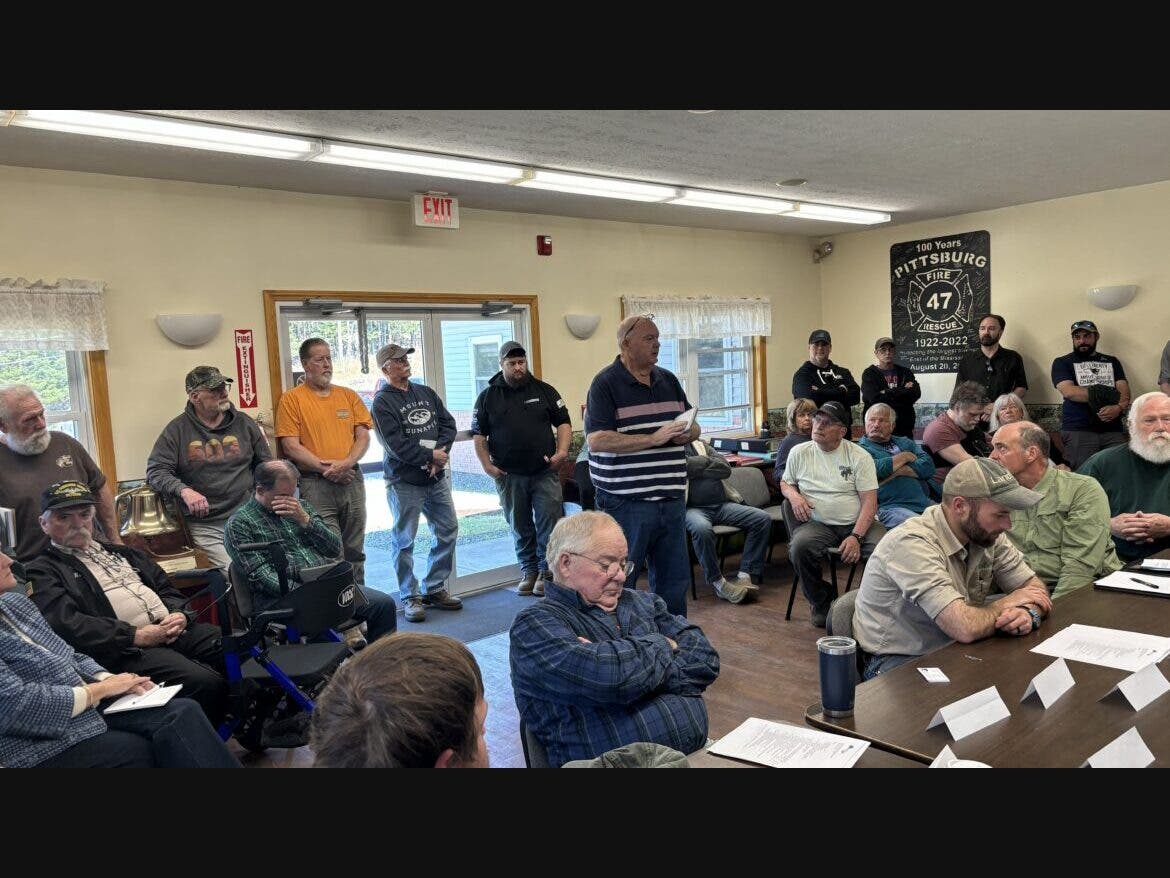
PITTSBURG, NH — The state's largest, privately held tract of land at the very northern tip of the state, the Connecticut Lakes Headwaters, may soon be sold and the state has a right of first refusal if a purchase and sales agreement is signed, members of an advisory committee were told here Friday.
The Connecticut Lakes Headwaters Citizens Committee, which for more than 20 years has advised the state on management of the 146,400-acre forest, which is privately owned. But an easement the state paid tens of millions of dollars for - aimed at protecting recreation and logging values on the land - remains in place.
Find out what's happening in Across New Hampshirefor free with the latest updates from Patch.
The committee heard that Aurora Sustainable LLC has an offer on the table to sell at a meeting Friday at the Pittsburg Fire Station.
Michael Phelps, on behalf of Aurora did not specify a price or who the interested party is, but said a purchase and sales agreement is being worked on.
Find out what's happening in Across New Hampshirefor free with the latest updates from Patch.
Aurora primarily makes its money selling carbon credits though they have also been logging the property as well since they took over ownership about five years ago.
The land is enrolled for 100 years in the California carbon compliance market and any successive owner, including the state, would either have to buy that interest out or assume it.
New Hampshire has traditionally used its forests for timber harvesting but a newer way for property owners to make a living off the land is to enroll them in carbon markets, both regulated and non-regulated, which allow owners to get money for not cutting the trees thereby making them an offset for companies that either want to or are required to reduce their carbon emissions.
Gov. Kelly Ayotte just signed into law a bill that prohibits the state from enrolling public lands into carbon capture. Separately a legislative study committee is looking at carbon capture and its impacts in the state.
When the easement for this tract was signed, there was no such thing as carbon sequestration. The land has a past history of industrial use in Pittsburg, Stewartstown and Columbia and has been considered a staple of the state's wood basket which feeds mills, provides timber tax revenue and logging jobs and is an important area for recreational pursuits such as hunting, snowmobiling and increasingly ATV use.
Members of the committee had expected to finally receive a copy of a five-year logging agreement between Aurora and the state, which Ayotte has said would mean more logging related jobs and timber tax revenues to the towns.
The five-year document has not been finalized yet with just a few more details to work out, said Patrick Hackley, head of the state division of forest and lands.
But the committee was told after Executive Councilor Joe Kenney, R-Wakefield, pressed the governor's attorney Myles Matteson that Ayotte has been told by Aurora there is an offer for the land that may well turn into a purchase and sales agreement in a matter of days.
The state holds a right of first offer and a right of first refusal in which the state would have to match the offer price and put down a 10 percent down payment, which may or may not be recovered if the state backed out.
In the past, the transactions were not subject to the state's real estate transfer tax, the committee was told.
The Connecticut Lakes Headwaters tract was formerly owned by International Paper Company who announced intentions to sell the tract and about 25,000 more acres in the 1980s.
That set about a scramble in federal and state government to protect the land for its traditional values and uses. Then Gov. Jeanne Shaheen, a Democrat and Republican U.S. Senator Judd Gregg led an effort with conservation groups to create this private-public partnership and 25,000 acres of the tract were separated and are owned by NH Fish and Game as a natural area.
Lyme Timber first owned the land and logged it for most of the past 20 years but sold it to the Forestland Group which then sold it to what is now known as Aurora and the state always waived the offer.
The Forestland Group enrolled the land in the carbon market and the sale to the current owners was part of a much larger series of land sales across North America of formerly industrial timber land and the only one with an easement restricting use.
In 2023 about 15,000 cords were cut on the land, well below its growth rate and a first draft of the long term logging plan offering to cut 10,000 to 20,000 was rejected by the state. The deal now is looking at an average of 30,000 cords a year which likely a new owner would have to assume.
Back in 2022 when state and local officials began to see that mills were furloughing workers and having to go as far as New York to source timber and the Town of Pittsburg was facing a massive hole in their municipal budget from a loss of timber tax with the reduction in cutting, carbon capture has become a major issue in the state.
Aurora stepped in with a payment in lieu of taxes to help the towns recover from the lost timber tax while Coos County continues to explore impacts of carbon capture on its bottom line as it has many unincorporated places where logging is key to the county's bottom line.
Matteson confirmed the new, long-term agreement which has not yet been available to the public has provisions which would allow towns to receive similar voluntary payments to make up the difference in revenue if the volume of cords cut drops below a 10-year average.
Peter Lucas of Landvest, which manages the land for Aurora, gave the committee an update that Aurora is on track to cut about 30,000 cords a year, which is part of the proposed five-year agreement.
He said from January to December, 2025, 28,093 cords were cut and from April 2025 to March of 2026 which is considered a timber tax year, there were 32,115 cords cut. Year to date, or through April, they have cut 13,709 cords and are on track, Lucas said.
He said in 2026/2027 the planned operation includes 17 harvests with a focus on summer harvesting planned for East Inlet, Upper Indian Stream, Magalloway Road to the Maine state line and winter harvesting planned for Deadwater Road in Stewartstown, Hall Stream, Moose Brook, Otter Camp Road, Carr Ridge and Lindsey' Lane.
Whether those go forward might depend on the change of ownership though it would be likely that a new owner would assume contracts signed.
The advisory committee also received a presentation from the state Department of Environmental Services about camp leases on Lake Francis, of which there are 39 and the potential for the state to sell the land on developed parcels to the owners, which would require future legislation.
A large number of people who own structures on those state lands leased in Pittsburg and Clarksville attended the meeting. They could be seeing their $1,000 a year lease fee go to $15,000 a year over the next five years.
About 24 of the 39 leaseholders have conveyed an interest in buying but they dispute the appraisal information.
The land was taken by eminent domain by the state to build the dam on Lake Francis and 30 years ago, the state was looking to end the lease program before local officials sounded the alarm they would be losing taxes they receive for the structures.
The state also provides the towns with payments in lieu of taxes for the leased land.
The committee also received a report on plans this summer to improve the Murphy Dam in Pittsburg, the largest in the state which is going out to bid this summer. It is not known how much that will cost the state but Corey Clark for DES said a good number of potential bidders came last week to review the project and was hopeful that it would be a competitive process.
Finally, the advisory committee took a vote to allow for a two week public comment period for ATV users and to change the trail on the tract "Alexa Way" to the Hall Stream Crossover.
Dianne Matott of the Great North Woods Trail Riders, advocated for the change and said it had been a good trail in the past and developed to avoid logging in that area, but is no longer safe with ledge its primary surface.
Ray Gorman, a member of the committee, said it is a safety issue and should be addressed sooner rather than later. After some discussion about how unsafe it was and what an immediate closure would mean to the 1,000 miles of interconnected ATV trails in the region, the advisory group agreed to let it go out to public comment and the landowner could meet with the interim commissioner of the Department of Natural and Cultural Resources to decide whether the closure and reroute is in the best interest of public safety on the tract.
"I need more information," said Phelps, on behalf of Aurora. "If it's a safety issue why not close it now? We are very concerned about safety," he said.
The committee heard that Dwane Covell, who has worked on the tract since its inception and was once a fire tower manager at Magalloway, is about to retire, taking with him a lot of institutional knowledge that will be impossible to replace.
This article first appeared on InDepthNH.org and is republished here under a Creative Commons license.