Politics & Government
Granite Staters Support GOP-Backed Tax Cap Vote, Survey Finds
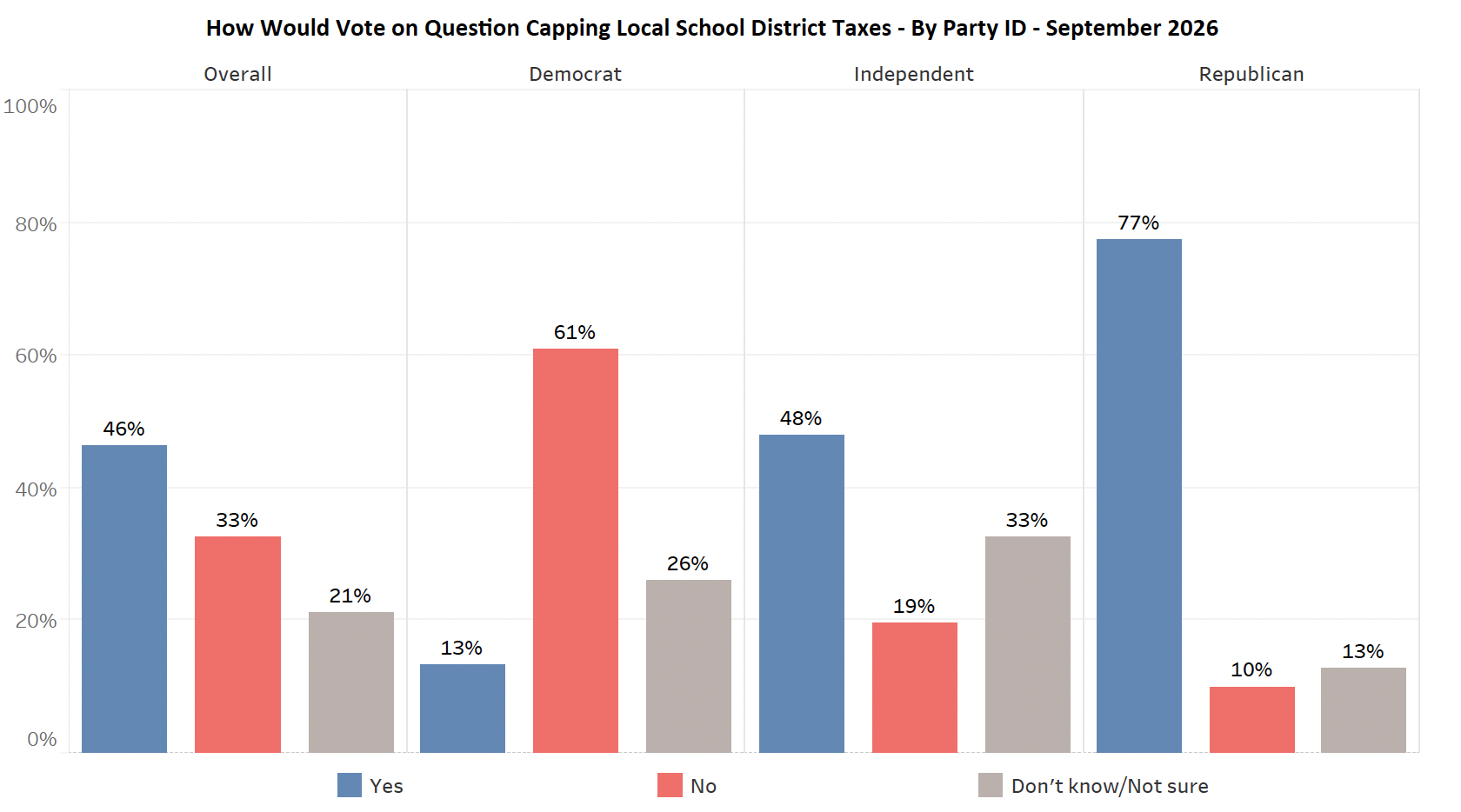
A solid plurality of Granite Staters, 46%, say they would vote yes to capping local taxes raised to support their school district.


New Hampshire Republicans have made no secret that they believe the school property tax cap question on November’s ballot can be a winner on both policy and politics. Allowing voters to cap their local education property taxes can help ease the fiscal pain for homeowners, and it could also motivate them to turn out for Republicans in a midterm election where Democrats are surging.
Numbers from the New University of New Hampshire Survey Center suggest the issue offers Republicans an opening in a difficult election environment.
Find out what's happening in Across New Hampshirefor free with the latest updates from Patch.
A solid plurality of Granite Staters, 46%, say they would vote yes to capping local taxes raised to support their school district, compared with 33% who would vote no, a 13-point advantage. Another 21% are undecided.
Not surprisingly, support is particularly strong in the party’s base: 77% of self-identified Republicans, 80% of conservatives and 90% of libertarians favor the cap.
Find out what's happening in Across New Hampshirefor free with the latest updates from Patch.
More exciting for GOP legislative leaders is the finding that independents support it by a 29-point margin, 48% to 19%, with a third undecided.
“It is not surprising that this is overwhelmingly popular. People are sick of watching their property taxes go through the roof and want some control over what they are being asked to pay,” said Rep. Ross Berry, R-Weare.
“Republicans got HB 1300 across the finish line and put the final decision where it belongs, directly in the hands of local voters. That is real local control and a much-needed win for New Hampshire taxpayers.”
The opportunity comes as other UNH findings show Republicans could use the help.
Democrats lead the generic ballot for Executive Council, 49% to 39%, and the state Senate, 51% to 41%. For the state House, 49% say they would vote Democratic and 39% Republican, while 7% would support a mix of candidates from both parties.
Those statewide preferences do not translate directly into district-by-district outcomes. But they underscore the challenge Republicans face in persuading voters to support their candidates.
The tax cap question gives the GOP an issue that draws stronger support from independents than opposition, while also appealing overwhelmingly to its own base. That is the political opportunity the GOP hopes to turn into an advantage.
“Polling shows a large number of people supporting a tax cap because property taxes are a critical issue for working families,” said Sen. Regina Birdsell, R-Hampstead.
“Why would Democrats block every effort to allow voters to adopt a tax cap in the November election?”
Gov. Kelly Ayotte signed HB 1300 in July, placing the question on general election ballots across New Hampshire in 2026 and 2028. The legislation faced nearly unanimous Democratic opposition.
The law gives voters the opportunity to adopt two limits: one on growth in the local school property tax levy and another on school administrative unit central office spending.
The school tax levy could grow by inflation plus qualifying new taxable property growth. SAU central office administrative spending would be limited to 6% of the combined appropriations of the school districts within the SAU. Qualifying bonded capital costs are excluded.
Adoption requires 60% support, calculated across the relevant school district or SAU. Caps approved this November would begin with fiscal year 2028 budgets, and the law provides procedures for overriding them.
The measure would limit future tax growth rather than automatically reduce existing tax bills. It also would not guarantee a particular limit on an individual homeowner’s bill.
Republicans argue that holding the vote during the general election will give a broader group of taxpayers a say than typically participates in local school budget meetings.
But the UNH results also show that passage is far from assured, as many residents have heard little about the proposal.
Only 8% say they have heard a lot about the law, while 27% have heard some. Another 34% have heard only a little, 21% have heard nothing, and 10% are unsure.
That leaves both supporters and opponents considerable room to make their case before November.
The partisan divide is pronounced. Among self-identified Democrats, 61% oppose the cap and 13% support it, with 26% undecided.
Self-described moderates are more closely divided: 39% support the proposal, 33% oppose it, and 29% are undecided. Percentages may not total 100% because of rounding.
Opponents have challenged the ballot language in court, arguing that it is confusing and misleading, including its assertion that the caps would not affect classroom instruction or school-based services. They contend that restricting school tax revenue could affect those services.
Merrimack County Superior Court Judge Daniel St. Hilaire denied a request for a preliminary injunction Sept. 16. Supreme Court Justice Bryan Gould denied an emergency request to block the question the following day, leaving it on the November ballot.
Those rulings did not resolve every underlying legal claim.
Republicans have made the effort to block the question part of their election message.
“First Democrats tried to block a property tax cap proposal in the Legislature. Then they tried to railroad it in the courts,” Birdsell said.
“Democrats have been raising property taxes for years at the local level. In fact, several of them are now running for the Senate,” she warned.
“The same Democrats trying to block local control over property taxes are also proposing nearly $2 billion of new spending. That is nothing more than a road map to an income tax.”
This story was originally published by the NH Journal, an online news publication dedicated to providing fair, unbiased reporting on, and analysis of, political news of interest to New Hampshire. For more stories from the NH Journal, visit NHJournal.com.