Politics & Government
John Doe Federal 'Laurie List' Lawsuit Against Lisbon Moving Forward
The federal lawsuit was placed on hold as Doe's state case went to the New Hampshire Supreme Court.

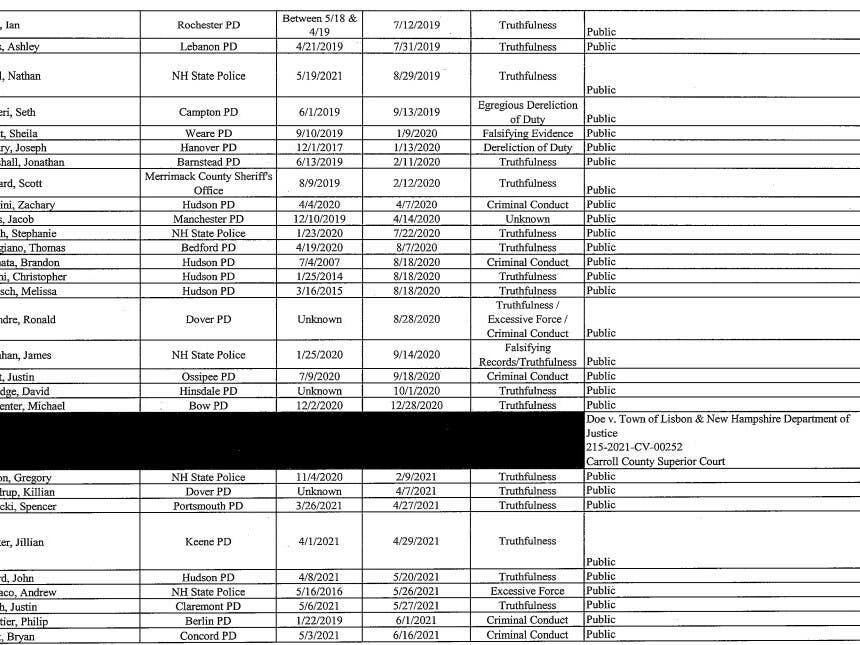
The most recent Laurie List, also known as the Exculpatory Evidence Schedule, of police officers disciplined for credibility or excessive force issues was posted on the Attorney General's website Feb. 11: https://indepthnh.org/wp-content/uploads/2026/06/february-11-2026-rsa-105-13-d-exculpatory-evidence-schedule.pdf
NORTH HAVERHILL, NH — The federal Laurie List lawsuit brought by a former Lisbon police officer is restarting after the town once again denied the officer his due process, according to court records.
Find out what's happening in Across New Hampshirefor free with the latest updates from Patch.
The officer, known as John Doe in his multiple court cases, says he was fired and placed on the state’s Laurie List, also known as the Exculpatory Evidence Schedule, as a form of retaliation after he clashed with his chief. Doe filed federal and state lawsuits over the firing to get his EES placement overturned.
The federal lawsuit was placed on hold as Doe’s state case went to the New Hampshire Supreme Court. Last year, the Supreme Court ruled in Doe’s favor and found that he was never given due process to challenge his placement on the list for police accused of dishonest conduct.
Find out what's happening in Across New Hampshirefor free with the latest updates from Patch.
“Under the circumstances of this case, we cannot conclude, as a matter of law, that the process was adequate,” the Supreme Court justices ruled in the unanimous July 2025 order.
The state case was sent back to Grafton Superior Court Judge Judge Lawrence MacLeod to determine an appropriate remedy. According to documents recently filed in the federal lawsuit, MacLeod issued sealed orders in the state case sending Doe’s EES placement decision back to the Lisbon Police Department for a new hearing.
That new hearing took place May 28, and once again Doe wasn’t able to challenge the case against him, according to his attorney, Christopher Meier. Doe wasn’t allowed to challenge the underlying allegations at the new hearing, which was conducted by Police Chief Derek Sullivan. Further compounding the problems is the fact Sullivan’s father-in-law is a sitting selectman who was on the board when Doe was originally fired, Meier wrote.
“Here, the Town is refusing to provide a hearing that provides adequate due process, and therefore the New Hearing cannot be used to meet the Town’s burden of proof in this matter to show that the initial deprivation of due process did not affect the substantive result,” Meier wrote
Meier did not respond to requests for comment, nor did Sullivan or Select board Chair Scott Champagne.
According to information filed in court, Doe was accused of lying to his sergeant, then Sullivan, about getting Lisbon Chief Benjamin Bailey’s permission to take his physical fitness test in the town of Bethlehem. Bailey resigned his position in 2024 and has since been replaced by Sullivan.
Doe had a difficult relationship with Bailey and the town ever since he clashed over his ballistics vest. Doe started with Lisbon in 2009, and in 2011 he bought himself a new ballistics vest for his duties. The town refused to reimburse him for that vest, according to his lawsuit. In 2016, Doe’s vest needed to be replaced, and the town again denied his request for reimbursement. However, Lisbon had reimbursed other officers in the department for their vests, including Bailey.
When Doe complained about not getting reimbursed for the vest, he was disciplined. He finally hired a lawyer and forced the town to reimburse him for the vest, his lawsuit states.
In 2020, Doe decided to take his three-year fitness test in Bethlehem, which was closer to his home. Officers commonly take their fitness tests at other departments for various reasons. Doe sent his test results to the New Hampshire Police Standards and Training Council, which approved him for continued certification.
When Bailey was informed via letter that Doe had taken the test in Bethlehem, he contacted Police Standards and Training and had the results invalidated, according to the federal lawsuit.
In early December, Doe was given a written warning over his supposed failure to take the test, despite passing the Bethlehem test months prior. He got another warning for failing to turn out some lights. A week later he was informed he was subject of an internal investigation, his lawsuit states.
Doe was fired after a closed door disciplinary hearing with selectmen in January of 2021. Doe was never told that the disciplinary hearing would also be used as an EES determination hearing, according to the records. The same day Doe was fired, Bailey sent a letter to the New Hampshire Department of Justice stating that a “determination has been made” that Doe’s name should be added to the EES.
Curiously, a footnote in the Supreme Court’s case order casts doubt on who made the call to put Doe on the list.
“The Chief stated under oath during discovery in this case that the Town did not make the EES determination because that responsibility belongs to the county attorney. The county attorney denied making the EES determination. The DOJ also denied making that determination, maintaining that its role in maintaining the EES is merely administrative,” the Supreme Court’s order states.
The names on the list were confidential until a law that went into effect Sept. 24, 2021 making them public, but allowing officers to file confidential lawsuits in Superior Court arguing why their names should not have been placed on the list in the first place.
Prosecutors use the list to flag when they must alert criminal defendants that officers involved in their case had been disciplined for dishonesty, excessive force or mental illness.
The law gave officers until March 28, 2022, to provide the Department of Justice with actual notice that his or her lawsuit had been filed.
According to the most recent attorney general compliance report, 75 officers notified the Department of Justice originally that they filed lawsuits in Superior Court. "As of the date of this report (Feb. 11) there are 6 pending lawsuits," the report said.
There are currently 260 names on the public list, although many have left law enforcement.
This article first appeared on InDepthNH.org and is republished here under a Creative Commons license.