Politics & Government
State Asks Court To Dismiss Pam Smart's Latest Bid For Freedom
The NH AG's Office filed in Merrimack County Superior Court a 34-page response in objection to Smart's habeas.

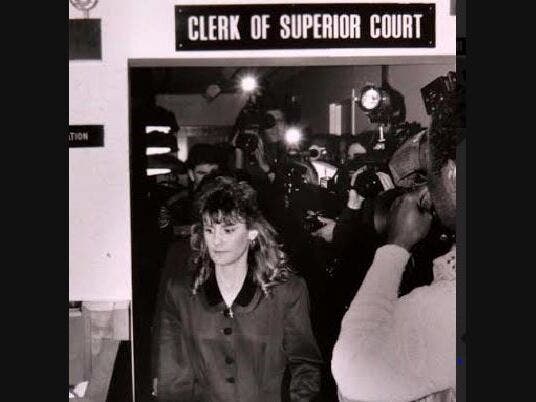
CONCORD, NH — The state has asked the court to dismiss Pam Smart's latest bid to get out of prison, a habeas corpus petition arguing she was convicted based on dodgy tape recordings of conversations with one of the prosecution's key witnesses.
"Tellingly, (Smart) fails to explain the legal relevance of the centerpiece of her habeas petition, viz., a study manufactured specifically for her case concerning transcripts of tape-recorded conversations (Smart) had with one of the prosecution’s multiple witnesses, Cecelia Pierce. (Smart) claims her study is of 'monumental' significance, and that it identifies “at least eleven sections of the transcript that are facially inaccurate.”
Find out what's happening in Across New Hampshirefor free with the latest updates from Patch.
This week, Anthony J. Galdieri, solicitor general/associate attorney general filed in Merrimack County Superior Court a 34-page response in objection to Smart's habeas.
Smart is serving a life sentence with no chance for parole for orchestrating the murder of her husband, Gregg Smart on May 1, 1990. She was convicted of the crime of being an accomplice to first-degree murder.
Find out what's happening in Across New Hampshirefor free with the latest updates from Patch.
Her legal team is pursuing a new approach as it relates to evidence at trial with the petition for a writ of habeas corpus. That means that an order is issued to bring the person before the court to determine if their detention is lawful.
The state is asking the court to dismiss it in its entirety and asks to deny any request for an evidentiary hearing.
But if the court chooses to hold a hearing, it should be limited to a legal argument on the motion to dismiss, it states.
"(Smart's) objection fails to meaningfully address the arguments set forth in the respondents’ opening brief, or even to clarify the basis for her claim that the jury’s decision 35 years ago finding her guilty of murder – which she has unsuccessfully sought to challenge in the New Hampshire Superior court through her petition for a new trial, the New Hampshire Supreme Court on direct appeal and appeal from the denial of her petition for a new trial, the United States Supreme Court, and the state and federal habeas courts, as well as unsuccessfully sought relief from the State Governor (the denial of which she also petitioned the New Hampshire Superior Court) – may now be reevaluated," the state argued.
The state writes that the legal relevance of the petitioner’s study is elusive.
"Not only does she fail to identify the inaccuracies in the recording transcripts she alleges, in rejecting her direct appeal, the New Hampshire Supreme Court found that the superior court had repeatedly instructed the jury it must determine what was said in the tape-recorded conversations at issue based on what the jurors heard, not read, and cautioned them that, in the event of a conflict, the recordings controlled.
"Perhaps in recognition of the logical gap at the center of her petition, (Smart) attempts to fill it by quoting three or four snippets from another post-verdict source, the transcript of the juror-misconduct hearing held by the superior court held on August 15, 1991. This attempt to sprinkle a handful of post-verdict needles into the haystack of the trial proceedings does nothing to show her conviction may now be challenged collaterally," the state argued.
After citing numerous cases the state claims that Smart's claim the jury failed to follow Superior Court instructions is unsupported and fails to allege actual prejudice, the state argued.
In January, Smart argued the transcripts doomed her to prison for her husband’s murder, according to the habeas petition she filed.
Jurors heard audio recordings of Smart during the trial, and prosecutors gave the jury printed transcripts of those recordings during deliberations. But, those transcripts attributed words to Pamela Smart that she now challenges.
“When people read a transcript while listening to unclear audio, they almost always ‘hear’ the words they are shown — even when those words are not actually present in the recording,” attorneys for the law firm Zernhelt Law LLC said in a news release at the time.
Her lawyers also argued the verdict was tainted by the extensive media coverage, that Smart was forced to accept guilt on one charge through her trial attorney’s defense strategy, that jurors received faulty instructions from the trial judge, and that Smart’s life-without-parole sentence is illegal since she, herself, was just the accomplice in Gregg Smart’s murder.
Smart was 22 when she was the media coordinator at Winnacunnet High School and had an affair with 15-year-old student Billy Flynn. The lurid true crime inspired a best selling novel that was later turned into the movie, To Die For, starring Nicole Kidman. Flynn and two friends convicted in connection with Gregg Smart's murder have all been released on parole.
In a video sent to members of the Executive Council, Pamela Smart claimed in 2024 that she finally took responsibility for Gregg Smart’s murder. As part of her application to be released from prison, Smart spoke in the video about coming to terms with her guilt while taking part in a writing class led by Vagina Monologues author Eve Ensler.
“She pressured us and encouraged us to go beyond and into spaces we didn’t want to be in,” Smart said. “It’s in those spaces where I found myself responsible for something I desperately didn’t want to be responsible for, my husband’s murder.”
Reporter Damien Fisher contributed to this report.
This article first appeared on InDepthNH.org and is republished here under a Creative Commons license.