Politics & Government
Volinsky: A Court In Turmoil
Attorney: Justices appear to have issued a false public statement about a court staff reorganization while showing financial favoritism.

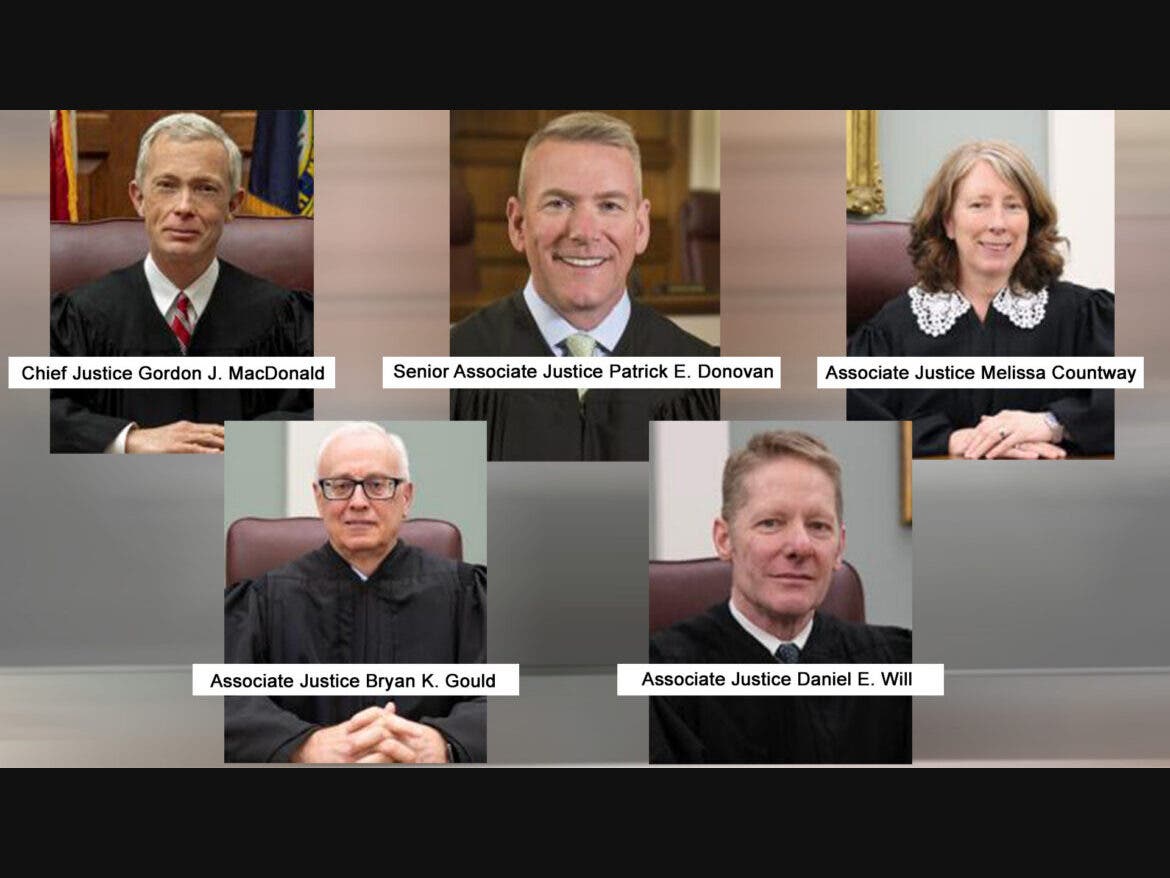
NH Supreme Court justices appear to have issued a false public statement about a court staff re-organization while showing financial favoritism to a certain staff member and while ignoring public concerns about appearances of bias in the Rand school funding case. Throw in a judge who was prosecuted for seeking favor from the governor for her husband and you have a court in turmoil and in deep trouble with the public.
It pains me to write this. I’ve been a trial lawyer all of my professional life. I’ve tried cases of all types before scores of judges and I can say that most were hard working, thoughtful and highly ethical. A great number of them sacrificed personal freedom and higher earnings for a position on the bench. I so respect them, but not all people who become judges fit this mold.
Find out what's happening in Across New Hampshirefor free with the latest updates from Patch.
There is so much to write about the NH Supreme Court that I am trying something new with this post. It is in two parts. The first part focuses on justices lying to the public. The second part, to be published next Wednesday, will bring you up to date about the Rand case.
Public Confidence in NH Courts
Find out what's happening in Across New Hampshirefor free with the latest updates from Patch.
There isn’t polling over time about confidence in the NH Supreme Court as there is with the US Supreme Court, but I’d say confidence in the NH Supreme Court is at an all time low. Chief Justice Gordon MacDonald resigned effective September 15th pursuant to a stipulation, or agreement, with the Judicial Conduct Committee (JCC) in which he agreed that he committed judicial misconduct. MacDonald admitted to arranging a $50,000 payout from state funds to Dianne Martin, a key lieutenant, while also participating in the release of a false statement to the public about how Ms. Martin came to leave one position with the court system for another.
Only two other state court chief justices were removed from their jobs or resigned in lieu of removal during the modern era. The modern era began in 1960 when California adopted an independent commission to review the conduct of judges. The ABA promulgated a model code for judicial conduct in 1972.
Allen Loughry of West Virginia resigned in 2018 after federal fraud convictions and Roy Moore was removed from office in 2003 for disobeying a federal order about the Ten Commandments monument he installed in Alabama’s main courthouse. He was re-elected and removed again in 2016, this time for ordering probate judges to reject gay marriages despite the Obergefell US Supreme Court decision (2015) recognizing them.
Why did Gordon MacDonald resign as NH’s chief justice?
In short, MacDonald showed favoritism towards an employee and lied to the public about it.
The JCC released a summary report about its proceedings. The report provides an insider’s glimpse of what happened including discussion of how the implicated justices, MacDonald, Donovan, Countway, and Gould, engaged in conduct that could be considered stonewalling of the investigation. These justices also tried to scuttle the entire investigation by seeking an injunction to stop it. Finally, the justices sought to remove the JCC’s investigator, Phil Waystack.
The employee at the center of all this tumult is Dianne Martin. Martin was a long time assistant attorney general when MacDonald was appointed to be the NH Attorney General by Governor Chris Sununu. MacDonald promoted Martin to be his chief of staff. The promotion came with a $25,000 raise.
Sununu then nominated MacDonald to be the head of the entire judiciary as chief justice. A chief is both a judge who decides cases and an administrator who runs the court system with its many judges and civilians at all levels of courts. I opposed MacDonald’s appointment to the Supreme Court as an executive councilor in 2019. In a Concord Monitor op-ed I questioned MacDonald’s leadership, lack of trial and judging experience and extreme partisanship. Sununu accused the Executive Council of violating the “tradition going back literally hundreds of years, working in a nonpartisan manner, executing their responsibility of confirming nominees based on their qualifications, body of work, and merit – without political bias.”
Sununu, of course, only appointed Republicans to the NH Supreme Court, ignoring the decades old practice of nominating justices who represented a balance between the two major political parties. Sununu also nominated arch conservative Republican Justice Robert Lynn, and now extremist state rep, to be chief justice. In doing so, Sununu passing over the more senior Justice Gary Hicks who was a Democrat.
Sununu renominated MacDonald to be chief justice after the Republicans regained control of the Executive Council in 2020.
After MacDonald left the AG’s office, Sununu appointed Martin to the Public Utilities Commission with a $130,000 salary. She then followed MacDonald to the court system, leaving the PUC two years into her six year term.
Martin became the head of the administrative office of courts (AOC) with a salary of $143,000. The AOC, formed in 1983, “is responsible for the Judicial Branch’s statewide administrative functions, including audit, communications, facilities, fiscal, legal, human resources, information technology, security, and treatment court services.”
Martin’s Shortcomings as a Manager
The JCC found that under Ms. Martin’s leadership virtually all of the court system’s human relations staff quit. It was so bad that the Department of Administrative Services, an executive branch agency, had to take over the court’s HR functions.
Martin, the JCC concluded, also left important court positions unfilled including the position of Director of Domestic Violence who is responsible for inputting domestic violence protective orders issued by NH courts into the national database for such orders. The database is important because federal law, and some state laws, prohibit some people subject to protective orders from owning or possessing a gun. “[W]hen an abusive partner has access to a gun, a domestic violence victim is five times more likely to be killed.”
Martin, the JCC concluded, also failed to timely pay bills such that court buildings received utility cut-off and eviction notices.
Martin’s extensive shortcomings as a manager were all communicated to Gordon MacDonald as chief justice.
A Surprising Twist-Justice Hantz Marconi Investigated Martin
The JCC wrote in their report, “As Chief Justice you knew about the difficulties with the operation of AOC. Associate Justice Anna Barbara Hantz Marconi undertook an investigation of what was happening at the AOC. After Justice Hantz Marconi was placed on administrative leave, Associate Justice Patrick Donovan became involved in taking over the work of investigating AOC because of substantial and widespread concerns about Ms. Martin’s management. . . .” (Emphasis supplied.) Justice Melissa Countway later joined Justice Donovan’s effort and on February 28, 2025 Donovan and Countway met with Martin and relieved her of her duties as head of the AOC. They offered her a position with the Court’s bar admissions office. Chief Justice MacDonald was furious with his colleagues and acted out by slamming doors and yelling at them. He later apologized for his conduct.
Hantz Marconi and MacDonald were part of another legal drama at the NH Supreme Court. Hantz Marconi was placed on administrative leave from her position as a justice in July 2024 and prosecuted for allegedly meeting with Governor Chris Sununu in an effort to have him influence the prosecution of Geno Marconi, Hantz Marconi’s husband. She eventually pled no contest to a low level misdemeanor and paid a fine. A part of the prosecution of Hantz Marconi relied directly on testimony from Chief Justice MacDonald. Hantz Marconi asserted that MacDonald sanctioned her meeting with Sununu before the meeting occurred. Reporting indicates that MacDonald later denied the claim when interviewed as part of the criminal investigation.
Now things got dicey.
Martin apparently complained about being shown the door and didn’t like the idea of becoming general counsel to the office that oversees admissions to the NH bar. Also, there was already a lawyer in that position who wouldn’t retire for months.
The solution was to have Martin break precedent and shadow the then bar counsel for five months, four and a half months longer than the overlap allowed by court personnel rules. The five months of shadowing meant that two employees, each paid $154,109 a year, did a job that one employee successfully managed previously.
To further sweeten the deal, Martin took a 48 hour break between the two jobs. The couple days off converted the job transfer to a “termination” that triggered a $50,000 payment to Martin for accrued sick, vacation and termination pay.
Then a whistleblower stepped in and reported the matter to the Department of Administrative Services. Todd Bookman of NHPR also started investigating and the story of special treatment started to leak.
How to deal with the uncomplimentary story?
The Court hired a lobbyist for $10,000 a month right after Bookman broke his story. Republican lobbyist Periklis Karoutas was hired within days after the story of Martin’s new job leaked. His no bid, non-public contract was signed on January 10, 2026, but was made retroactive to October 27, 2025. Bookman’s story broke on October 23, 2025.
Karoutas’ firm was hired to provide: “expert consulting services related to communications strategies, developing an assessment of the Branch’s current communications efforts, and identifying opportunities for improvement in order to promote public trust and confidence in the judicial branch.”
Karoutas reported directly to the lawyer for the judicial branch instead of the chief justice or the existing communications manager in order to shield his work from public view under the attorney client privilege.
The public statement claiming there “is nothing to see here” was issued on October 31, 2025, eight days after Bookman’s story broke and four days after lobbyist Karoutas’ retroactive contract date. The public statement was issued through the court system’s communications manager. It is entitled, “Statement of Supreme Court Justices MacDonald, Donovan, Countway and Gould.”
In the public statement, four Supreme Court justices falsely claimed Martin’s re-assignment was part of “a comprehensive review of its administrative operations and costs as part of an effort to improve efficiency, better align staffing with current needs, and lower overall costs for taxpayers.” The four justices claimed the review that led to the change in Martin’s employment was part of a systemic re-organization that had been ongoing “[s]ince early 2024.” The statement characterized Martin’s transfer as a layoff and alluded to her entitlement to three weeks notice presumably to point out that she would receive three weeks pay in lieu of the required notice. Three weeks pay would have been $8,250.
The statement didn’t mention that three justices investigated Martin’s work or that her employment was terminated because of what was considered poor management. The public statement didn’t mention that she received a $50,000 payout or that two people would perform the job of bar counsel for five months.
Martin’s job as head of the AOC also continued to exist after she left the position and was immediately filled by Judge Chris Keating. The position was not re-organized out of existence for months and now is performed by Keating but with the title of judge administrator.
The Chief’s Resignation
Gordon MacDonald resigned his position as chief justice and admitted he violated the Code of Judicial Conduct, ethical rules that apply to judges, for his role in crafting the unorthodox and contrived termination of Dianne Martin and in lying to the public about it.
In the language of the stipulation that MacDonald agreed:
MacDonald admits to violating the following provisions of the Code of Judicial Conduct (The Code).
a. Chief Justice MacDonald, in violation of Canon 1, Rule 1.2, failed to act in a manner that promotes public confidence in the impartiality of the judiciary and failed to avoid the appearance of impropriety.
b. Chief Justice MacDonald, in violation of Canon 2, Rule 2.5(A), failed to perform his administrative duties competently and diligently in connection with the characterization, processing and public explanation of Dianne Martin’s removal and reappointment, including by bypassing established Judicial Branch rules and procedures in extending her a position without the competitive, merit-based process required of every other Judicial Branch employee.
c. Chief Justice MacDonald, in violation of Canon 2, Rule 2.13(A), failed to exercise the power of administrative appointment impartially and on the basis of merit, and failed to avoid favoritism.
The Code of Judicial Conduct that the JCC enforces is adopted as part of the rules enacted by the NH Supreme Court. The code is organized into broad statements called “canons” and more specific implementing rules. The preamble to the Code states its purpose.
…The United States legal system is based upon the principle that an independent, impartial, and competent judiciary, composed of men and women of integrity, will interpret and apply the law that governs our society. Thus, the judiciary plays a central role in preserving the principles of justice and the rule of law. Inherent in all the Rules contained in this Code are the precepts that judges, individually and collectively, must respect and honor the judicial office as a public trust and strive to maintain and enhance confidence in the legal system.
Canon 1 requires judges to avoid even the appearance of impropriety. Canon 2 requires judges to perform their jobs competently, diligently and impartially.
Rule 1.2, which MacDonald agreed he violated, requires judges at all times to promote confidence in the judiciary. Rule 2.5 makes clear the duty applies equally to a judge’s role as an administrator. Finally, Rule 2.13 provides that “In making administrative appointments, a judge: (1) shall exercise the power of appointment impartially and on the basis of merit; and (2) shall avoid nepotism, favoritism and unnecessary appointments.”
In their summary report, the JCC noted that it could not remove a justice from the Court. It could only suspend him. Removal required action by the legislature and the governor. It accepted MacDonald’s resignation without a public hearing because it was a better outcome than the JCC could order if MacDonald was found guilty of everything.
What about the other justices who also issued the false statement and agreed to the Martin payout scheme?
What about those other justices?
The JCC and Justices Donovan, Countway and Gould have been mum about whether there is an ongoing investigation of these justices for their conduct with respect to Martin or the public statement.