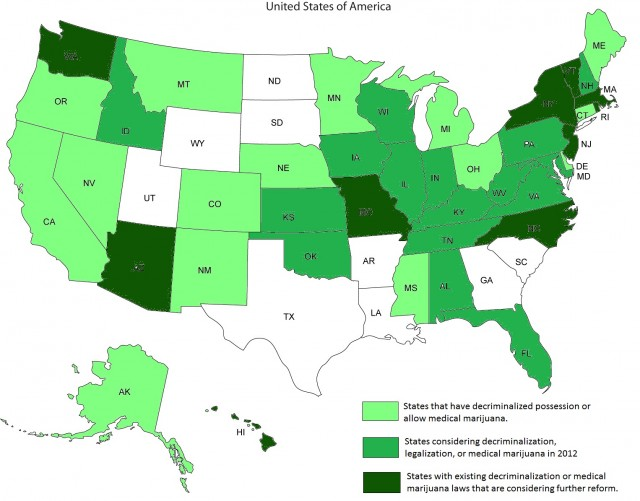
The Criminal Justice committee of the NH House is currently considering a limited rollback of Prohibition. House Bill 492, co-sponsored by three Republicans and two Democrats, would decriminalize possession of small amounts of marijuana. The committee will vote soon on releasing the bill to a vote by the full House.
The bill is opposed by NH police chiefs, who prefer the lucrative business of shaking down harmless marijuana users to the dangers of dealing with actual violent criminals. It is also opposed by Governor Hassan, who opposes anything that might cut the number of government-union members working for her re-election. Probably 90% of NH taxpayers are tired of paying to imprison their neighbors for use of a mild drug, but we in the 90% haven’t spoken up. Our silence is costing us. I’ve never used marijuana, but I’ve paid a lot of taxes for Prohibition anyway.
Can We Afford Prohibition Anymore?
The Federal deficit for fiscal year 2013 was over $640 billion, bringing us to about $17 trillion in (on-budget) debt. Our GDP is only $16.7 trillion. If the Federal government were a business, it would be General Motors… only there is no one to bail out the United States.
We have been in financial trouble before, and recovered. When FDR took the reins during the Great Depression, the very first thing he did was rush through legislation repealing Prohibition. State governments started receiving taxes from legal alcohol again. The human costs of deaths and blindness from adulterated alcohol ended. Murder and assault rates fell steeply after the Alcohol War armistice; no bystanders get killed in fights over alcohol turf today.
Find out what's happening in Bedfordfor free with the latest updates from Patch.
Unfortunately Prohibition returned in new forms, driven by political opportunism (and without the bother of passing a Constitutional Amendment). Nixon escalated the “War on Drugs” in 1971 to draw attention away from defeat in Vietnam.
Like most of Nixon’s projects, from wage and price controls to bombing Cambodian villages, the Drug War became a human and economic catastrophe. Today the US leads the world in percentage of population incarcerated. The fiscal damage is a world record as well.
Find out what's happening in Bedfordfor free with the latest updates from Patch.
The Cato Institute estimated in September 2010 that the direct cost of Drug Prohibition is “roughly $41.3 billion per year in government expenditure on enforcement of prohibition. $25.7 billion spent by state and local governments, $15.6 billion by the Federal government”.
Their report also estimated that drug legalization would yield tax revenue of $46.7 billion annually, assuming legal drugs were taxed at rates comparable to those on alcohol and tobacco.
The indirect costs are many times larger. The 1.7 million people arrested for drug offenses every year lose tens of billions of dollars in lost work time and future employability. The crimes committed to get money for overpriced illegal drugs make American inner cities dangerous and unfriendly places.
And there is the sheer deadweight load of people paying hundreds of extra dollars per month for smuggled drugs. We have made every addiction into an economic catastrophe for the poor, a gratuitous increase in the sum of human misery.
The Taliban, the FARC in Colombia, the Mexican drug cartels, and many other terrorist groups only exist because of the ecological niche afforded by artificially expensive drugs. According to the Mexican government, drug turf wars killed 28,000 people in that country from 2006-10.
Ending Drug Prohibition would end all these subsidies to terrorists overnight. Just as the end of alcohol Prohibition wiped out the speakeasies and the whiskey smugglers, no one would buy Taliban opium when it cost 100 times as much as the legal tax-stamped product.
An America without Prohibition would not be a new experiment. Our country had no drug laws until 1914. Our ancestors managed to build railroads across the continent, invent the airplane and electric light, and build the biggest economy ever seen in human history, with no drug laws.
We can’t afford the Drug War. We can’t afford its human cost, its economic cost, and most of all we can’t afford the cost to our freedoms. Freedom isn’t a luxury; it is an economic necessity. Look at a satellite picture of North Korea vs. South Korea, or any other free vs. unfree border. Freedom powers economic life, as well as cultural life.
If you want to roll back Prohibition in NH, make your voice heard. Contact the Criminal Justice committee members and urge that they show up and vote to let HB 492 out of committee. And contact Governor Maggie Hassan, and ask her to stop supporting Richard Nixon’s Drug War with the threat of her veto. Prohibition failed. Let’s try freedom instead.