Neighbor News
NH Cancer Survivors Travel to Nation’s Capital to Lobby Congress
Bedford, Windham & Silver Lake Advocates Called for Congress to Increase Cancer Research Funding & Other Priorities
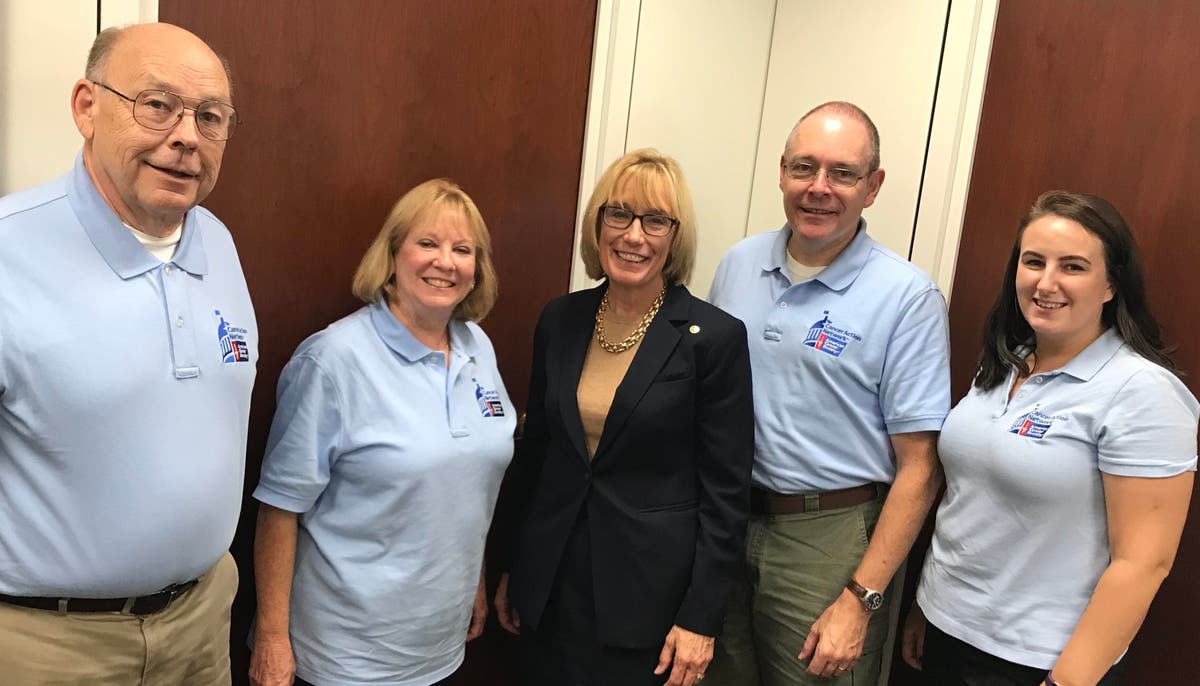
At the end of September, nearly 700 cancer patients, survivors, volunteers and staff from all 50 states and nearly every congressional district gathered in Washington, D.C., as part of the annual American Cancer Society Cancer Action Network (ACS CAN) Leadership Summit and Lobby Day. Advocates urged Congress to take steps to make cancer a national priority and help end a disease that still kills more than 1,670 people a day in this country.
A group of advocates from New Hampshire met with members of the state’s Congressional delegation to ask for support in three key areas in the cancer fight. They discussed the need to support an increase in federal funding for cancer research. They also asked them to advance legislation that works to improve patients’ quality of life and to support legislation that would close a loophole in Medicare that can result in surprise costs for seniors when a polyp is found during a routine colonoscopy.
Among those advocates were:
Find out what's happening in Bedfordfor free with the latest updates from Patch.
- Don Parrish from Bedford – Don is a prostate cancer survivor, diagnosed this past winter with the disease. Don was also a caregiver to his wife during her cancer battle until she passed away several years ago; he also lost his mother to cancer when he was only 12 years old. He has been a passionate advocate for many years.
- Nanci Carney from Silver Lake – Nanci lost her husband and the father to her children in 1998, at the age of 38, after a six-month battle with a rare cancer. Nanci has honored his legacy as an advocate with ACS CAN since 2004.
- Bill Sherry from Windham – a cancer advocate with ACS CAN.
“Too many Americans are suffering and dying from cancer every day. Families across this country are counting on Congress to lead the fight against this terrible disease,” said Mike Rollo, government relations director for ACS CAN in New Hampshire. “The volunteers who traveled to DC in September did an amazing job urging our Congressional leaders to commit to making cancer a national priority by increasing federal funding for cancer research, supporting improvements to patient quality of life and eliminating surprise costs for seniors getting colorectal cancer screenings.
“Roughly one in three Americans will be diagnosed with cancer in their lifetime. Their lives may depend on the decisions made by our lawmakers today. We want Congress to know that volunteers from New Hampshire, and from every state across the country, are counting on them to take action now to fund cancer research and ensure those with a history of cancer have access to affordable, meaningful health coverage.”
Find out what's happening in Bedfordfor free with the latest updates from Patch.
Specifically, Parrish, Carney, Sherry and their fellow volunteers asked their Members of Congress to:
- Increase funding for research at the National Institutes of Health (NIH) by $2 billion for Fiscal Year 2019. All of us have been touched by cancer – whether it’s a friend, family or ourselves directly. There is perhaps no better way for Congress to demonstrate support for the fight against cancer than by funding lifesaving research to develop better treatments. Over the last three years, there has been tremendous support for cancer research funding with sustained increases in federal funding, including the Fiscal Year 2018 increase for the NIH of $3 billion. The Senate budget bill increases funding for NIH by $2 billion and we need the House to follow suit as they make their final budget decisions this month. Today, advancements in research are saving more lives than ever. Shortly after the advocates visit, President Trump signed into law this lifesaving funding increase.
- Support the Palliative Care and Hospice Education and Training Act (PCHETA) which will greatly improve the quality of life for cancer patients. From the very moment a person hears “you have cancer,” they deal with the anxiety and fear of the unknown, followed by the pain and side effects of treatment, and finally, the often-lingering physical symptoms of survivorship. It doesn’t have to be this way. There is an extra layer of support widely available to patients and their caregivers called palliative care. In addition to their curative treatment, patients can receive help from a team that often includes a palliative care specialist, a nurse, a social worker, a pharmacist and a psychologist to better coordinate their care and manage their symptoms. Studies have shown that patients who receive palliative care have better quality of life and even better treatment outcomes. Palliative care saves the health system money by reducing the need for emergency room visits, hospital stays and intensive care. PCHETA has tremendous bipartisan support in Congress. It recently passed the House unanimously and is awaiting action in the Senate, where the bill already has 33 cosponsors.
- Support the Removing Barriers to Colorectal Cancer Screening Act. Colorectal cancer is the second most common cause of cancer death in the United States, yet it is also one of the most preventable forms of cancer through routine screening. One of the biggest barriers to screening has been cost sharing. Cost sharing has been mostly eliminated in the private insurance market, but some Medicare patients can still get hit with a bill if a polyp is found and removed during a colonoscopy, which changes the classification from a “screening” to a diagnostic procedure. ACS CAN supports bipartisan legislation that would eliminate this cost sharing glitch, allowing men and women to receive those screenings without waking from the procedure and facing an unexpected bill.
Before meeting with their legislators, cancer advocates attended training sessions on communicating with elected officials, conducting grassroots activities in their communities and engaging the media.
The ACS CAN Lobby Day culminated with an evening Lights of Hope ceremony in front of the Lincoln Memorial featuring more than 30,000 lights in honor of a cancer survivor or to memorialize a loved one lost to the disease.
ACS CAN is the non-profit, non-partisan advocacy affiliate organization of the American Cancer Society, which is dedicated to eliminating cancer as a major health problem. ACS CAN works to encourage lawmakers, candidates and government officials to support laws and policies that will make cancer a top national priority. ACS CAN gives ordinary people extraordinary power to fight cancer. For more information, visit www.fightcancer.org