Neighbor News
Brogan: Margaret's Magic 'Wand' Arrives!
Margaret Porter's 15th book, "The Myrtle Wand" arrives at Gibson's on October 12th.


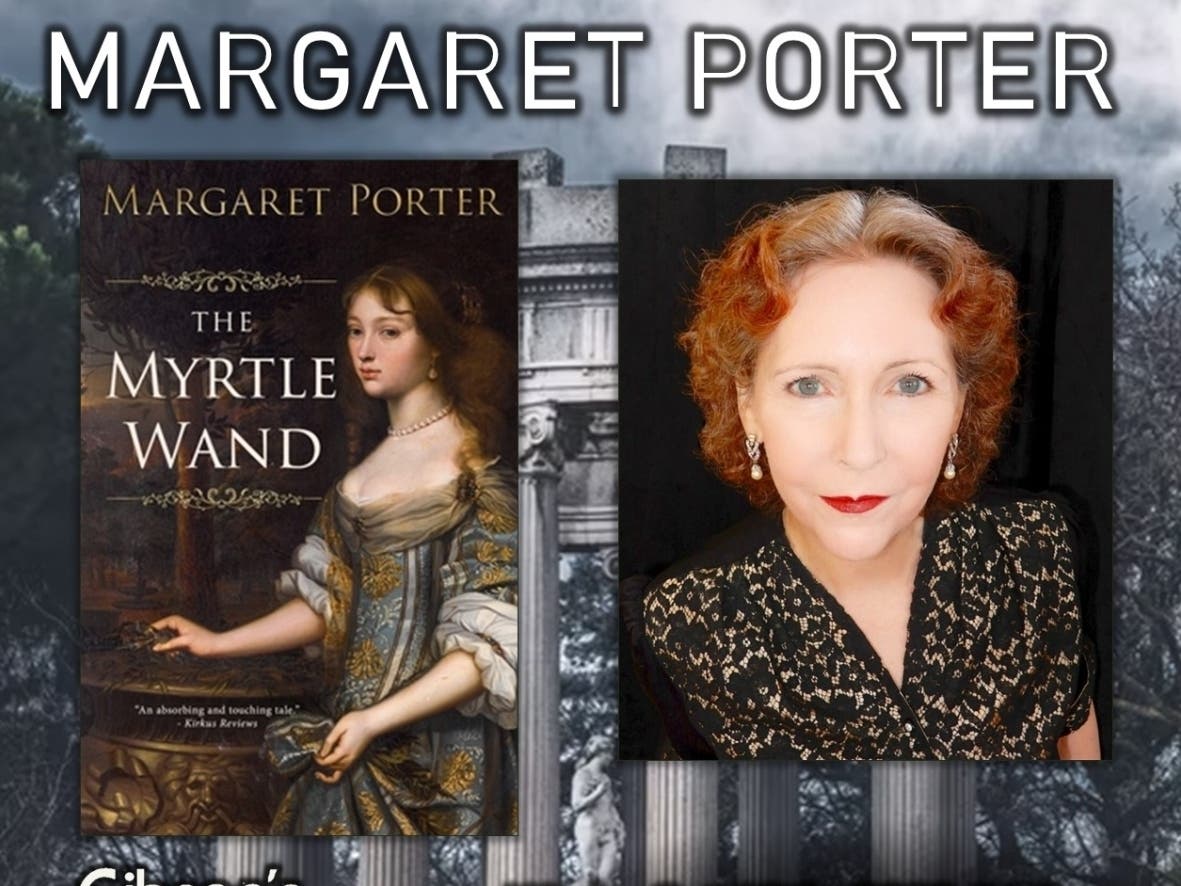
A new book by Concord's Margaret Porter is always a reason for celebration. Her latest, and 15th, The Myrtle Wand, arrives at Gibson's Bookstore in downtown Concord next week. While it is also available on Amazon and Banes and Noble, among other sites, I would urge you to support our beloved downtown book emporium.
On Wednesday evening, October 12, Margaret will be talking about her latest book, doing a reading and signing copies for everyone who wants to stop by and enjoy this free event. It begins at 6:30 PM, and if you've never been to one of Margaret's book-signings, you are in for a real treat.
If I didn't know better, I would swear that Margaret has Time Machine on her property. So real is her remarkable ability to take her reader on a journey to another time and place, that you become enveloped in the smallest detail of the setting and come to fully understand her characters.
Find out what's happening in Concordfor free with the latest updates from Patch.
Her last two enormously popular and award-winning titles, Beautiful Invention: A Novel of Hedy Lamarr and The Limits of Limelight, took us fortunate readers to many places including Hollywood during its Golden Era of the 1930's and 40's. For her new book, Margaret takes us back even further - several hundred years in fact. Margaret's passion for research beautifully blends history with romance and even a touch of magic. It's a book that I found impossible to put down and I dare you to try to.
Margaret recently made time in her very busy schedule to answer some questions I put to her about her latest foray as well as her exciting career as a writer.
Find out what's happening in Concordfor free with the latest updates from Patch.
1. The Myrtle Wand is your 15th book. What motivates and drives you to continue to write, while maintaining such a high quality with each title?
Passion for and interest in a subject, a person, a period in history is incredibly motivational, driving me deep into a project and keeping me going all the way to the end. I’ve got more ideas and plans for books than I’ll ever have time to complete, so I’m never at a loss for something to write. In the research process, while gathering fascinating facts, I get increasingly excited and eager to share it. Quality is extremely important to me—by my definition it consists of compelling and sympathetic and flawed characters who are truly people of their time and place, historical accuracy, and good pacing. Also, I strive for writing that is stylistically accessible—neither too simple nor too complex, straddling a line between literary and commercial.
2. Your last two books brilliantly captured Hollywood's Golden Era. With your latest book, you go back several hundred years. Is the same amount of research necessary whether your book is set in the 1600's or in the 1930's and 40's?
Thank you for the compliment! The intensity of research is the same and yet it’s different. There’s a massive amount of source material for Hollywood’s Golden Era, as you know—academic studies, histories, memoirs, biographies, fan magazines, studio documents, publicity photographs and candid pictures, newspaper archives, and newsreels. I carry out exhaustive research for my Hollywood books, because I have a hunger for information and want to know everything. But I must also be extremely selective about what actually goes into the novel . . . how the facts connect with the character arc or develop my plot. I also enjoy busting popularly held but inaccurate myths about celebrities of that era.
For a novel set so much farther back in the past, I sometimes have to scrounge and hunt hard for obscure information. If it’s biographical, about a real person, I seek out histories and biographies and published letters. Mass communication was more limited in the 1600s, but newspaper and other archives do exist. The internet makes it possible to track down the location of primary source material, and I’ve traveled long distances and to other countries in order to access an antique diary or batch of letters written by somebody hundreds of years ago. To see their handwriting on yellowed paper, and to imagine them forming the words I’m reading always give me chills. I’m also very visual, seeking images of the real people I write about. Through that research, I’ve actually located paintings of people that were completely unknown or wrongly identified.
If historical sources aren’t in agreement, which frequently happens, I choose whatever is most plausible and makes the best story or heightens the plot conflicts.
3. Is living in Concord a help, a hindrance or does it not make a difference when you write?
Well, there’s certainly plenty to do in Concord, so I can easily be distracted from writing! In general, I’m somewhat less productive in the summertime, because of all the outdoor activities and keeping busy in the garden, but it depends on the stage of the project—I’m extremely disciplined when getting close to deadline. Still, I seem to get more writing done from the time the leaves drop until spring bulbs start blooming. However, this is such a solitary profession that I do take advantage of opportunities to spend time with friends and take advantage of the Capital Region’s cultural events and great restaurants. During the pandemic I managed to write two novels, I suppose because I was spending so much more time at home because of many closures. I’ve been very thankful for my “bubble” of friends and neighbors!
4. Your books have achieved great success, not only with readers but with the impressive number of awards and honors you have received. What is most satisfying to you - hearing from a reader who expresses their pleasure and excitement, or being handed an award?
Reader response! There’s no greater joy than learning that someone appreciated the time spent reading one of my novels, whether I find out in person or via email or in a social media post or a review. Sometimes they have valuable insights, or reactions that surprise me. I feel fortunate and blessed to have enjoyed critical success and naturally I treasure my awards—wonderful affirmation, but not something I can control or expect. Providing a good reading experience and connecting with readers is my goal and purpose for writing and means so much more.
5. What would be your most important piece of advice to someone reading this, who wants to write but does not know if they have a gift?
Sorry, but I can’t limit myself to just one piece of advice!
First, I hope the would-be writer is an avid reader of the type of book they most want to write, because that’s what sparks the desire and provides examples of what can be achieved. Reading is really the best first way of learning about writing. I also feel it’s necessary for a writer to gain objectivity about their abilities without being so self-critical that they become discouraged or blocked. I won’t say practice makes perfect—there’s no such thing as absolute perfection in writing. I know, because I’m a chronic reviser. But writing regularly, consistently, does help a writer develop their voice and style, and discover what aspect of writing comes easily, what’s more difficult, what might need improvement. After committing to a project and making some progress, if the writer isn’t quite satisfied, it might be time to access writing workshops in person or online or participate in a writing conference like the one sponsored each year by New Hampshire Writers Project. Getting involved in the community of writers—which in New Hampshire is wonderfully large and rich, in my experience, very welcoming and supportive—can be helpful at any stage.
I hope you'll all join me at Gibson's on October 12th.