Politics & Government
See What’s Inside The Concord City Manager’s $155 Million Fiscal Year 2026 City Budget
City Manager Tom Aspell proposes raising the tax rate by 3.96% to cover $2.4 million in pay increases and $31.6M in capital improvements.


CONCORD, NH — City councilors and officials will begin deliberations on the fiscal year 2026 city budget on Thursday night, with City Manager Tom Aspell asking for a 3.96 percent tax rate increase to fund operating and capital improvement budgets of nearly $155 million.
Aspell, who enters his 19th year as manager, will present the budget overview and highlights to city councilors, who will meet as the Finance Committee, on Thursday night. The real work begins on Monday night, with councilors analyzing proposals for each department and funds. In the past, Aspell and the city council have attempted to limit increases to 3 percent or less, keeping them below inflation, and some years have been close to zero.
Approximately $87 million will be allocated from the general fund budget, while nearly $32 million will be allocated toward capital budget items. An additional $21.5 million will be allocated to wastewater and water.
Find out what's happening in Concordfor free with the latest updates from Patch.
Aspell said he approaches budgeting not as a single year but multiple years, because there are unexpected influences outside of the city that are affecting Concord.
Some of the financial items include reduced state and federal aid; others involve maintaining compensation levels comparable to other communities, which are all competing for quality employees.
Find out what's happening in Concordfor free with the latest updates from Patch.
Read the city manager’s fiscal year 2026 budget proposal online, linked here.
During the last fiscal year, $405,000 was spent, outside the initially approved budget, on retention bonuses for police officers — many who are working double shifts and overtime due to short staffing, and $400,000 for general services employees involved in winter operations. In past years, large segments of the police department either retired or left for other communities with higher pay structures and less stress. The department still has 17 staff vacancies, mostly officers, but also parking staff and a dispatcher.
About a $2.4 million increase in pay structures is included in the budget this year after five of the city’s six labor unions entered into new agreements. Benefits, however, are expected to increase by only about $150,000 in the next fiscal year.
About 7 to 8 percent of the city’s employees are on salary and work more like a private sector employee, juggling many responsibilities, and not regulated by union rules, according to Deputy City Manager-Finance Brian LeBrun.
Like the school district and other government structures, most of the budget is allocated for personnel, accounting for approximately 75 percent of the operating budget.
“Those are things beyond your control (and) you’re looking at every lever to keep those costs down,” Aspell said, while still keeping quality employees staffed.
The city is also undergoing a compensation study.
A 1 percent tax rate increase amounts to about $546,000, according to LeBrun. The 3.96 percent tax rate increase is $156 more next fiscal year for a home assessed at $400,000.
Debt service, too, is a significant line item, with Aspell noting the city has historically been good at building new structures but not as good at maintaining them.
“People want improvements,” he said, “people want things fixed.”
Budget Hearing Schedule
The Finance Committee (the city council during budget hearings), will be meeting on the following dates to discuss various budget items:
- 5:30 p.m. on Thursday, May 15: City Manager’s Fiscal Year 2026 Budget Presentation
- 5:30 p.m. on Monday, May 19: General government, public safety (police and fire), and general services.
- 5:30 p.m. on Thursday, May 22: Community development, leisure services (library and parks and recreation), human services, and capital improvement program (CIP) (tax increment finance, TIF, districts and capital projects)
- 5:30 p.m. on Monday, June 2: Special revenue funds (parking fund, airport fund, conservation property fund, revolving fund, golf fund, arena fund, and solid waste fund) and enterprise funds (water fund and wastewater fund).
- 5:30 p.m. on Thursday, June 6: Committee work session, public hearings, and public hearing action (budget adoption).
Although the 3.96 percent may seem high, Aspell said the past five budgets have averaged around a 2.8 percent tax rate increase, or well below the inflation rate.
“Nobody else has done this,” he said.
The city has also been hit slightly by reduced investment income despite relatively high certificate of deposit interest rates during the past year.
LeBrun said the city has both long- and short-term rates. Long-term rates are lower, while the short-term rates have been between 3.8 and 4.1 percent, for the most part, with the city staggering the maturity of reserves.
“We don’t have a magic button where we can get double (4 percent),” he said. “(and) we try to find that happy spot in between six and 18 months (intervals) for us.”
However, there have been some rate decreases as well. The $805,000 in employee retention bonuses, though, came out of that money. If the Federal Reserve lowers rates, interest rates will go down for the city, “and it will become more of a struggle for us,” LeBrun said.
Aspell has also budgeted $460,000 for the first year’s payment on a 20-year bond for a new golf clubhouse at the Beaver Meadow Golf Course, although the project remains in limbo and has not been approved by the council.
Some other budget notes include the city maintaining a AA+ bond rating and meeting all of the policy goals of the city council during the past two years.
Aspell also said he was not budgeting any money to donate to event organizers as the city did last year.
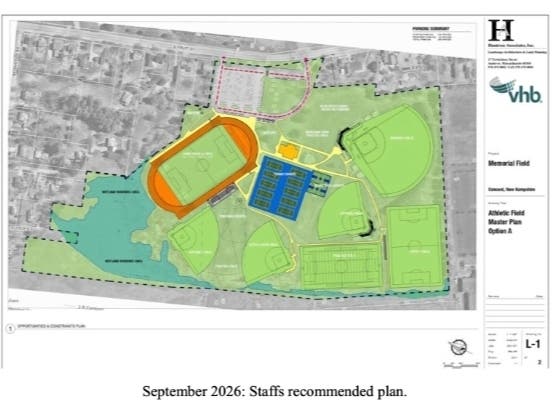
Nearly $3 million will be spent on paving, while $690,000 will be spent on a final redesign of Manchester Street and $630,000 will be spent on downtown sidewalk repair. About $280,000 will be spent on new police vehicles, and $1.2 million will go toward a new fire engine. The city will spend $1.2 million on replacing ornamental LED streetlights. Water rates will increase by 7.75 percent and wastewater rates will increase by 9.5 percent. The city will also spend $1.5 million on design plans for Memorial Field which will be split with SAU 8, the Concord School District. An additional $1.5 million will be allocated to replace water mains, while $1.3 million will be spent on parking garage improvements.
Editor's Note: Concord city councilors will be working in their capacity as the Finance Committee not the Fiscal Policy Advisory Committee, which is also a separate council committee. These errors in the story have been fixed.
Do you have a news tip? Please email it to tony.schinella@patch.com. View videos on Tony Schinella's YouTube.com channel or Rumble.com channel. Patch in New Hampshire is now in 180 communities. Follow the NH Patch political Twitter account @NHPatchPolitics for all our campaign coverage.
Get more local news delivered straight to your inbox. Sign up for free Patch newsletters and alerts.