Schools
Concord School Board Electioneering Against Tax Cap Ballot Question Being Reviewed By Election Law Unit
An alert sent to SAU 8 families via ParentSquare, urging voters to reject a proposal to contain school costs, may violate New Hampshire law.


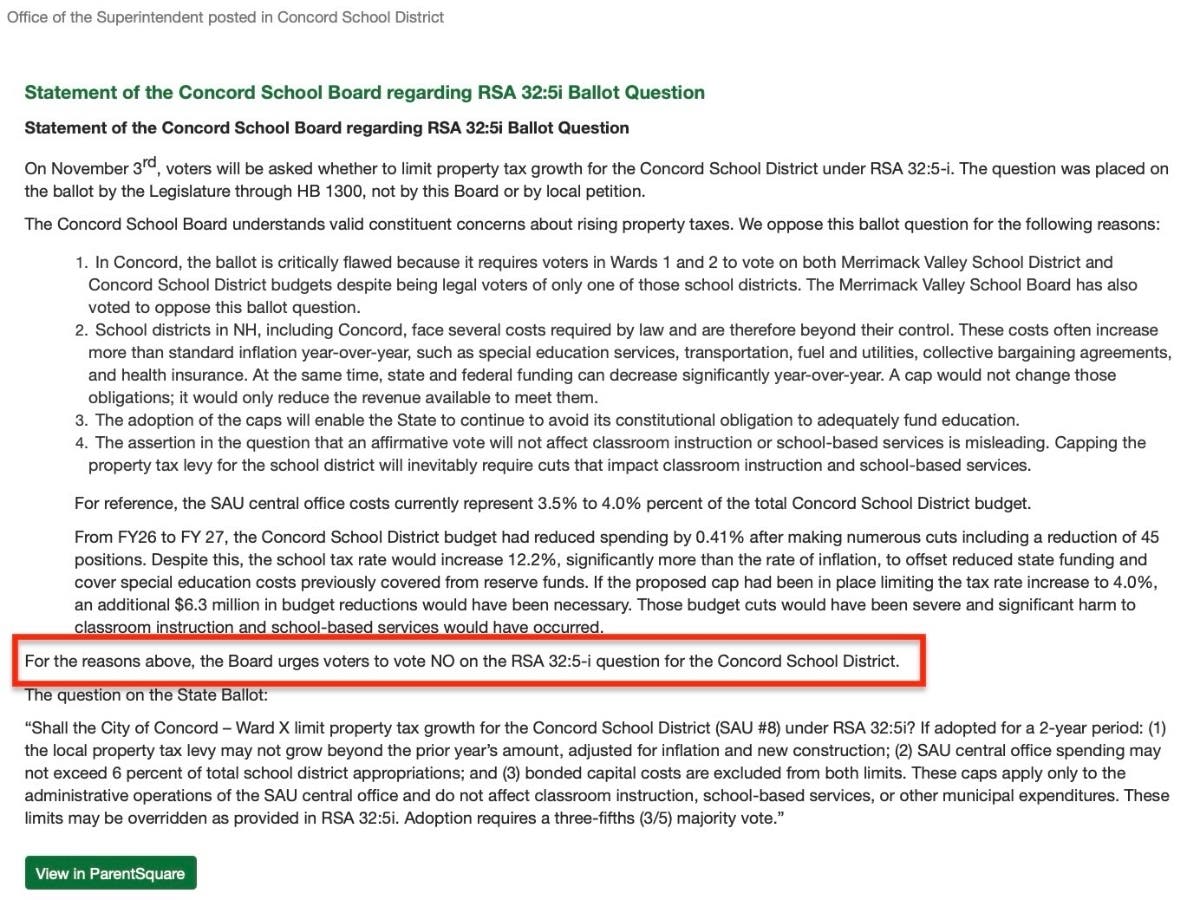
CONCORD, NH — The Concord Board of Education may be in hot water after sending political messaging via an app to district parents opposing a ballot question that, if approved, would rein in its spending.
On Monday afternoon, the Office of Superintendent for SAU 8, the Concord School District, used ParentSquare, an all-in-one app school districts use to communicate with families, to send an alert regarding HB 1300, the ballot question voters will consider on Nov. 3. The question, which was approved by both bodies and signed by the governor, calls for limiting property tax increases in two ways during the next two years. The first limits property tax growth to the prior year, adjusted for inflation, and new construction. The second provision would limit central office spending — a line item which has exploded in school districts across the state despite a nosedive in student enrollments to 6 percent of a district’s total appropriations. The ballot question also clarifies that “bonded capital costs are excluded from both limits.”
Most New Hampshire communities already approve or reject school budgets, union contracts, and capital project expenditures at town meetings in March and April — historically low turnout affairs. While voters in the village of Penacook approve school budgets at town meeting and keep voting for higher tax rates despite 43 percent of its students qualifying for free and reduced lunch, their counterparts in Concord have not been allowed to vote on a budget in 65 years.
Find out what's happening in Concordfor free with the latest updates from Patch.
After meeting last week, the Concord Board of Education gave four reasons why members opposed the ballot question despite “valid constituent concerns about rising property taxes.”
The first involved allowing a mix of Merrimack Valley and Concord voters in Wards 1 and 2 to consider the vote on a unified ballot question instead of two separate ballots for each district.
Find out what's happening in Concordfor free with the latest updates from Patch.
The board also complained about “costs required by law” which were “beyond their control.”
These costs include special education services, transportation, fuel, and health insurance. One other cost listed as “beyond their control” was union contracts. But the board controls union contract costs since it negotiates and approves those contracts. Concord teachers are some of the highest paid in the state and have been for many years. Education unions all around New Hampshire have used the Concord Education Association step-and-track grid in their own fights with communities to secure higher wages, according to several reports to Patch by town officials over the years.
The board also stated that approval of the cap would “enable the state to continue to avoid its constitutional obligation to adequately fund education.”
This, however, is still being debated in the courts and the Legislature and comes down to a million different viewpoints of what “an adequate education” entails — and how the state comes up with $3,200 more per pupil without an income or sales tax or guarantees that property taxes would decline in the wake of more state monies (the last available data, from fiscal year 2023, showed spending of more than $3.5 billion on K-12 in New Hampshire — with data showing per pupil spending skyrocketing while enrollments plummet).
Board members also called an assertion that approval of the ballot question would not affect classroom instruction or school-based services “misleading.” Approval, they said, would require cuts.
The board also stated that central office expenditures at SAU 8 were between 3.5 and 4 percent annually or below the 6 percent allowed under the provision.
The board then advocated, i.e., electioneered, directly to parents receiving the notification: “For the reasons above, the Board urges voters to vote NO on the RSA 32:5-i question for the Concord School District.”
The alert then included the text of the ballot question.
Complaints Filed
At least a few Concord residents have filed complaints with the New Hampshire Attorney General’s Office, Patch has learned.
Michael Garrity, the AG’s Office director of communications, confirmed officials were examining the filings on Tuesday.
“The New Hampshire Department of Justice’s Election Law Unit can confirm that it has received related complaints and that it will review them,” he said.
State Laws Possibly Violated
The board and district may have violated state laws when sending the “No” vote advocacy to parents.
One is RSA 659:44-a, electioneering by public employees.
The law restricts public employees from electioneering while performing their official duties. School board members are not public employees, but district employees are (though the superintendent has some leeway when representing the board). However, the law bans using “government property or equipment, including, but not limited to, telephones, facsimile machines, vehicles, and computers, for electioneering.”
ParentSquare would fall under the government property provision.
The state defines “electioneering” under RSA 652:16-h as “visibly displaying or audibly disseminating information that a reasonable person would believe explicitly advocates for or against any candidate, political party, or measure being voted” on while banning the distribution of information via “a card, handbill, poster, placard, picture, pin, sticker, circular, or any other form of communication that a reasonable person would believe explicitly advocates for or against any candidate, political party, or measure.”
Sending a message on a taxpayer-funded app to alert parents to advocacy for a political outcome on a ballot question should be considered a form of electioneering.
The maximum fine for violating the law is $1,000.
Another law possibly violated is the state’s campaign finance law, RSA 664, which addresses disclosure of political messaging.
There were no disclosures in the notification that it was a political message or who paid for it, although parents receiving the notification should know that since they, as well as property taxpayers, know they paid for ParentSquare and the employees involved in the process of notifying them — something that would not be allowed because the district is a form of government.
Violation information varies on the disclosure requirements.
In the past, the district has mailed information about ballot questions to the public, as it did during the charter commission process. But the mailer did not include any opinions.
According to the New Hampshire Journal, a complaint was also filed in Croydon after the board voted in September to create a flyer opposing the ballot question. The complaint was filed by state Rep. Ross Berry, R-Weare, the chairman of the House Election Law Committee.
This has also not been the first time board members have bent the rules or broken the law to get their way or influence a political outcome, as noted here: Rep. to File Complaint Against School Officials and here: Navigating The Sordid Past Of Concord’s School District Charter
Budget Public Hearing
The school district is also hosting a public hearing and special board meeting concerning the fiscal year 2027 budget at 6 p.m. on Oct. 26 in the board room of the superintendent’s office on Liberty Street.
Concord NH Patch has made a right-to-know request for records related to this incident and will update when the information becomes available.
Do you have a news tip? Email it to tony.schinella@patch.com. View videos on Tony Schinella's YouTube or Rumble channels. Patch in New Hampshire is now in 227 communities and neighborhoods. Also, follow Patch on Google Discover.
Get more local news delivered straight to your inbox. Sign up for free Patch newsletters and alerts.