Politics & Government
House GOP Pledges Lower Taxes, Energy Costs In 'Granite Guarantee'
"Common sense vs. communism" — That's how House Majority Leader Jason Osborne framed the November election at a press conference Monday.

“Common sense vs. communism.”
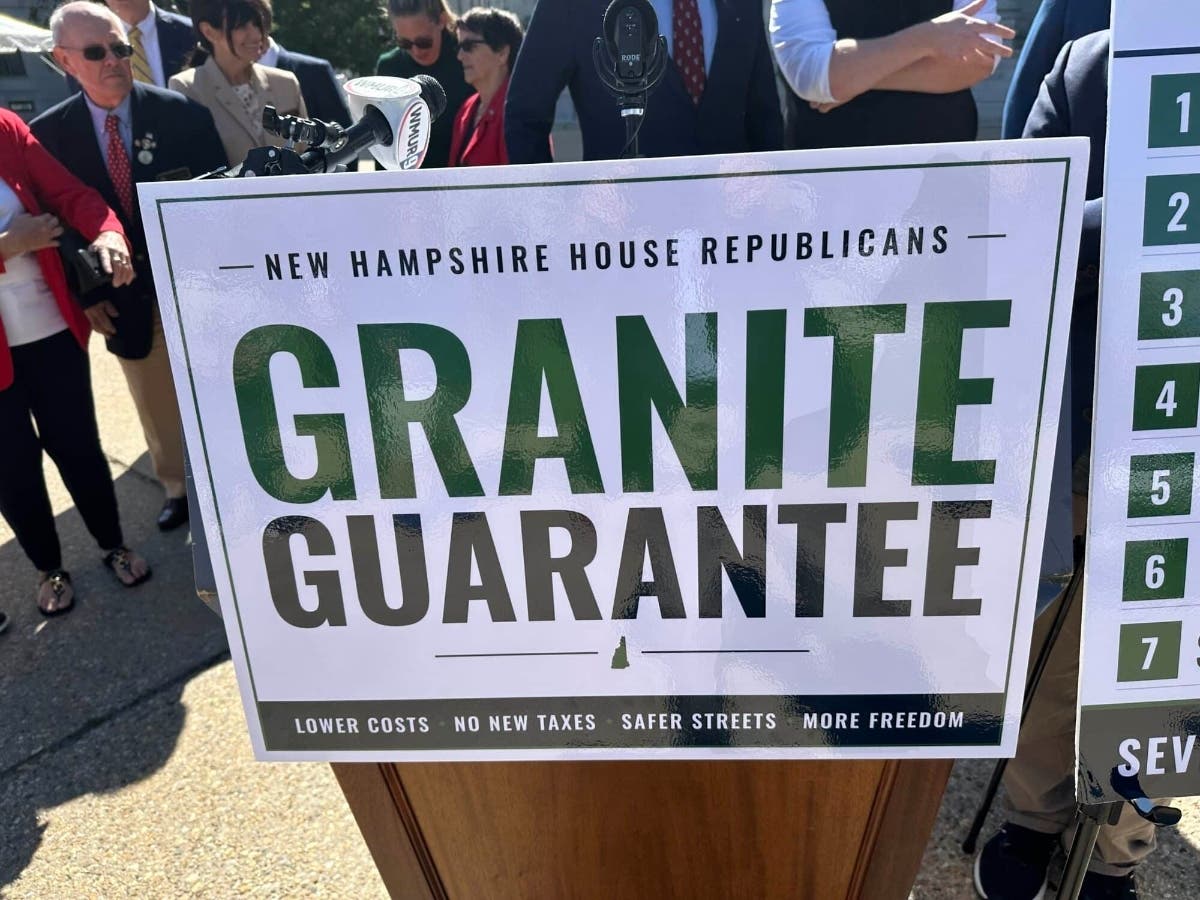
That’s how New Hampshire House Majority Leader Jason Osborne framed the November election at a press conference Monday, announcing his caucus’ “Granite Guarantee” to voters.
Find out what's happening in Concordfor free with the latest updates from Patch.
In their Granite Guarantee, House Republicans make seven promises:
- Ban an income tax — forever.
- Cap your property tax.
- Cut even more red tape.
- Lower energy bills.
- Lower health care costs.
- Parents decide.
- Support public safety.
“Seven promises. In writing,” the document declares.
Find out what's happening in Concordfor free with the latest updates from Patch.
It is a pared-down successor to the 10-point “Contract With New Hampshire” House Republicans used in the 2024 campaign to help them turn their razor-thin majority into a solid 222-178 advantage.
Critics have dismissed New Hampshire Republicans’ rhetoric about socialism as overblown, but Osborne pointed to the results of last week’s Democratic primaries to bolster his case.
 “We saw one out of three Democrats vote for an outright socialist for U.S. Senate,” Osborne said, a reference to Democratic Socialist of America candidate Karishma Manzur. “Socialism has taken over the Democratic Party. No different here in New Hampshire.”
Manzur won 50,000 votes challenging U.S. Rep. Chris Pappas in the Democratic primary, and she has still not endorsed him in the upcoming general election.
In response, House Republicans said they’re offering “common sense” proposals on taxes and affordability. Item one: preventing a future broad-based income or sales tax.
Earlier this year, GOP legislators twice tried to send voters a constitutional amendment prohibiting a state tax on personal income. Both efforts failed to win the legislative supermajority needed to place the question on the ballot, due to nearly unanimous opposition from Democrats.
And the Democratic nominee for governor, Cinde Warmington, has pointedly refused to support a sales or income tax ban — most recently on a WMUR appearance that aired Sunday.
Warmington insists she does not support an income tax.
“I do not believe a broad-based sales or income tax is the right way to go in our state.”
Osborne’s response: Taxpayers, grab your wallets.
“They’ll say out of one side of their mouth, ‘No income tax.’ They betray their true intentions,” Osborne said.
At Monday’s press conference, Deputy House Majority Leader Joe Sweeney (R-Salem) noted that a bill to create an income and sales tax has already been pre-filed by a House Democrat in advance of the 2027 legislative session.
“Democrats even filed a bill today for an income tax in New Hampshire that they are fully going to push through if they get control of the House and the Senate this year, which we cannot let happen,” Sweeney said.
The bill was filed by Rep. Ellen Read (D-Newmarket), a fringe member of the Democratic caucus who has been at the center of several recent State House controversies. Asked about the Republican response to her proposal, Read responded by mocking the GOP.
“They can build a bridge and get over it,” Read said, adding: “Sheesh, you’d think I put in a bill seceding from the Union or something,” a reference to legislation calling for New Hampshire to secede from the United States sponsored by seven GOP House members in 2022.
Republicans say the comparison doesn’t work because Democrats have overwhelmingly voted against legislation to ban or control future tax increases, including their opposition to the property-tax-cap question that will appear on local ballots in November under HB 1300, which Gov. Kelly Ayotte signed in July.
The law requires voters in every community to decide whether to limit increases in school spending and administrative costs to the inflation rate, with adjustments for new construction. The cap would take effect only in communities where it receives 60 percent support and could be overridden by the same margin.
The measure is facing a court challenge from opponents who argue the ballot question is confusing and misleading. Democrats and teachers unions also say the cap could harm public schools and that voters already have the power to impose local tax and spending limits.
Osborne said the November vote would give more Granite Staters a direct role in determining how quickly their school property taxes increase.
“There isn’t a mechanism for the voters to participate in their tax decisions, and we are providing at least a small mechanism for them to get involved,” Osborne said. “When they send us the message in November about their true feelings on property taxes, I think that will give us the fuel that we need in our fire to keep going.”
Sweeney said the affordability agenda would also include speeding up state and local permitting for housing, energy and infrastructure projects.
“We’re going to continue the work that we’ve done these last two years at cutting red tape in state government to make it easier to do business in the Granite State,” Sweeney said.
Rep. JD Bernardy (R-South Hampton), vice chairman of the House Science, Technology and Energy Committee, blamed New England’s high electricity prices on policies adopted by Massachusetts and other neighboring states. He said Republicans would promote natural gas and other reliable power sources while resisting regional net-zero mandates and the costs associated with offshore wind.
“That’s the goal of the Republican Party,” Bernardy said. “That’s what we’re going to continue to work for.”
Rep. Erica Layon (R-Derry) said the GOP’s health care agenda would focus on competition, patient choice and reducing government regulation.
“New Hampshire Republicans are going to make sure that we have more options where people can find a quality doctor at prices where they’re willing to pay and where they’re happy to work together to improve the health of Granite Staters,” Layon said.
Rep. Lisa Freeman (R-Tilton) delivered the caucus’s message on education.
“Republicans believe in parental rights because we believe any parent of a minor child knows what’s best for their child, especially around the issue of education,” Freeman said. “We believe in the parent, we believe in the family, and again, as House Republicans, we will continue to fight that fight.”
Rep. Jennifer Rhodes (R-Winchester) pledged that Republicans would prioritize crime victims and resist criminal justice policies imported from more progressive states.
“We are going to continue to put the victims in front of the perpetrators and keep New Hampshire safe,” Rhodes said.
Asked how House candidates would break through the political noise surrounding President Donald Trump and the nationally watched U.S. Senate race, Osborne said Republicans would take the Granite Guarantee directly to voters through door-knocking, television, online advertising and mail.
“The reason this list is here is because this is what the voters have told us that they want us to do,” Osborne said.
He also expressed confidence that the GOP’s statewide ticket — led by Ayotte and U.S. Senate nominee John E. Sununu — would help drive Republican turnout.
“We have probably the strongest top of the ticket that we’ve had since I’ve been old enough to pay attention,” Osborne said. “I think that turnout is going to be something we’ve never seen in a midterm before.”
For Osborne, the fundamental message is that New Hampshire voters face a choice between the state’s traditional low-tax approach and the policies of its Democratic-led neighbors.
“The choice is clear: common sense, (or) communism,” Osborne said. “We’re here with the guarantee, and we’re going to keep New Hampshire, New Hampshire.”
This story was originally published by the NH Journal, an online news publication dedicated to providing fair, unbiased reporting on, and analysis of, political news of interest to New Hampshire. For more stories from the NH Journal, visit NHJournal.com.