Politics & Government
Income Tax 'Shift' Or Tax Hike 2.0? Volinsky Makes His Case
Andy Volinsky says he's not proposing a tax increase; it's a shift — moving about $1B from the state's property tax burden to an income tax.

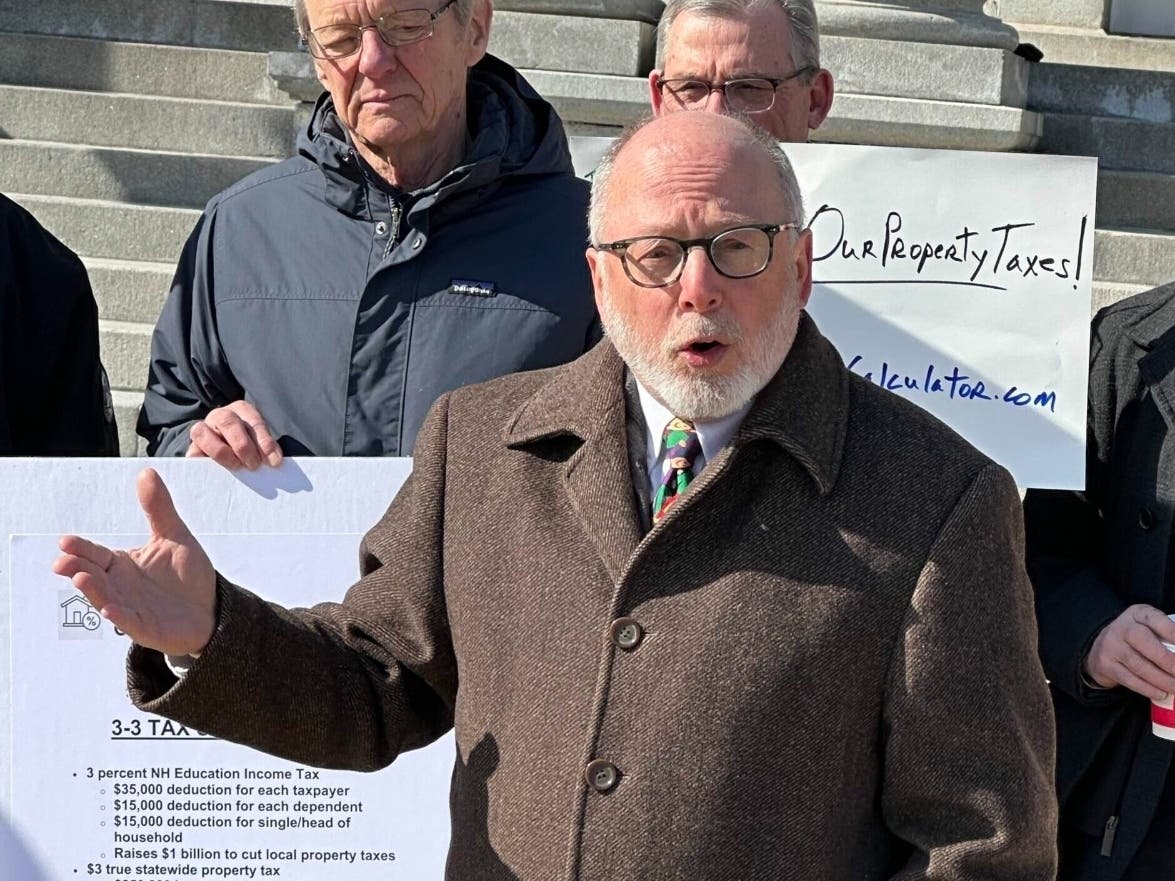
Andy Volinsky wants Granite State taxpayers to understand clearly that while he’s proposing a new income tax to fund state education spending, he is not proposing a tax increase. It’s a tax shift, moving about $1 billion from the state’s property tax burden to an income tax.
“It’s not designed to increase spending,” Volinsky told the NHJournal podcast.
Find out what's happening in Concordfor free with the latest updates from Patch.
Listen here: Podcast: Volinsky Wants An Income Tax And He's Here To Tell You Why.
He was less clear, however, on how it would stop property taxes from rising after an income tax was in place, potentially leading to a Connecticut-style situation in which New Hampshire has both an income tax and some of the highest property taxes in the nation.
Find out what's happening in Concordfor free with the latest updates from Patch.
Volinsky, a former executive councilor and Democratic candidate for governor, is part of an organization promoting the “3-3 Tax Savings Plan”: a 3 percent income tax and a $3 true state property tax with large deductions and a homestead exemption for homeowners and renters “to make the plan as progressive as possible to protect working class and middle class taxpayers,” as Volinsky puts it.
He argues the current system relies on an outdated measure of wealth.
“There was a time when property ownership was a fair estimate of your wealth… wealth is different now,” Volinsky said.
Asked about critics’ warnings that adding an income tax to lower property taxes would eventually lead to two taxes that are both too high, Volinsky did not offer a direct solution. Instead, he pointed to the problems facing New Hampshire due to high property taxes.
“First, how’s the current system working for you? We have over-reliance on the property tax such that people either can’t get into the housing market,” Volinsky said.
“Number two, I think we need to look up. And by that, I mean, look up at people with higher incomes. Are they contributing a similar share of their income through property or income taxes as you are?”
According to the Tax Foundation, New Hampshire has the fifth-highest effective property tax rate in the nation, and the issue is a top concern of Granite State voters. Republicans have attempted to address it by capping local governments’ ability to increase spending, but Volinsky rejects that approach.
“In the past couple of sessions, the Free State leadership in the legislature has tried harder and harder to cap local budgets for schools. Those efforts have been rejected at town meetings and SB 2 meetings, not because school administrators are demanding more money, but because people value their local schools.”
But if local town meetings can raise unlimited amounts through property taxes — on top of an income tax — doesn’t that mean higher taxes overall?
“If you want locals to be in charge despite money coming from the state, why would you tell them they can’t raise local money in addition?” Volinsky asked.
Volinsky acknowledged that his income tax proposal has not received a warm welcome inside his own party.
“I put forward an income tax. You may not agree (with it), but it’s a policy proposal,” Volinsky said.
“I think the leadership of both parties is failing us in all sorts of ways, but in particular by not being willing to have this discussion. If you ask Alexis Simpson, the highest-ranking Democrat in the House, her answer isn’t to have this discussion. Her answer is no,” he added.
“And the second-highest (ranking) person in the House, Laura Telerski, quoted (House GOP Leader) Jason Osborne when she said no. So they’re off the table as far as being open to a discussion of what fair taxation and equitable funding should be.”
Democratic gubernatorial front-runner Cinde Warmington has done the same, publicly rejecting any talk of an income tax. So would Volinsky consider entering the race, if only to give his “3-3” income tax plan a public hearing?
“To run for governor is a major undertaking that requires a level of commitment and walking away from other parts of your life. And at this point in my life, it’s not the right time to do that.”
This story was originally published by the NH Journal, an online news publication dedicated to providing fair, unbiased reporting on, and analysis of, political news of interest to New Hampshire. For more stories from the NH Journal, visit NHJournal.com.