Schools
Move To Hybrid Learning In Concord Schools Successful, So Far
COVID-19 impact in schools remains low despite increase in cases in the city and Merrimack County; attendance close to pre-pandemic levels.


CONCORD, NH — The Concord School District is in the middle of its second full week of hybrid learning, with students attending physical classes for at least two days, and while there have been some small bumps in the road, Kathleen Murphy, the interim superintendent for SAU 8, said it had been successful, so far.
Students in Concord began attending in-class classes at a limited level this month. The first week was left open for move-up day students for kindergarten and first graders in elementary school, sixth graders going to Rundlett Middle School, and ninth graders heading into Concord High School. The second week was the first full week of twice a week classes for all grades.
"It has gone really well," Murphy said. "The kids were excited to be back with their teachers and their friends — even if they weren't able to hold hands or anything."
Find out what's happening in Concordfor free with the latest updates from Patch.
The hybrid classes are two days of direct instruction and the other days are follow-up to the in-person instruction days with assignments and other work. Schools are cleaned in between. Most of the classes are "very small cohorts," about 10 students attending. This, she said, allows students to "make those connections" and "have some time with their teachers" — which is more conducive than fully remote learning.
In some classrooms at Rundlett and the high school, furniture had to be removed to implement the best social distancing possible. At the same time, with the small classes, if there are any infections, the outbreaks will be limited, Murphy said.
Find out what's happening in Concordfor free with the latest updates from Patch.
So far, attendance appears to be at or close to pre-COVID-19 pandemic levels, according to Murphy. Of the 1,720 elementary school students, about 95 percent have been attending classes, on average, which is about what it was for the 2018-2019, according to data from the New Hampshire Department of Education. About 93 percent of the 950 middle schoolers are attending classes which is close to the 2018-2019 data and 91 percent of the nearly 1,500 high schoolers are attending classes which is down about 2 percent.
About 83 percent of high school students have chosen to participate with in person learning while 82 percent of elementary school students are attending the two day a week classes. Only 77 percent of middle school students are currently in hybrid classes, Murphy said.
The hybrid classes appeared to be "helping parents get some hours into their work days" and while her focus is the education of students, the community's focus was multifaceted, Murphy said.
"We're all part of a much bigger picture here," she said.
Murphy said there have been some issues with parents and students not filling out information properly when the district began making plans to move hybrid classes. Principals, she said, were working through those problems.
After the surveys were filled out, administrators went to work to build a safe classroom setting. It was hard though to reverse course for more students based on what they initially planned. Some teachers are teaching remote while others have medical issues and maternity leave, too, which has thrown the district a curve ball. Teachers that are remote also have proctors physically in the classroom which allows for greater supervision but also greater costs.
Community Transmission In Concord, Merrimack County
On Tuesday, state public health officials moved Merrimack County from "moderate" to "substantial" based on 101.5 cases per 100,000 residents.
An outbreak at a long-term care facility in Warner during the past two weeks was a major reason for the change in transmission designation. The town, which has a population of around 3,000 people, had 44 active cases as of Tuesday.
But cases have also increased in Concord — from 5 to 9 cases two weeks ago to 36 cases on Tuesday. While that increase is small, still, it was a quadrupling or more of positive test results in a city which has been in single digits for many months.
The change in the designation of the level of community transmission in the county though does not automatically move Concord back to remote learning, according to Jake Leon, a public information officer for the New Hampshire Department of Health and Human Services.
The school transmission data guidelines are twofold: community transmission and level of school impact. Right now, he said, the county has increased due to the outbreak in Warner and community transmission increasing in Concord. But, Leon said, the level of school impact in Concord "remains low."
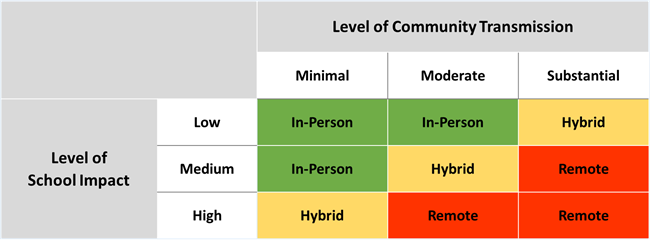
Public health officials are using this matrix as a guide for when schools should shift from various forms of learning. Credit: New Hampshire Department of Health and Human Services.
That low impact combined with a substantial county setting would still allow for hybrid learning, as noted in the chart.
If, however, school impact goes up to medium or high, with a substantial community transmission in the county, regardless of whether the cases were connected to Concord, all remote learning would kick in.
The health department did not release any specific information about the community spread in Concord, whether the 36 cases were connected to youth hockey, or anything else.
ALSO READ:
- Transitioning Between School Instructional Models
- School Officials In New Hampshire Seek More COVID-19 Money
- Concord 'Superheroes' Get Ready For The 2020-2021 School Year
- Concord Regional Technical Center Prepares For COVID-19 Learning
- Concord Schools Could Move To Hybrid Model By Late September
Currently, there is only one active case in a Concord school — at the Christa McAuliffe Elementary School. There are, however, teachers and students who were interacting with the student and they have been quarantined, as a precaution, Murphy said. She said it had been more than a week now for the quarantining of the elementary students and staffers and, so far, no new infections to report. A staffer tested positive and a band member also tested positive in September.
"I'm constantly monitoring the data," she said. "I check in with (health officials) twice a day. All the guidance documents are there for us to use."
Murphy said when she saw the numbers going up, it was a concern, especially in Concord, but the county numbers connected to the Warner facility have limited-to-no connection to the capital city.
"I am not ready to move to remote at this time; that's where I'm at today," she said. "But I don't want anyone to think that I'm not paying attention to the data. I am. We have safety protocols in place — the distancing, masks, it is safe environment with the youngsters. Is it ideal? Of course not. We want the kids in there five days a week, learning, with full days. But we can't do that. But it is worth it to have the kids in there (at least two days a week)."
Murphy said she understood the anxiety parents and educators may have but, so far, in Concord, it has been safe.
"If we have to return to remote, we will; but we can't pivot every other day," Murphy added. "But it isn't like a snow day; it's very complex on how we make decisions."
Even though the district appears to be handling the coronavirus in a responsible manner and there were limited positive test results in schools or student activities, it may not be so in the future. Murphy said she was worried about the holidays, families traveling, and gatherings.
"The district will be monitoring all of that information," she said.
Thanksgiving, which is one of the busiest travel seasons of the year, will probably be worse than Christmas or Hanukkah, when students are out of school for a longer period of time.
While none of this is ideal, educators, administrators, and others were doing everything they could to get the best education to students in Concord as possible, Murphy said.
"Given the circumstances," she said, "given the situation, at least our kids are getting some education. Some of it is independent; some of it is face-to-face. But sitting at home, five days a week … to me, that's not right. All of our work is worth it. I'm sure not everyone agrees with that."
But, the most important thing in the education business, beyond learning, student outcomes, and being with their friends and activities, "are those relationships between students and teachers," that they can only get in a classroom, Murphy said.
Got a news tip? Send it to tony.schinella@patch.com. View videos on Tony Schinella's YouTube channel.
Get more local news delivered straight to your inbox. Sign up for free Patch newsletters and alerts.