Crime & Safety
NH Fire Marshal, Sprinkler Association Urge Holiday Fire Safety
Watch: Officials promote smoke detectors, sprinklers, and say certain types of fake Christmas trees are just as flammable as dry real trees.




CONCORD, NH — Fire safety officials, including New Hampshire's state fire marshal and a regional manager for a national sprinkler association, are urging residents to protect themselves from fire dangers this holiday season.
While most people understand real Christmas trees need to be watered regularly in order to not catch fire by heating elements, broken lights, or electrical wiring, fake trees, too, can be flammable and just as much of a danger. During an exercise at the state fire academy in Concord Wednesday, state Fire Marshal Paul Parisi and David LaFond of the National Fire Sprinkler Association showed just how hazardous fake trees can be — especially if they have not been approved by Underwriters Laboratories. Even fire-retardant furniture can go up in flames quickly in the right setting.
"Trees tend to burn fairly rapidly," Parisi said. "And we want to stress the importance of some holiday safety tips during this demonstration."
Find out what's happening in Concordfor free with the latest updates from Patch.
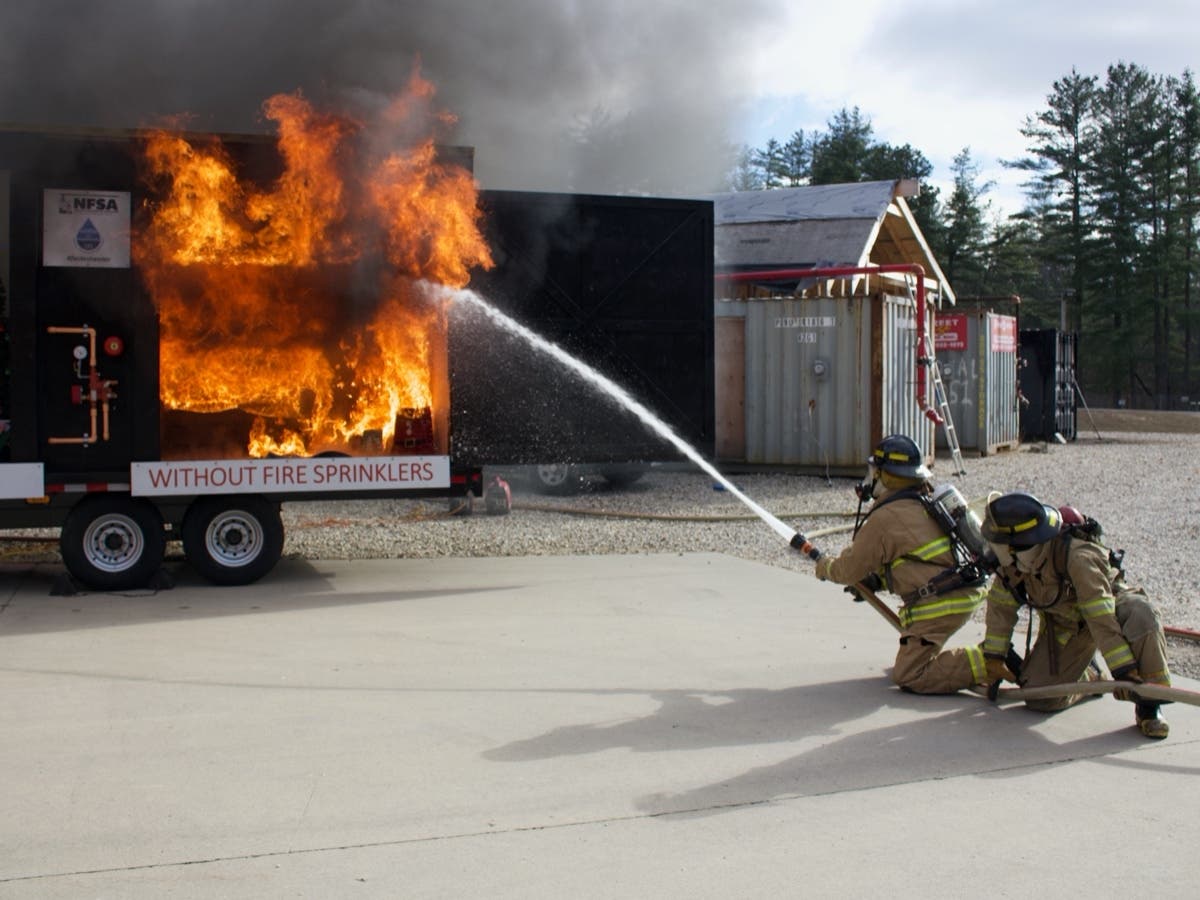
During the demonstration, two mock living rooms were set up with the same fake tree, decorations, a couch, presents, and a newspaper on the floor that caught on fire from a heating element. One of the rooms had a fire sprinkler and the other did not.
In the room without the sprinkler, the newspaper was set ablaze and smoke alarms quickly went off, within about five seconds. The fire quickly caught onto drapes and the tree and then spread to the wall and under the couch.
Find out what's happening in Concordfor free with the latest updates from Patch.
LaFond offered commentary as the flames became engulfed in the room without the sprinkler, offering a rough idea of what the temperature was in the room, and how, if there were residents, they only had a few minutes to get out before the fire grew so hot that it would become fatal.
"We're now about 1,400 degrees at the ceiling," he said, as the fire and smoke bellowed from the mock room. "We've reach flashover. Nobody can survive flashover."
In less than four minutes, the room was engulfed in flames and after being doused, showed heavy damage. Fire response times differ in the state — with the National Fire Protection Association suggesting around five minutes and 20 seconds as an ideal response time. After eyeing the three minutes and 50 second time for the first fire, LaFond remarked, "Most likely, the fire department hasn't responded yet … you need to do something in that time. You have to get out of your home."
The second demonstration, featuring a mock living room with a fire sprinkler, had some technical glitches — the fire did not catch as quickly and the sprinkler did not go off right away. But even with those issues, after two minutes and 20 seconds, the sprinkler activated and then, quickly flooded the flames.
"It flows at about 13 gallons per minute of water," LaFond said.
LaFond said the difference between the two post-fire settings was noticeable — the damage done in the room without the sprinkler could take months to fix and even require rebuilding whereas with the room with the sprinkler, the home would still be fairly livable.
"You can really see the difference in the damage," Parisi said.
Parisi also stressed the need for smoke alarms to be installed in every home adding there had been 10 fire fatalities in New Hampshire in 2020 and, in every instance, the homes did not have working smoke detectors.
"It's something we need to do better at in our state," he said.
Parisi said he did not know how many homes in New Hampshire had sprinkler systems. The state does not require them in one- or two-family unit buildings although, "we encourage it," he said. Buildings with three or more units must have them, Parisi said.
The added cost of sprinklers in new homes is about $1.35 per square feet nationwide or around 1 to 2 percent of added home costs. It is a little bit higher in the Northeast, LaFond added. Some savings can be found with home insurance costs though — fees are 20 percent less with homes that have sprinklers. Some homes in rural areas require small tanks to hold the water but most can use municipal water or wells.
Got a news tip? Send it to tony.schinella@patch.com. View videos on Tony Schinella's YouTube.com channel or Rumble.com channel.
Get more local news delivered straight to your inbox. Sign up for free Patch newsletters and alerts.