Politics & Government
At NH Forum, Granite Staters Try To Turn Civil Talk Into State Policy
Wednesday's roughly 50-person event, at the Bank of NH Stage in Concord, drew a politically balanced mix of Granite Staters.

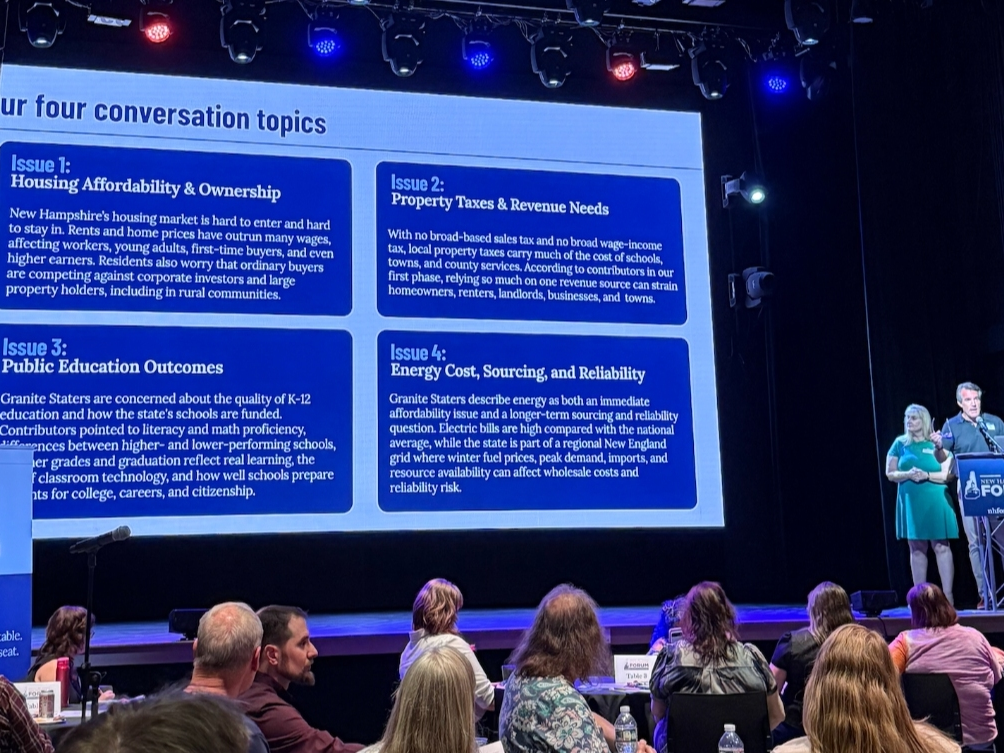
Reinstate the state’s interest and dividends income tax. Remove electronics from classrooms. Prioritize real estate developers with deep community ties. Allow homeowners with solar-plus-battery setups to become small-scale power generators.
Those were just a few of the proposals generated Wednesday night at the first New Hampshire Forum “Community Conversation” at the Bank of NH Stage at the Capitol Center for the Arts in Concord.
Find out what's happening in Concordfor free with the latest updates from Patch.
The gathering was part of a statewide, nonpartisan initiative launched in April by actor, entrepreneur, and civic activist Andrew Shue, best known to many Americans as a star of the 1990s television show “Melrose Place.” Shue is also the co-founder of DoSomething.org, a youth civic action organization, and the board president of The People, a nonprofit promoting citizen-driven democracy and cross-partisan problem-solving.
Find out what's happening in Concordfor free with the latest updates from Patch.
“We have elected leaders from both sides, who have shown up for this idea,” Shue said at a Concord press conference in April. “We have partisans who have been traditionally just battling each other, now putting down their arms and saying, ‘We want to work differently. We have been divided for too long.’”
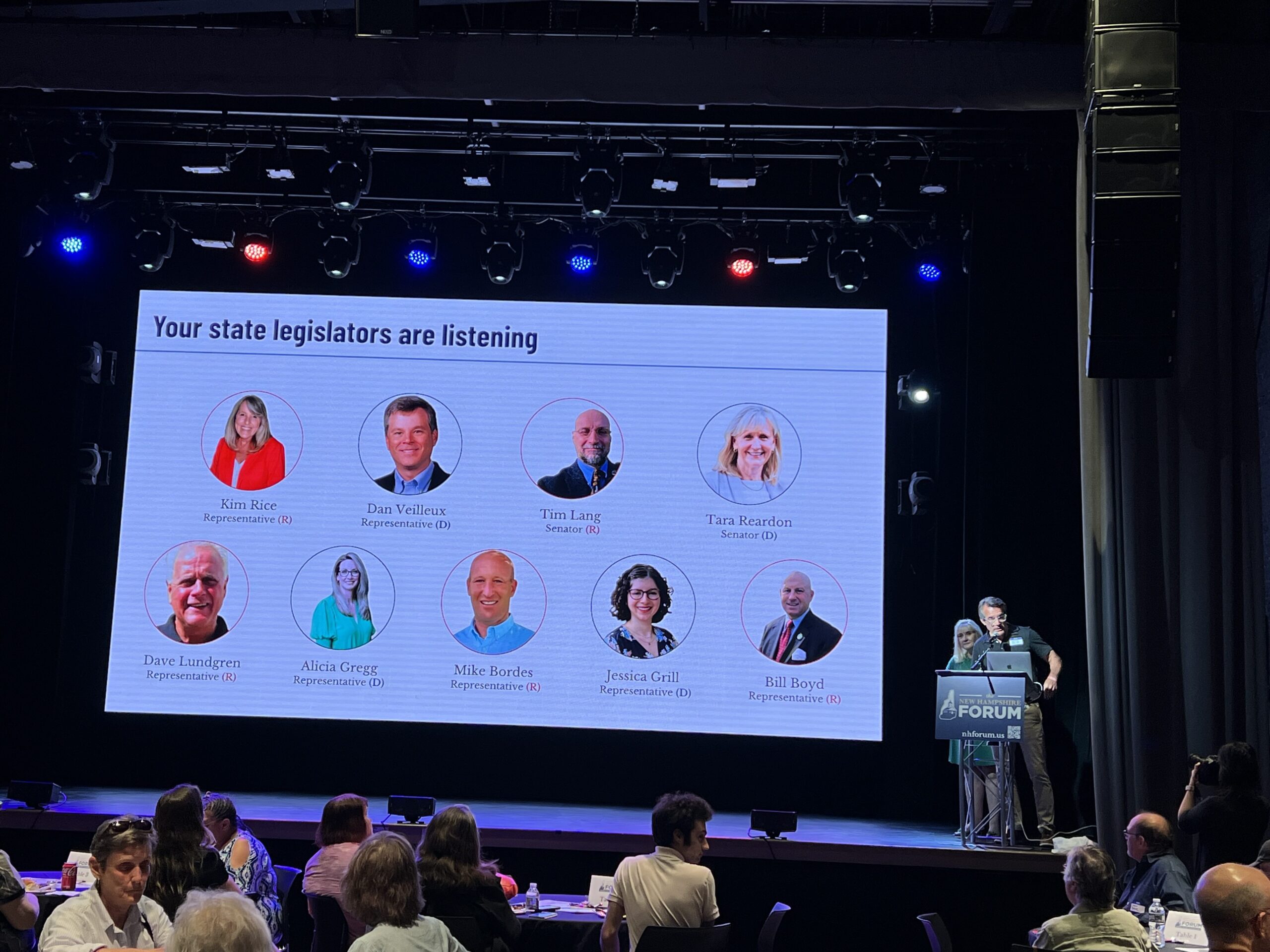
Wednesday’s roughly 50-person event drew a politically balanced mix of Granite Staters, including Democratic Executive Councilor Karen Liot Hill and state Rep. Mary Murphy (R-Francestown).
Shue has framed The Forum not as a political campaign, but as civic infrastructure, a way to get everyday citizens back into the process of shaping public policy before elected officials in Concord make the final decisions.
The goal is ambitious: Gather ideas from Granite Staters across the political spectrum, identify proposals with broad public support, refine them through a citizens assembly this fall, and ultimately turn at least one of them into legislation for the 2027 session of the New Hampshire General Court.
Wednesday’s gathering featured small-group discussions on topics including housing, property taxes, education and energy. Each table was divided among Democrats, Republicans and independents, with a facilitator assigned to keep the conversation focused, record the discussion and present at least three proposals that earned broad agreement among participants.
For many attendees, the surprise was not the disagreement, but how much agreement emerged once partisan labels were set aside.
“There was really just broad consensus that not only does there need to be change, but that we want stable change,” Zachary Taylor, a Concord resident who identifies as center-left, told NHJournal. “We want to see fewer reductions in tax revenue streams. This sort of change could be very easy if people just spoke up as opposed to letting the politics control what happens.”
A hallmark of the Forum model is what organizers describe as a bipartisan, “Noah’s Ark” approach: Every state-level effort is led by co-chairs from both parties.
In New Hampshire, the effort is led by Kevin Smith, the former Londonderry town manager and 2022 Republican U.S. Senate candidate, and former Democratic state Senate leader Donna Soucy of Manchester.
“This evening demonstrated that people are eager for opportunities to come together, listen to one another, and engage thoughtfully on the issues affecting their communities,” said Soucy. “When residents have the chance to move beyond talking points and share their lived experiences, they often discover more common ground than they expected.”
Murphy, who serves on the House Ways and Means Committee, said she used the discussion to pitch what she called “New Hampshire Advantage 2.0.”
“It involves creating a three-prong strategy that would increase business profitability,” Murphy said. “The final thing is to establish a specialized business court that we could use to attract incorporation fees to the state, similar to what Delaware does.”
“Delaware lost $33.6 billion because they made some mistakes in terms of how they’re running their courts, and so it’s an opportunity for New Hampshire,” Murphy added.
Though Wednesday night’s attendees were evenly split politically by design, they leaned slightly left in a straw poll in which they responded to a series of right-left framed statements on key issues. Left-leaning positions such as new taxes, including an income tax to offset rising property tax costs, increased investment in green energy, and housing subsidies were popular, while expanding school choice was viewed skeptically.
But the proposals that emerged from the small-group discussions did not map neatly onto the political spectrum. Some sought to reduce tax disparities among towns. Others would increase the number of classroom support staff, require more transparency from utility providers, and study New Hampshire’s tax competitiveness compared to other New England states.
The Forum is the latest New Hampshire project backed by Shue and The People. In 2024, the related New Hampshire Together initiative convened a citizens’ assembly focused on election confidence, polarization, and government responsiveness. That effort helped produce proposed legislation on a single presidential primary ballot, though the bill did not survive the legislative process.
That history gives the New Hampshire Forum both a model and a test: Can a citizen-driven, bipartisan process produce proposals lawmakers are willing to take seriously?
Organizers say the current effort began with online issue collection from Granite Staters, followed by voting to narrow the list to topics with broad appeal. The top issues included housing, property taxes, education funding and energy costs, all of which were reflected in Wednesday’s discussions.
Over the next few weeks, seven additional “Community Conversations” are scheduled to take place online ahead of the New Hampshire Forum’s Civic Assembly, set for Sept. 25-27 in Concord. Delegates to the assembly will be chosen by lottery and asked to approve a set of proposals generated from the community conversations.
Those proposals will then be carried to state lawmakers for possible introduction in the 2027 legislative session.
As for Wednesday night’s gathering, Smith recounted a comment from a woman he met that summed up the event.
“Even though we all knew we were sitting across from folks on different sides of the political spectrum, we talked and debated not as Republicans and Democrats, but as Granite Staters, each wanting the best for our fellow citizens.”
This story was originally published by the NH Journal, an online news publication dedicated to providing fair, unbiased reporting on, and analysis of, political news of interest to New Hampshire. For more stories from the NH Journal, visit NHJournal.com.