Neighbor News
Rep. Deborah Aylward: Wow! What a Day in Concord and Beyond. . .
Session Notes; Special Bible; Speaker Packard; House Bills; Danbury school building; Town Asset Tracking

March 26th SESSION NOTES
Sent back to the House by the Finance Committee:
1. The House voted Ought-to-Pass on HB112-FN, 191-157, requiring students in the university and community college systems of New Hampshire to pass the United States Citizenship and Immigration Services civics naturalization test, take a course that covers fundamental American documents as part of the general education curriculum, or pass a civics course competency test. The bill, with fiscal note, originally passed the House on a roll-call vote of 192-158 with 98.45% Republican support.
2. Voted Ought-to-Pass w/amendment, 194-156, HB 1130 is relative to judicial performance evaluations. It originally passed the House with 99.46% Republican support. The bill revises the process for the evaluation of judicial officers, and deletes ‘case processing’ as a criterion.
Note: Numerous GOP reps have taken a 'dim view' of judicial performance over the years, especially when it comes to family law judges.
Find out what's happening in Concordfor free with the latest updates from Patch.
A BLESSED SESSION
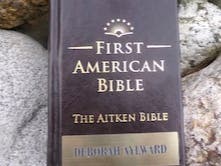
At the Thursday, March 26th House Session, members of the Granite State Baptist Church were on hand to present and distribute beautiful, personalized ‘First American Bibles’ to all State Representatives, with each bible having a metal, gold-colored name plate attached (see photo above). The bible was first brought back into print by the Aitken Bible Historical Foundation. The church group displayed the original, 1782 bible which was housed in a lit, plexiglass case.
Titled ‘The Aitken Bible’, it is the only bible approved by Congress; recommended to Americans; the first King James Bible made in America; the first English Bible made for schools, and is the Bible of the American Revolution. The bible was printed only six years after the Declaration of Independence and five years before the Constitution of the United States. It is written in Old English, with the letter ‘F’ used instead of an ’S’.
Find out what's happening in Concordfor free with the latest updates from Patch.
SPEAKER ON THE MEND
After a bad fall, and having to miss a couple of sessions, the Speaker of the House, Sherman Packard briefly appeared to address representatives on March 26th to express his gratitude for the well-wishes while recuperating.
Citizen Commentary, by Deborah Aylward
The Future of the Danbury Elementary School Building
With the advent of Danbury Elementary School closure by the school district, a sharp reversal of a previous decision made by the board, a meeting of parents, organizers, and interested parties was held on Thursday, March 26th, at the Grange Hall to discuss formation of a charter school.
Though a virtual meeting between the Dept. of Education, Sen. Innis, and District 5 Reps to discuss possible attendance by a department representative was scheduled beforehand, the meeting was canceled at the last minute.
However, in attendance, was Mr. Clayton Wood, who recently founded such a school, and who came at the request of Alvin See, both being state representatives. Mr. Wood sits behind me in Representatives Hall and is a proverbial, walking-talking encyclopedia on charter schools. Also in attendance was Sen. Innis and Louise Andrus, who, according to Wood, remained relatively quiet.He stated that he was ‘proud’ to have been included.
During Session held earlier the same day, Wood opined, that after research, he thought the school had been ‘teacher heavy’, for what its worth.
According to Wood, there were approximately 50-60 parties in attendance. This aligns slightly less with the number of pupils enrolled. He stated he was impressed with the organizers, and the astute questions asked by attendees. In his opinion, the most important thing that needs to be accomplished by the group, is to “lock down the school”, meaning acquiring the building for its purposes.
But wait! There may be two or more sides to this coin. There should not be an ‘assumption’ that the Town is going to automatically give the building away, or lease it out for charter school purposes. According to Wood, if the Town decides it is not going to use the building for Town purposes, a charter school has first right of refusal.
So my questions are: To be fair to taxpayers, should the Town consider keeping the building and using it for Town purposes? Or, could not the Town ‘own and operate’ the school as its own School Administrative Unit (SAU)? Take the Town of Hill, for example. It is a single-town school district, AND its own administrative unit (SAU), grades pre-K-6th grade. Or, lease the building for charter purposes, and perhaps also lease space for after school or private day care thus generating revenue for the Town?
However, reusing an existing public building for public purposes may:
--Reduce long-term capital costs
--Avoid future bonding for new municipal facilities
--Improve efficiency of town operations
The building becomes a public asset owned by the taxpayers of Danbury, and no decisions have been made about its future use. Any future use—whether municipal, educational, both or otherwise—must go through a transparent public process and reflect the best interests of the town.
Voters must ultimately decide on the building’s 'highest and best use'.
There are several potential uses worth exploring, including consolidating town offices, housing the police department, providing space for department heads, and creating a suitable venue for Deliberative Sessions and other public meetings. Depending on space and feasibility, portions of the building could also support educational purposes.
And here’s a radical idea, why not convert the building into the Town’s Safety Center? Gut part of it, raise the roof and voila! you have a firehouse. Create a sally port to the rear for the police department, and use left over open space for Deliberative Sessions, and as a polling place. This, as opposed to building from the ground up, the cost of which voters have twice rejected.
No single proposal—charter or otherwise—will move forward without full public review, cost analysis, and voter input where required. Taxpayers need to demand transparency from local officials, and keep an eye on the property tax impact of any proposal.
This is an opportunity for thoughtful, fiscally responsible planning—not a predetermined outcome. Residents will have a voice in that process. Given past warrant articles asking voters to approve multi-million dollar bonds for municipal building projects, such demonstrates a need for more space. Use of the building for Town purposes, could save taxpayers millions in the future --and must be explored.
I believe it would be prudent and fiscally responsible to retain the services of an independent party experienced in municipal planning to objectively analyze all the possibilities and report the results to the Select board for informed decision making, with minutes of Select board meetings properly reflecting 'discussion' regarding this matter going forward —- to assure transparency.
If the Town Doesn’t Track It, Does the Town Really Own It?
Speaking of Town of Danbury assets, the last time I checked—about a couple of years ago—neither the Road nor Fire Departments maintained an inventory of Town assets in their possession. This gives rise to the question of whether or not all other departments and offices maintain such an inventory, and if not -- if government doesn’t know what it owns, how can it responsibly manage taxpayer dollars?
The below, petitioned warrant article ensures that the Town of Danbury maintains a clear, accurate record of the equipment and assets purchased with taxpayer funds. It appropriates a modest amount for inventory software, that is likely easier to use than spreadsheets for non-technical users. Without a standardized inventory, there is no reliable way to know what the Town owns, where it is, what condition it is in, or when it should be repaired or replaced.
For Better Budgeting & Capital Planning, Maintaining Inventories:
Prevents:
--Duplicate purchases
--Emergency replacements
--Guesswork during budget season
Enables:
--Planned equipment replacement cycles
--More accurate capital improvement planning
Every private business—large or small—maintains an inventory of its assets.They do this to control costs, prevent loss, plan for replacement, and ensure accountability.
Town government should meet at least that same basic standard when managing taxpayer-funded property. This is not about mistrust—it is about basic stewardship, transparency, and responsible planning. This assures budget decisions are based on FACTS, not MEMORY and "We need this" requests are not made without verification.
2027 DRAFT ARTICLE: TOWN-WIDE ASSET INVENTORY SYSTEM
Shall the Town vote to require all Town departments, boards, and offices to create and maintain a complete, itemized inventory of all town-owned equipment, vehicles, tools, furnishings, and capital assets under their custody or control having an individual value of $500.00 or more, which shall also include all powered equipment, and electronic devices, regardless of value; and to appropriate the sum of $3,000.00 for the purchase and/or subscription of inventory management software or systems to support this requirement?
Such inventory shall include, at a minimum:
--Description of each asset
--Date of acquisition
--Purchase price or estimated value
--Funding source (e.g., tax appropriation, grant, donation)
--Serial number or identifying information, where applicable
--Physical location or assigned department
--Maintenance and repair history, where applicable
--Disposition, transfer, or replacement information, if applicable
This article shall take effect upon passage. Each department, board, and office shall complete and submit its initial inventory to the Selectboard or its designee no later than October 1, 2027 or such earlier date as may be established by the Selectboard in advance of the Town’s annual budget development process. Thereafter, inventories shall be updated and submitted annually by October 1. Consumable supplies and incidental items, such as office supplies, shall be excluded. The Town shall maintain a consolidated inventory record, which shall be made available for public inspection in accordance with RSA 91-A, including publication and archiving on the Town website. No Town department shall dispose of, transfer, or replace any asset unless it has been recorded in the inventory. Departments not in compliance shall not expend funds for purchases of $500.00 or more until compliance is achieved. Any unexpended funds shall lapse to the general fund at the end of the fiscal year.
Thanks for reading!
Deborah Aylward is a Danbury resident, and serves as a State Representative (Merr. District 5). She can be contacted at Deborah.Aylward@gc.nh.gov