Politics & Government
'Leaving Money On The Table'? Hampton Liquor Store Deal Draws Scrutiny From Portsmouth State Senator
Sen. Rebecca Perkins Kwoka wonders why the rent payment in the proposal is so low compared to the rent revenue of the Hooksett properties.

The rent is too damn … low?
During a committee hearing Monday on the proposed 35-year redevelopment deal for the Interstate 95 liquor store and service center properties in Hampton, Sen. Rebecca Perkins Kwoka, D-Portsmouth, asked a key question: Why is the rent payment in the proposal so low compared to the rent revenue from the Hooksett service area?
Find out what's happening in Hampton-North Hamptonfor free with the latest updates from Patch.
The proposal from Manchester developer Dick Anagnost and Massachusetts-based Global Partners includes approximately $33 million in guaranteed minimum base rent.
The legislature’s Long Range Capital Planning and Utilization Committee unanimously approved moving the proposal forward. A final agreement requires approval from Gov. Kelly Ayotte and the Executive Council.
Find out what's happening in Hampton-North Hamptonfor free with the latest updates from Patch.
For Perkins Kwoka, the proposed return raises questions about how Hampton compares with the Common Man-operated welcome centers on Interstate 93 in Hooksett.
“The rent here seems to be pretty different than the Hooksett location,” she said. “Over the term of the lease there, it looks like we are looking at closer to $90 million, which is about twice the estimated total revenue at this location.
“It seems like the state might be leaving a little bit of revenue on the table,” she added.
The commission’s presentation projects $994,000 in first-year lease revenue: $550,000 in base rent, $400,000 from fuel sales and $44,000 from electric vehicle charging. That total would rise to approximately $1.063 million in year five as base rent increases 3% annually.
By comparison, Hooksett’s actual rental payments have exceeded $2 million annually, the Union Leader reported.
Ken Currier, principal at C-Store Investments and president of Atlantic Valuation Consultants, said Hooksett’s operating history provides a useful benchmark that wasn’t available when the project’s original rent was negotiated. His appraisal business specializes in gas stations, convenience stores and car washes.
Currier said Hampton also benefits from higher traffic counts, making Perkins Kwoka’s question worth asking.
“That’s a good question she asked, because in this situation, the state has got an excellent property, and it can manage that rent. But you only get to bite the apple once here, and you want to make sure that you get the (guarantee) right.”
And there’s another reason to give the current proposal a second look, Currier said.
“You have the performance at Hooksett to use for comparison. When they originally set the base rent, nothing was built there.” Now, he says, the state has more concrete data.
State officials defended Hampton’s guaranteed minimum, noting that its approximately $33 million over 35 years exceeds Hooksett’s $23 million guarantee.
“This is $33 million. So, I do believe the guaranteed minimum is higher than in Hooksett,” Matthew Broadhead, an attorney with the state Department of Justice, told the committee, according to the newspaper.
But guaranteed rent and total rental income are different measures. Additional payments tied to sales can substantially increase the state’s return.
The Hampton presentation specifies fuel rent of 5 cents per gallon and a 5% share of EV charging revenue. It also describes a proposed tiered percentage rent based on gross sales, fuel, and EV charging that “will be considered during the negotiation of the 35-year Ground Lease Contract.”
The presentation provides neither the rates nor projected proceeds from that additional provision. It also says the state would reimburse the developer up to $26.83 million for construction of the two new liquor stores.
Common Man Roadside, operating as Seacoast Welcome Center LLC, sued the Liquor Commission after being disqualified over financing. According to the Union Leader’s account of court documents, the commission did not evaluate the company’s financial bid after it failed the initial qualifications review.
Common Man had qualified during an earlier procurement, which the state canceled after identifying a procedural deficiency. The company is challenging its exclusion from the restarted process.
Merrimack County Superior Court Judge Martin Honigberg denied its request to temporarily halt the procurement. Common Man has sought reconsideration, while the commission has moved to dismiss the lawsuit. The denial of preliminary relief did not resolve the entire case.
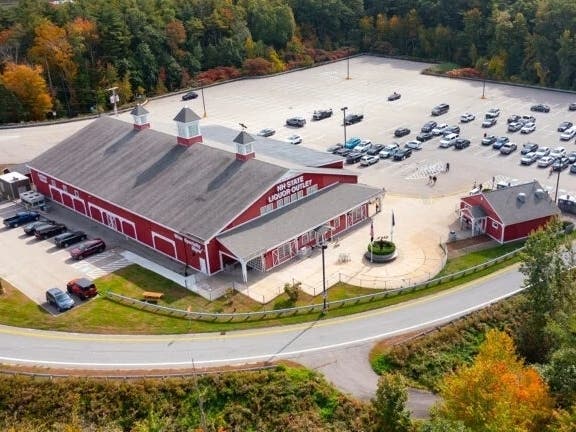
The redevelopment would replace the two Hampton outlets with buildings containing liquor stores, dining, convenience retail, and visitor amenities. Ayotte previously halted a proposed land sale in favor of keeping the properties under state ownership.
As the Hampton agreement moves toward Ayotte and the Executive Council, the unresolved percentage-rent terms will help determine how much the state ultimately receives — and whether the higher guaranteed minimum translates into a competitive overall return.
Currier said the traveler experience also matters, pointing to Massachusetts friends who appreciate Hooksett’s New Hampshire character on trips to the Lakes Region.
“Hooksett is so different from the places on the Mass Pike. They’re just gas stations. Hooksett is something special, and people do appreciate that hometown feel.”
XFacebookLinkedInCopy LinkEmailShare
This story was originally published by the NH Journal, an online news publication dedicated to providing fair, unbiased reporting on, and analysis of, political news of interest to New Hampshire. For more stories from the NH Journal, visit NHJournal.com.