Politics & Government
Why Was Common Man Disqualified From I-95 Liquor Project?
Common Man Roadside is taking the New Hampshire Liquor Commission to court over its exclusion from the Hampton project.

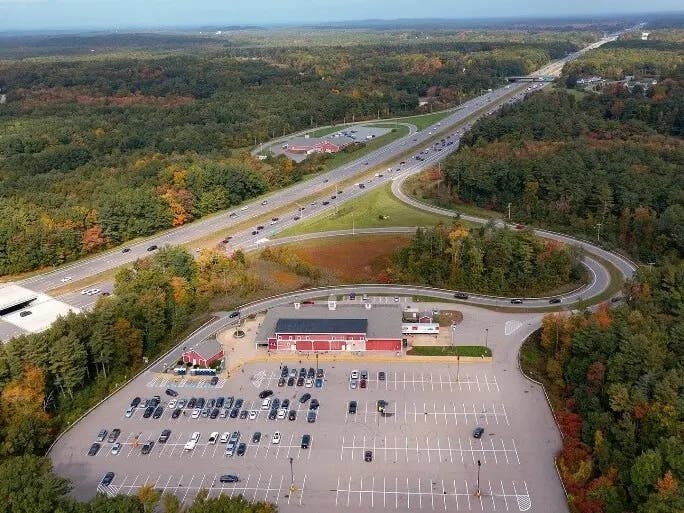
The Common Man restaurants are part of the New Hampshire landscape, a local dining institution.
So why was Common Man disqualified from competing for the I-95 Hampton welcome center project?
Find out what's happening in Hampton-North Hamptonfor free with the latest updates from Patch.
Just a few months ago, Common Man Roadside (CMR), operator of the popular northbound and southbound welcome centers in Hooksett, was deemed qualified to compete for the state’s massive Interstate 95 liquor-store redevelopment project. But now it has been disqualified under nearly identical requirements — and the public has not been told why.
Now, CMR is taking the New Hampshire Liquor Commission to court over its exclusion from the Hampton project.
Find out what's happening in Hampton-North Hamptonfor free with the latest updates from Patch.
The company’s legal entity, Seacoast Welcome Center LLC, is seeking a temporary restraining order and preliminary injunction preventing the commission from moving forward with the procurement. A hearing is scheduled for Tuesday in Merrimack County Superior Court.
At issue is the commission’s plan to lease approximately 88 acres surrounding the northbound and southbound state liquor stores on I-95. The successful developer would build and operate new travel plazas featuring twin 22,000-square-foot liquor stores, restaurants, fuel pumps and other amenities.
The two bidders are Common Man Roadside and a team consisting of Manchester developer Dick Anagnost and Massachusetts-based Global Partners, operator of the Alltown and Alltown Fresh convenience-store brands.
Just months ago, Common Man was considered qualified under essentially the same request for proposals and advanced to the final round, where bidders made oral presentations. That procurement was abruptly canceled in April after the state Department of Justice identified an unspecified “procedural deficiency” that “affected the review of all submissions.”
The Liquor Commission issued a replacement request for proposals in May. This time, however, Common Man was disqualified before the oral presentation stage. Only the Anagnost-Global Partners team advanced to final consideration.
Neither the commission nor the publicly available court documents explain what changed.
“There are real questions around how a business applying to contract with the state of New Hampshire can be ‘qualified’ to advance for consideration in one moment, only to be ‘disqualified’ under identical requirements a few months later,” said George Bald, a former commissioner of the state Department of Resources and Economic Development.
“Transparency and consistency must be at the center of these competitive bids,” Bald added. “The citizens of our state demand clarity and assurances that there is nothing inappropriate happening behind the scenes of this process. I hope there can be a quick resolution.”
The Liquor Commission said it received two proposals and selected one bidder for an oral presentation following what it described as a “comprehensive review process by the Selection Committee and aided by experts in complex transportation projects, consulting, auditing, legal and accounting.”
It has not identified that bidder, though Common Man’s disqualification leaves the Anagnost-Global Partners team as the apparent finalist.
“The RFP process is still ongoing, and by law, we cannot share additional details about the RFP participants at this time,” the commission said.
The commission has cited RSA 21-G:37, which allows it to withhold bidders’ proposals and scoring information until the procurement is completed. The scores would become public if a ground-lease contract is signed and submitted to Gov. Kelly Ayotte and the Executive Council for approval.
That leaves the public — and apparently state officials outside the Liquor Commission — waiting for an explanation of how Common Man went from finalist to disqualified bidder.
John Nyhan, president of the Hampton Area Chamber of Commerce and chairman of the New Hampshire Association of Chamber of Commerce Executives, said the process should be transparent.
“I think, to be fair, it really needs to be transparent on how they reached the decision of Global Partners versus Common Man,” Nyhan told NHJournal. “I think they are deserving of knowing what happened.”
Nyhan has supported Common Man’s proposal since the company first pursued the Hampton project. He said Common Man was the only bidder that contacted local business leaders before developing its plans and asked what they wanted to see in the architecture, amenities and overall design.
“Basically, they sent in almost the exact same application as the previous RFP, and they were not disqualified,” Nyhan said. “So how can one proposal in one bid process be OK, and then the other [be] disqualified?”
Nyhan said he hopes the lawsuit results in the commission reconsidering the decision or restarting the process with clearer and more consistent standards.
Common Man is seeking relief through a writ of certiorari, which allows a judge to review an administrative agency’s decision. According to the complaint, the court must determine whether the Liquor Commission “acted illegally with respect to jurisdiction, authority or observance of the law, or unsustainably exercised its discretion or acted arbitrarily, unreasonably or capriciously.”
The lack of publicly available information is particularly striking because this is not the project’s first troubled procurement.
The state began exploring redevelopment of the Hampton properties several years ago. Under the original plan, the land would have been sold to a private developer for an estimated $15 million.
Ayotte stopped that proposed sale and directed the Liquor Commission to pursue a public-private partnership under which New Hampshire would retain ownership of the land. The arrangement would resemble the Hooksett welcome centers operated by Common Man Roadside.
“One of the things I love about the way we have done the rest areas in New Hampshire is that it is a very New Hampshire solution,” Ayotte said in October 2025. “You go into the rest area, and you can tell you are promoting New Hampshire.”
The Hampton ground lease would run for 35 years, with two five-year extensions available at the state’s discretion. Any final agreement must be approved by Ayotte and the Executive Council.
The bid specifications call for a “vibrant, first-class and thoughtful New Hampshire-centric development.”
Common Man points to its decade operating the Hooksett welcome centers as evidence that it can deliver that experience.
“The Hooksett Welcome Centers on I-93 are proof of our concept, where we have spent 10 years showcasing the best of New Hampshire — local vendors, local products, local character,” Pernaw previously told NHJournal.
Global Partners says it has deep ties to the Granite State despite being headquartered in Massachusetts. The company says it owns, operates or supplies 92 retail locations in New Hampshire. Its development partner, Anagnost, has developed 13 state Liquor & Wine Outlets.
The Massachusetts company is familiar with challenging government procurement decisions. Last year, Global Partners sued the Massachusetts Department of Transportation after losing a competition for a 35-year lease to redevelop and operate 18 Massachusetts service plazas.
Global alleged that the Massachusetts procurement “was fatally compromised” by improper communications, conflicts of interest and violations of state procurement and ethics laws.
“We filed this lawsuit because the public deserves a fair, transparent process, not a backroom deal riddled with conflicts of interest where people win by not playing by the rules,” Global Partners CEO Eric Slifka said at the time.
The winning bidder subsequently withdrew, and Massachusetts is restarting its service-plaza procurement.
Now, it is Common Man asking a New Hampshire court to determine whether the Granite State’s selection process was fair.
Until the Liquor Commission’s records become public or the court removes some of the redactions, the central question remains unanswered:
How did a proven New Hampshire operator go from qualified finalist to disqualified bidder in a matter of months?
This story was originally published by the NH Journal, an online news publication dedicated to providing fair, unbiased reporting on, and analysis of, political news of interest to New Hampshire. For more stories from the NH Journal, visit NHJournal.com.