Schools
Father Who Lost Son to Cyber Bullying Sheds Light on Serious Problem
John Halligan said his son, Ryan, was 13 when he committed suicide in 2003 after being subjected to intense cyber bullying at school.


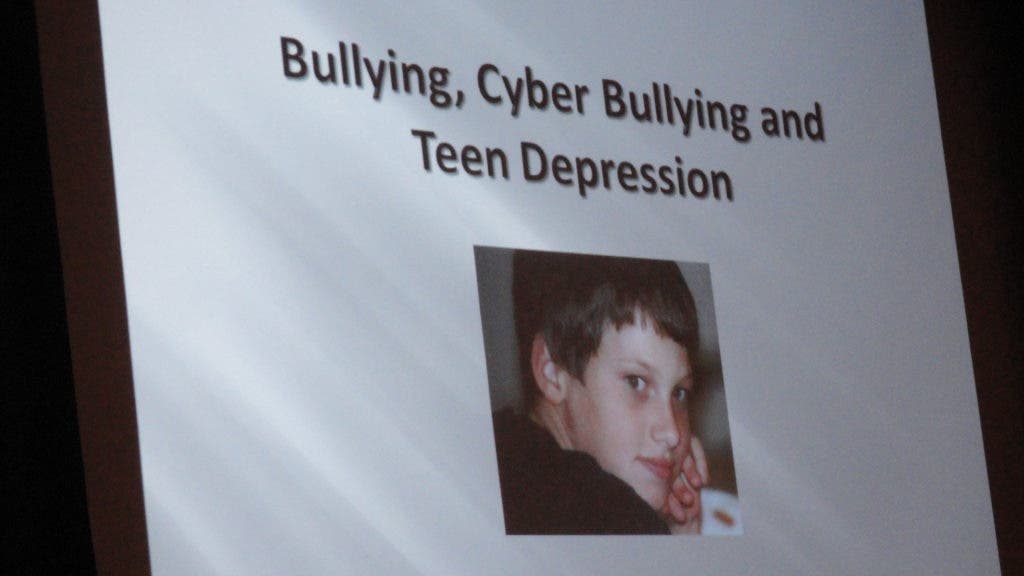


John Halligan often says his life can be divided into two separate parts: the first was when his son, Ryan, was still alive on Oct. 7, 2003; the second part is the years following his son's suicide on that same day after he was subjected to cyber bullying at school.
On Monday night, Halligan related his story to nearly 100 Portsmouth area residents at Portsmouth High School with the hope that they will be able to help their children if they are ever subjected to school bullying.
The program was presented by Portsmouth Regional Hospital and the Project Safety Association.
Find out what's happening in Portsmouthfor free with the latest updates from Patch.
Halligan told his son’s story with a video on stage that showed footage of his son, who he describes as a sweet, gentle 13-year-old boy who was just trying to navigate the beginning of his adolescence.
In 7th grade, his son continued to be bullied at his Vermont middle school. Halligan and his wife tried to work with the school officials to address it. The bully then used social media to spread a rumor online that Ryan was gay and it spread like wildfire through the school. Ryan suffered youth depression from the bullying and one day he hung himself in his bedroom.
Find out what's happening in Portsmouthfor free with the latest updates from Patch.
“As Ryan’s dad, I completely underestimated the emotional toll of bullying,” Halligan said.
Halligan said he never found a suicide note, but was able to learn a great deal about the emotional challenge his son experienced through the hundreds of online chats he had with his cyber friends. Halligan said his family had a rule of no secret passwords and thankfully Ryan obeyed this rule, allowing Halligan to see what was going on.
His son even had a girl at school who pretended to like him online, Halligan said. When his son approached the girl at school, she humiliated him and rejected him.
Halligan said his son also learned from a friend that he commiserated with online how to commit suicide by learning about websites that taught him different ways. When he told his friend he decided to kill himself, the cyber friend told him, “It’s about (expletive) time.”
Halligan said parents should allow their kids to have some "go to" adults in their life so they can at least talk to someone if their kids feel they cannot go to them.
Halligan said parents can also not be afraid to ask their children the tough questions if they suspect they are feeling suicidal. “Ask the question,” he said.
If a child says, "Yes," Halligan said parents can then take action to help them which could range from making a call to a pediatrician or even a stay overnight in an emergency room to at least get them stabilized.
Halligan said another sign that a child might be in distress is cutting. He said Ryan wore wrist bands to hide where he had been cutting himself for some time and kids can be very creative when it comes to hiding areas where they may cut themselves.
When children go for an annual physical, Halligan said parents should ask their doctors to “check them from head to toe.”
School’s use of conflict resolution to deal with bullying is ineffective because the problem lies with the audience a bully commands.
“If you chip away the audience, you chip away the power that comes from bullying,” said Halligan.
The bystanders who observe the bullying, whether it is physical, emotional or relational, can make a big difference if they tell the bully they are not amused and they should stop, he said.
“At the end of the day, they own this,” Halligan said of students.
Halligan said parents must realize that cyber bullying is another ball game. Whether it is cell phones, computers, laptops, e-mails, texting, game consoles like voice chat over Xbox live, and social media like Facebook, Twitter, MySpace, Halligan said there are too many ways for people to attack one another.
When this technology is placed in the hands of middle school kids, which is a socially awkward age, Halligan said it becomes clear how some bad cyber bullying can occur.
Now cyber bullying “is at an epidemic level. It’s driving the school folks crazy,” Halligan said.
“You’ve got to be proactive, you’ve got to be preemptive, you’ve got to check,” Halligan said.
Another website called formspring.me “is an awful website,” he said. It allows people to put out questionnaires, surveys anonymously and it often leads to some real “nastiness” and “it causes a lot of pain,” he said.
Halligan said Social Networking is not all bad. He said some students do some really positive stuff with it like tribute pages to his son or other kids who have stated they will no longer be a bystander. But it is often misused by other kids who don't understand the damage it can do, he said.
“The word discretion doesn’t seem to be in the vocabulary of this generation,” Halligan said of the way some people use social media.
Halligan said that with YouTube, it is now becoming common for a bully to physically assault a kid and then put out a video that often goes viral on the Internet. He added that now instead of a kid being humiliated in front of a few kids, they are humiliated in front of a million people.
“This is where you start to realize the game has changed,” he said.
Some Ways to Prevent Cyber Bullying Ask children how they are using technology Open your own Social Media and e-mail accounts Do not allow secret passwords at home Do not let children share secret passwords with their friends Discuss cyber bullying and school bullying with children Monitor and filter software Set strict time limits for technology use Consider not only a child's age, but also maturity level Use eBLASTER program to review all children's activity onlineGet more local news delivered straight to your inbox. Sign up for free Patch newsletters and alerts.