Politics & Government
'Elections Transparency Act' Anything But, Critics Say As Bill Passes NJ Senate
The bill increases campaign contribution limits and gives the governor power to appoint NJ's Election Law Enforcement Commission members.


NEW JERSEY — A bill which critics say takes the bite out of New Jersey’s elections watchdog has passed the state senate, and gives Gov. Phil Murphy a one-time chance to overhaul the committee.
The New Jersey Senate passed a re-altered version of the Elections Transparency Act (S2866) on Monday by a vote of 24 to 12, with four senators not voting. Senate President Nicholas Scutari (D-22) is sponsor of the bill, which has seen several changes since its first introduction. An Assembly version of the bill awaits a hearing in front of the full body.
Legislators removed a controversial section that would have allowed the governor’s office to appoint the chair of ELEC (the Election Law Enforcement Commission), but included a provision that vacates the current four-member ELEC board and allows Gov. Murphy to make four bipartisan direct appointments without Senate approval. It also establishes a $30,000 salary for board members.
Find out what's happening in Across New Jerseyfor free with the latest updates from Patch.
The bill's approval comes after longtime ELEC chair Jeffrey Brindle filed a lawsuit against Murphy and three of his top aides. Brindle claims Murphy and his staff violated the New Jersey Civil Rights Act by retaliating against him after he poked fun at the state's political fundraising rules in a satirical column last fall and trying to fire him over a purported offensive email.
Murphy's office declined Patch's request to comment on the lawsuit. Related article —Murphy Sued By Top NJ Elections Watchdog
Find out what's happening in Across New Jerseyfor free with the latest updates from Patch.
Other provisions in the bill:
- Require political reporting of donations over $7,500 for 501(c)(6) nonprofits, 501(c)(4) nonprofits, and super PACs.
- Reducing statute of limitations for ELEC to investigate campaign finance and election violations from 10 years to two.
- Make a statewide pay-to-pay law that eliminates local guidelines
- Doubles the amount of money donors can give to political committees, candidates, and parties.
- Requires candidates and various committees to report campaign contributions above $200 within 72 hours.
- Allows Democratic and Republican parties and committees to create separate “housekeeping accounts” for non-political expenses like accounting, human resources, and capital expenses.
Three Republican senators joined 21 Democrats in supporting the bill. Sen. Nina Gill (D-34) was the one Democrat opposing it, saying that giving the governor’s office power to appoint ELEC commissioners destroys its impartiality and “eliminates all checks and balances between the commission and the executive branch.”
Sen. Holly Schepisi (R-39) hinted that the Murphy-appointed ELEC members could target certain members of the legislature for their opinions about the administration.
"If you speak out on something, we will have an ELEC that is solely appointed by one person," she said. "And they'll have to prioritize, in the two-year statute of limitations, who they go after. I would not be surprised if it's people who speak out or don't toe the line.”
Three commissioners on the current four-member ELEC board serve in a holdover capacity and there is one vacancy. Scutari said the move would "allow the governor to put people that are highly qualified on the election board."
"We're insured that the folks that they're looking at to replace the current commissioners are of the highest quality," Scutari told NJ Spotlight News, citing conversations with the governor's office.
Scutari also said the reduced statute of limitations allows ELEC to focus on more current campaigns, mentioning the $31,573 fine the commission issued this month against Paterson council candidate Wendy Guzman for an alleged 2016 campaign finance violation (which was first filed in September 2017).
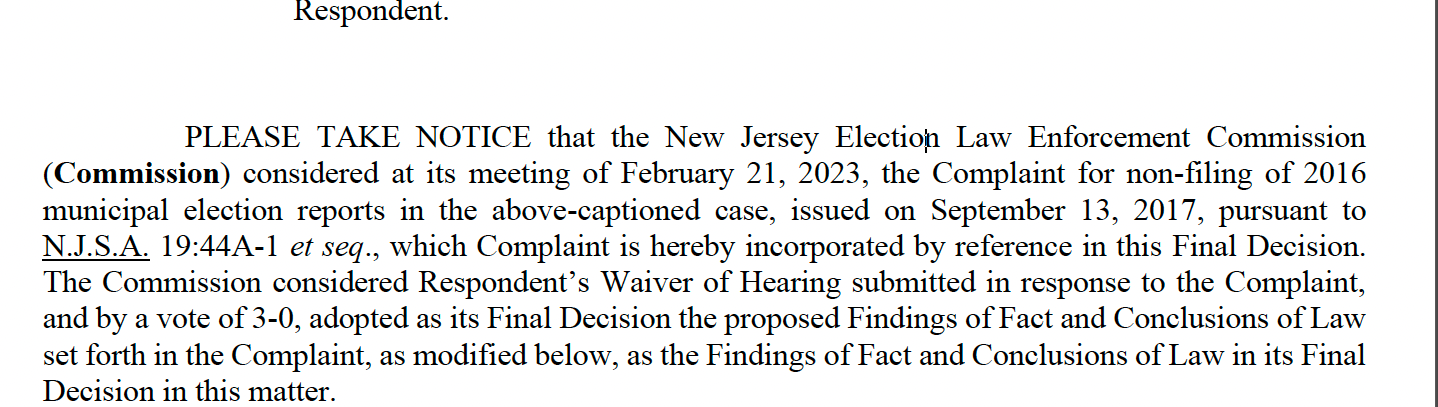
"We should be looking at filings that happen in real time and not wasting our time on stuff that happened in 2016," Scutari said in an interview with NJ Spotlight News.
Politico's Matt Friedman reported that retroactively reducing the statute of limitations "would wipe out an estimated 80 percent of its current cases."
This would include a 2017 investigation against the NJ Senate Democratic Majority PAC.
The League of Women Voters of New Jersey has continued to push legislators to oppose S2866 and the Assembly version, A4372, calling it a "dirty money bill" and saying it changes laws for the worse rather than offering "transparency and real campaign finance reform."
"New Jersey desperately needs to require disclosure for dark money campaign ads, but that transparency must not come at the expense of limits on campaign contributions, the independence of our campaign finance watchdog, and of our anti-corruption laws," LWV-NJ said.
Get more local news delivered straight to your inbox. Sign up for free Patch newsletters and alerts.