Politics & Government
NJ Funnels Billions Into These 10 Agencies
A Patch analysis of state spending shows a handful of departments dominate the state's budget.


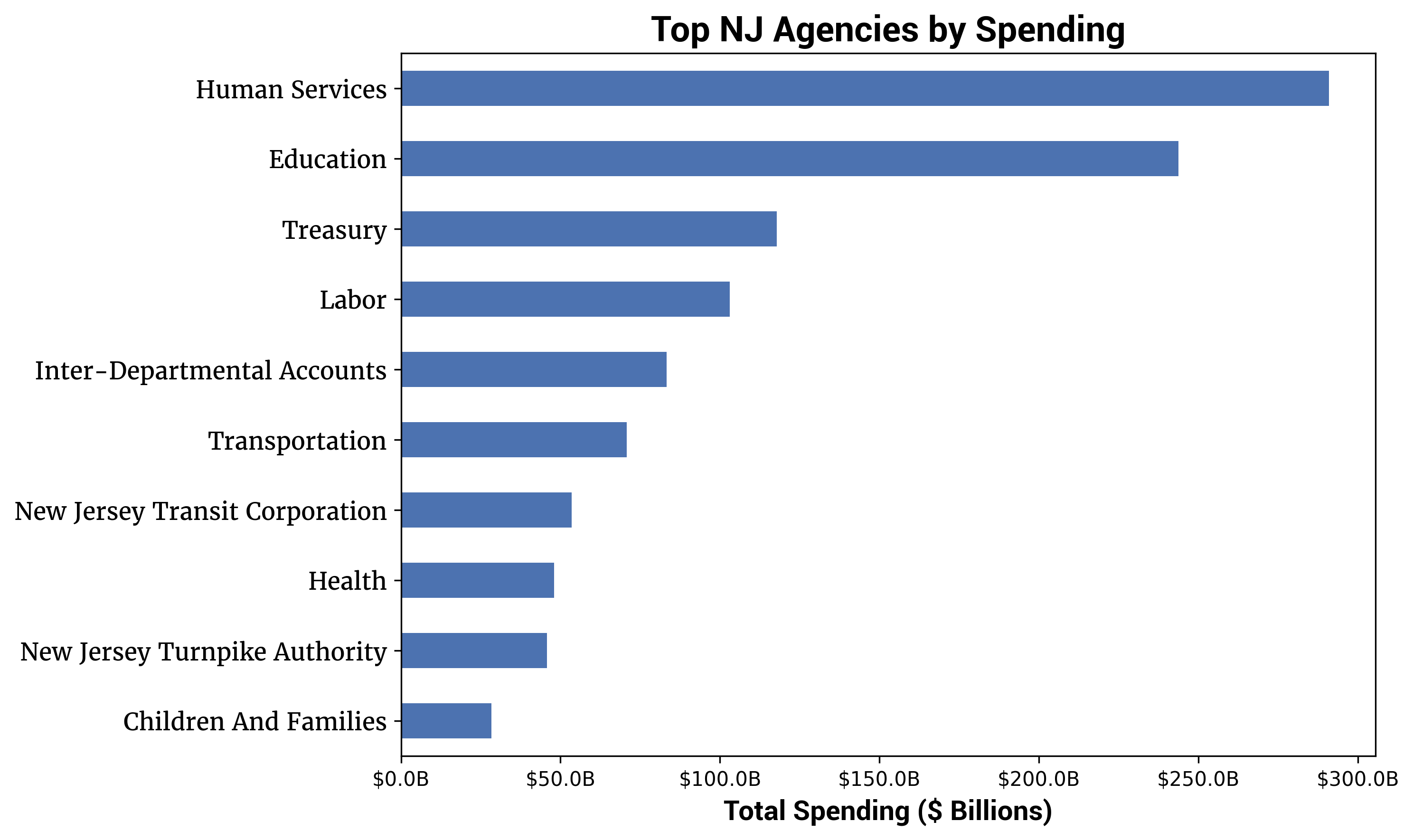
NEW JERSEY— A handful of agencies controls the majority of New Jersey's budget, leaving smaller departments to navigate shrinking state spending or sudden spikes, according to a Patch analysis of state expenditure data.
Four departments control nearly 60 percent of the spending tracked in the dataset: the New Jersey Department of Human Services, the New Jersey Department of Education and Treasury and Labor.
Those agencies oversee some of the state’s most expensive programs, including health coverage for low-income residents, school funding, unemployment benefits and statewide financial operations.
Find out what's happening in Across New Jerseyfor free with the latest updates from Patch.
Human Services alone accounts for about 22.7 percent of total spending, largely driven by Medicaid and other health and social service programs.
Education represents roughly 18.9 percent.
Find out what's happening in Across New Jerseyfor free with the latest updates from Patch.
That concentration of spending highlights the stakes as the state faces a looming budget shortfall.
Interdepartmental accounts, funds used to cover costs shared across multiple state agencies, also make up a significant portion of the budget.
Those accounts typically pay for statewide expenses such as employee health insurance and pensions, debt payments, shared technology services and property tax relief programs.
The funds are managed centrally through the New Jersey Department of the Treasury, but support programs used across many departments.
According to figures from Gov. Mikie Sherrill, her administration will need to solve an estimated $3 billion structural deficit.
The increased costs for health care, school funding, employee benefits and direct property tax relief have driven much of the state’s financial pressure, New Jersey State Treasurer Aaron Binder said.
On Tuesday, Sherrill proposed nearly $2 billion in cuts and increasing more than $700 million in new revenue by “closing corporate tax loopholes.”
“If we do nothing, our entire $7.2-billion-dollar surplus will be gone in less than two years – and we’ll be another $750 million in the hole,” Sherrill said.
According to the state’s data, the largest agency spent roughly $291 billion, while the median agency spent about $1.4 billion.
Several smaller agencies recorded declines, including the Civil Service Commission, the Office of Information Technology and the Commission on Higher Education.
Election oversight spending, by contrast, surged.
The New Jersey Election Law Enforcement Commission recorded the largest percentage increase, reflecting the timing of election cycles and heightened campaign finance activity.
State officials cautioned that broader budget pressures extend beyond individual agencies. Pandemic-era federal relief funds temporarily stabilized finances, but those funds have ended.
Nonpartisan think tank New Jersey Policy Perspective warned that cutting alone could harm low-income residents and working families.
“Fixing a deficit this size through cuts alone would seriously harm low-income residents and working families who depend on Medicaid, school funding and property tax relief,” the group reported. “The governor’s budget proposal should ask the wealthiest individuals and corporations to pay their fair share.”
Get more local news delivered straight to your inbox. Sign up for free Patch newsletters and alerts.