Politics & Government
Sherrill Looks To End Crisis: 5 Takeaways From NJ Budget Address
What might get cut – and how much? Are any new taxes on the table? Here's the latest update from Gov. Mikie Sherrill.


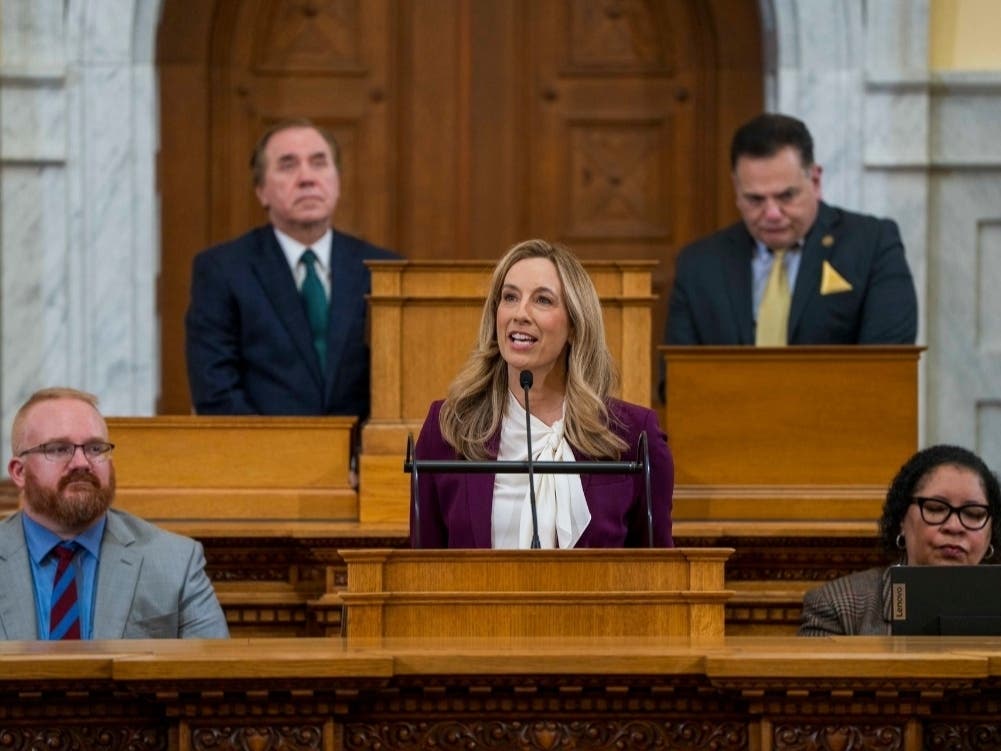
How will New Jersey deal with its massive, multi-billion-dollar budget crisis? That’s the unpleasant job Gov. Mikie Sherrill is facing as she reaches a big milestone: her first state budget proposal.
Sherrill held a highly anticipated news conference Tuesday to outline her $60.7 billion spending plan, which includes a $5.4 billion surplus and $2 billion in cuts. Watch video footage here.
According to figures from the governor, the state is looking at an estimated $3 billion structural deficit – one of the worst budget gaps in the nation.
Find out what's happening in West Orangefor free with the latest updates from Patch.
“If we do nothing, our entire $7.2-billion-dollar surplus will be gone in less than two years – and we’ll be another $750 million in the hole,” Sherrill said.
New Jersey State Treasurer Aaron Binder has blamed the financial crunch on increased costs for health care, school funding, employee benefits and direct property tax relief. Binder also pointed to pension payments and debt service as major factors, and said that federal spending cuts scheduled to start in 2027 are adding to the problem.
Find out what's happening in West Orangefor free with the latest updates from Patch.
On Tuesday, Sherrill outlined a two-pronged approach to attacking the budget gap: making spending cuts, and bringing in more cash.
According to Sherrill, her budget proposal includes nearly $2 billion in tough-but-necessary cuts. Meanwhile, she wants to raise more than $700 million in new revenue from “closing corporate tax loopholes.”
Sherrill said that she has spoken to lawmakers in the Senate and Assembly – and it’s time to chart a new pathway forward.
While the last eight state budgets increased almost 7 percent annually on average, this budget is 1.6 percent above the fiscal year 2026 adjusted appropriation, she said.
Republican Party leaders are planning to hold a news conference on Tuesday afternoon to respond to Sherrill’s proposed budget. Watch video footage here.
Here are five takeaways from Sherrill’s first budget proposal:
PROPERTY TAXES
New Jerseyans continue to pay among the highest property taxes in the nation. To combat the rising cost of living, the state has funneled billions into relief programs like Affordable New Jersey Communities for Homeowners and Renters (ANCHOR). Another property tax program available in New Jersey is the Stay NJ program, which offers benefits to eligible homeowners aged 65 and older. Other aid programs include the “Senior Freeze,” which reimburses eligible senior citizens and disabled persons for property tax or mobile home park site fee increases on their principal residence.
Sherrill said her budget proposal would provide the most property tax relief in state history: nearly $4.2 billion dollars next year. That includes $2.3 billion for ANCHOR, $700 million for Stay NJ, and $350 million for the Senior Freeze program.
However, some changes might be coming for Stay NJ, the governor said.
Under Sherrill’s proposal, eligibility for Stay NJ would be modified to cap the qualifying income threshold at $250,000, matching ANCHOR. Additionally, the maximum benefit amount for Stay NJ would be capped at $4,000.
“Stay NJ is a great program – it keeps seniors, so often living on a fixed income, in their homes,” Sherrill said. “But it benefits households that make as much as $500,000 a year. I'm changing that, to safeguard Stay NJ for middle class seniors. If you make $250,000 or less, your tax relief is in this budget. That’s going to save taxpayers hundreds of millions of dollars a year.”
Sherrill also said her budget proposal will target more relief to low- and middle-income senior renters through the ANCHOR program.
The $250 bonus formerly extended to senior homeowners and renters under ANCHOR is set to expire after fiscal year 2026. Under this budget proposal, senior renters would continue to receive the $250 bonus while many senior homeowners would continue to receive the additional benefit amount through Stay NJ instead.
“That’s a fairer, more efficient use of taxpayer money,” Sherrill said.
Taxes and home values have gone up steadily throughout New Jersey over the past decade, regardless of what political party is in power. Statewide, the average tax bill topped $10,000 for the second time last year.
When former Republican Gov. Chris Christie and the state Legislature reached a historic deal for a 2 percent cap in 2011, the average property tax bill in New Jersey was at $7,759 for a home valued at $299,014. By the time Christie left office, the average property tax payment had risen by 13 percent.
The average tax bill in New Jersey continued to rise under former Gov. Phil Murphy, a Democrat. When Murphy first took office in 2018, the average tax bill stood at $8,767. In 2025, the average bill reached $10,570 – a 20.5 percent increase.
SCHOOLS
On Tuesday, the governor proposed a record breaking $12.4 billion for K-12 schools in fiscal year 2027. It’s the largest amount in state history and a $370 million increase over last year’s funding.
The budget also includes a record $1.4 billion for preschool education aid.
According to state data, school taxes made up more than half of a property owner’s taxes in New Jersey last year (52.2 percent). This was followed by municipal taxes (29.9 percent) and county taxes (17.9 percent).
During her campaign for governor, Sherrill said she was open to merging some local school districts to drive down taxes.
The governor remains open to the idea, she said Tuesday.
“Evidence shows the huge benefits of shared services for things like special education, transportation, books and software,” Sherrill said. “So this budget invests in and lays the groundwork for consolidating services and curricula.”
New Jersey taxpayers have complained about the school portion of their property taxes to for decades. Regionalization has been discussed for years throughout New Jersey, with proponents saying it will help reduce costs because it would reduce the costs of administration and associated professional services of running a district.
However, merging school districts would require the state Legislature to act; it could not be ordered by the governor.
The idea of merging districts has also sparked worries among parents and community members. During the 2025 gubernatorial election, rumors of potential mergers were amplified on social media – prompting a response from the Sherrill campaign.
MORE MONEY
Sherill has insisted that her administration is not planning to raise taxes on New Jerseyans. Her administration recently released a policy blueprint that cites a plan to boost revenues without new taxes.
The governor repeated that message again Tuesday, saying that her budget proposal “does not raise taxes on individual New Jerseyans.”
Instead, the state will be looking to its wealthiest residents and businesses to chip in.
Sherrill said her budget proposal will pare back corporate tax breaks in the state, capping the deduction that our highest-earning companies can take for net operating losses.
“After COVID, more started claiming this deduction, to write off losses seen in those years,” she said. “It’s time to move on. We won’t keep shortchanging the future. Limiting this loophole saves taxpayers almost $500 million dollars.”
At the same time, some companies have been using a deduction that was introduced 15 years ago to help small businesses weather the Great Recession, she said: the Alternative Business Calculation.
“The whole point was to level the playing field for entrepreneurs,” Sherrill said. “But bigger companies started using it, too. So our budget limits that deduction to the actual small businesses it was meant for, capping eligibility at business income of a million dollars a year.”
“The car repair shop and the diner down the block are the ones who should benefit,” Sherrill said. “This fix will save another $120 million dollars a year – without taxing families a dollar more.”
FEDERAL FUNDING
According to Sherrill, federal COVID relief money over the past six years has “papered over” underlying fiscal problems. Now, that the pandemic-era cash has stopped flowing, the state has been forced to confront some “very real fiscal problems,” she said.
Sherrill also said the Trump administration is making cuts that will cost New Jersey “hundreds of millions of dollars” next year in areas such as health care, housing, food, schools and infrastructure.
“Washington isn’t coming to save us,” she said during a Feb. 26 press conference.
On Tuesday, Sherill said her proposed budget would attempt to cope with an upcoming drop in federal health care funding by asking large companies to beef up their coverage.
“Because Washington refused to extend Affordable Care Act credits, nearly half-a-million New Jerseyans will see their premiums triple this year,” Sherrill said. “And because his H.R.1 law makes people jump through hoops to stay on Medicaid, 300,000 more New Jerseyans will be kicked off. To prevent that, this budget invests in new technology to help people meet Trump's burdensome paperwork requirements.”
“But many families will still lose coverage – and the cost of insuring them directly would be billions of dollars,” she continued. “Instead of asking taxpayers to foot that bill, this budget looks to large employers. It asks any company with 50 or more employees on Medicaid – companies like Amazon and Walmart – to cover their workers, which they should do anyway; or pay a fine. That helps warehouse workers, cashiers, healthcare aides – people who keep our economy running.”
The proposal would reduce strain on hospitals, easing the expected surge in E.R. care – the most expensive kind, Sherrill said.
“And it’ll raise $145 million dollars a year to cover Trump’s extra Medicaid costs,” she said.
TAX THE RICH OR CUT SPENDING?
Some experts have suggested that Sherrill and other lawmakers should hike taxes for the state’s wealthiest residents and biggest corporations.
“Fixing a deficit this size through cuts alone would seriously harm low-income residents and working families who depend on Medicaid, school funding and property tax relief,” nonpartisan think tank New Jersey Policy Perspective (NJPP) reported last week.
“The governor’s budget proposal should ask the wealthiest individuals and corporations to pay their fair share,” the nonprofit suggested.
Two years ago, the NJPP released a study that says New Jersey would be able to raise an extra $4 billion annually if it jacks up taxes for super-wealthy corporations and residents, hikes its sales tax and reforms its tax code.
The idea of hiking taxes for the nation’s wealthiest has seen majority support in several polls, including in the Garden State. A recent study from PDFExpert.com found that a billionaire tax is the “most desired” new tax in New Jersey.
Last year, the Pew Research Center found that 63 percent of U.S. adults believe tax rates on large businesses and corporations should be raised – with 34 percent saying they should be raised “a lot.” Meanwhile, 58 percent of people said tax rates for households earning more than $400,000 should be raised.
In 2023, a Fairleigh Dickinson poll found that 54 percent of New Jersey residents supported an extra tax on businesses earning more than $1 million if it would be spent on improving NJ Transit – a fee that was later enshrined as a new corporate transit tax.
Meanwhile, New Jersey activists continue to demand higher taxes for the wealthy.
Last year, a coalition of more than 40 unions, community organizations and advocacy groups sent a letter to Murphy and the state Legislature, calling for higher taxes on businesses to pay for health care, housing, education and transit.
“The wealthy and well-connected got the biggest handouts from Washington,” said Eric Benson, coalition manager with the Advocates with the For The Many coalition – referring to the controversial tax cuts instituted under the Trump administration.
“Now it's time for them to pay their fair share so we can protect the health care, housing, and services our communities need,” Benson said.
- Related: NJ Activists Rally On Budget: ‘We Want Justice, Tax The Rich’
- Related: 6 Billionaires From NJ Make New List Of World's Richest
Other experts and lawmakers in New Jersey have taken the opposite stance, demanding that the governor’s office abstain from raising taxes on any person or business – wealthy or otherwise.
Among them is the New Jersey GOP leadership, which has been pushing the governor to prioritize cuts over raising taxes.
Sen. Declan O’Scanlon previously said the proposed budget is Sherrill’s “first big test” when it comes to balancing the books in New Jersey. He accused Trenton Democrats of “papering over a cratering budget mess,” adding that “tax increases aren’t the answer.”
Senate Republican Leader Anthony Bucco agreed, although he gave Sherrill credit for being “transparent” with the state’s finances.
“Her approach reflects a clear departure from the previous administration, which we consistently described as one marked by missed opportunities and the squandering of billions in federal funding,” Bucco previously said.
“We hope the governor remains true to her commitment to prioritize spending discipline over tax increases,” Bucco said. “If that is achieved it will mark a genuine change to the past eight years of failed policies under a Democrat-controlled legislature.”
After former Gov. Murphy presented his final state of the state address in January, several Republican leaders in the Senate and Assembly said that Sherrill faces an uphill battle to balance New Jersey’s coffers.
“We’ve got a budget that has increased $22 billion,” Bucco said at a news conference. “We've got property taxes on average now today that are up over $10,000 a home. Unemployment taxes are up. Payroll taxes are up. More and more people in New Jersey are living paycheck to paycheck.”
“These are all things that should be sending a warning sign to us,” Bucco continued. “But yet… my colleagues on the other side of the aisle along with the governor signed a bill adding another $128 million to a budget that is already estimated to [have] a $4 billion shortfall.”
“That is all going to fall on the backs of the taxpayers,” he added.
Other Republican lawmakers such as Assemblyman Christopher DePhillips have called for New Jersey to loosen up its “worst-in-the-nation” 11.5 percent corporate business tax.
DePhillips has also opposed the additional 2.5 percent corporate transit fee charged to businesses earning over $1 million.
“Businesses that stay in New Jersey have to cut costs somewhere and unfortunately that is translating to job loss, because that is what they can control,” he said last month. “The unemployment rate indicates that New Jersey is moving in the wrong direction and the only way to correct course is to cut taxes.”
Meanwhile, Assemblyman Brian Bergen recently proposed that New Jersey lawmakers – including himself – should look to their own paychecks when deciding what to chop from the budget.
During the lame-duck session in 2024, members of the Senate and Assembly increased their salaries from $49,000 to $82,000 annually. The pay raise – which took effect this year – is the first since 2002. The bill got support from Democratic and Republican lawmakers alike.
Bergen has introduced a proposed state law that would eliminate legislative salaries beginning in 2028. It would save about $9.8 million, he said.
While the debate over taxing the state’s richest residents and businesses rages on, the average “middle class” New Jersey resident continues to see their cost of living rise.
According to an annual study from SmartAsset, the Garden State ranks second in the nation for the highest income a household can earn and still be considered middle-class: $208,588. Meanwhile, it takes $69,529 to cross the lower threshold into middle class in New Jersey.
- Related: NJ Raises Minimum Wage To $15 – But It Still Isn’t Enough To Live On
- Related: NJ Sees Huge Spike In Number Of Workers Postponing Retirement, Study Finds
Sherrill acknowledged the financial struggles that many New Jersey residents are facing during her budget address on Tuesday.
“This is an affordability budget, rooted in lowering costs for hardworking families and making state government more accountable to the people we serve,” Sherrill said.
“New Jerseyans gave me a mandate to challenge the status quo and that’s exactly what this budget does – there's no more kicking the can down the road,” she said.
Send local news tips and correction requests to eric.kiefer@patch.com. Learn more about advertising on Patch here. Find out how to post announcements or events to your local Patch site.
Get more local news delivered straight to your inbox. Sign up for free Patch newsletters and alerts.