Weather
Summer Stargazing Is At Its Peak During Perseid Meteor Shower
The Perseid meteor shower is best seen from Aug. 11 to 13, brightening up the night sky. But a full moon may dim the show.


NEW JERSEY — It's a summer of stargazing, if you know where and when to look.
The Perseid meteor shower is hurtling toward our New Jersey (and the planet's) skies, peaking Aug. 11 through 13.
Its prologues are the less spectacular Delta Aquariid and Alpha Capricornids meteor showers. The former runs through Aug. 2, having peaked July 28 to 29, favoring southern latitudes, according to the American Meteor Society. The latter runs through Aug. 15 and has a "plateau-like" peak on July 31 and is not considered very strong by the society.
Find out what's happening in Across New Jerseyfor free with the latest updates from Patch.
So enter Perseid.
And Cara Muscio, associate director of the Robert J. Novins Planetarium on the campus of Ocean County College in Toms River, is in her element.
Find out what's happening in Across New Jerseyfor free with the latest updates from Patch.
"Perseid is the big one. It's usually amazing. More than 50 meteors per hour at its peak."
The Perseid meteor shower starts the last week of July and peaks at about Aug. 11 to 13. Look for it at midnight to 2 a.m., Muscio advises, although watchers will have to contend with a full moon at that time.
But there is advice for that too. Earthsky.org noted that "around mid-July, Earth enters the meteor stream for each of these showers" (the Perseids and the Delta Aquariid and Alpha Capricornids). But in 2022 moonlight will interfere with Perseids’ peak. So we recommend you watch in late July and early August – on multiple nights – to catch meteors in these two grand showers." And you can explore the 2022 Guide To Meteor Showers, Supermoons, Other Celestial Events for more stargazing options.
Mythology meets science
Perseids produce about 50 to 100 meteors an hour at the peak, according to NASA. The shower is produced by the comet 109/P Swift-Tuttle, discovered in 1862.
The showers are known for their fireballs, which are "larger explosions of light and color that can persist longer than an average meteor streak," NASA said, explaining, "This is due to the fact that fireballs originate from larger particles of cometary material."
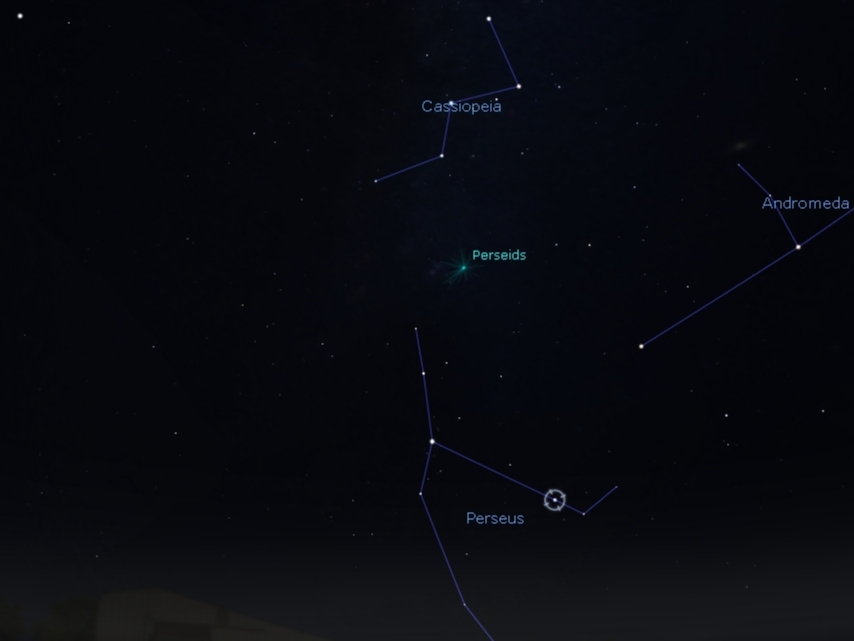
The Perseid shower radiates from the area of the constellation of Perseus, in Greek mythology the slayer of Medusa and rescuer of Princess Andromeda, Muscio said.
The Perseid show should be visible in the northeastern sky at this time of year, she said. Perseus is visible to the right of the The Big Dipper.
She also said there are apps and online resources to help stargazers locate the Perseus constellation.
"He's like a stick figure - an upside down Y and a reddish star 'Algol' seems held in his hand - the head of Medusa," according to mythological tradition, she said.
But, be prepared for that moon. The peak for the Perseid meteor shower is also the time of the full moon, the full sturgeon supermoon.
"The glowing ball of light in the sky will make the meteor shower less visible," Muscio concedes.
Moonlight or unnatural light, light pollution is an issue is all developed areas - but especially on the East Coast of the U.S. - and particularly in New Jersey, Muscio adds.
'Awe and wonder'
But that never stopped Muscio's childhood fascination with the night sky.
With a birthday near the Perseid meteor shower, Muscio recalls she would stay up all night as a kid to watch it.
She studied environmental and earth science, specializing in the biology of water; she worked in government and nonprofits for many years.
She then "slid into teaching " - teaching college courses and then came to realize "my skill is as a science communicator."
And she imparts an enthusiasm and knowledge in a voice that is as clear as a bell and brimming with energy. One would not doze off in a planetarium seat with Muscio at the microphone.
She wants to share with people the "awe and wonder" of astronomy. The planetarium is a great place to do that through not only night sky lectures but in specialized programs, such as one recently on the James Webb telescope and its new images from space.
And she advises giving the meteor show a try - even with the full moon.
"Get a chair, some beverages and a snack and just hang out," she advises.
Don't expect to see one and done, she says. "Stay a while." It does take some patience.
"Make an evening out of it," Muscio advises.
And don't worry if you miss anything, Muscio said. "Perseid comes back every year."
.jpg "Planetarium")
Get more local news delivered straight to your inbox. Sign up for free Patch newsletters and alerts.