Asbury Park, NJ|Local Classified|Announcement|
Jersey Shore University Medical Center’s Neuroscience “A-Team” Saved a Patient’s Life in Record Time
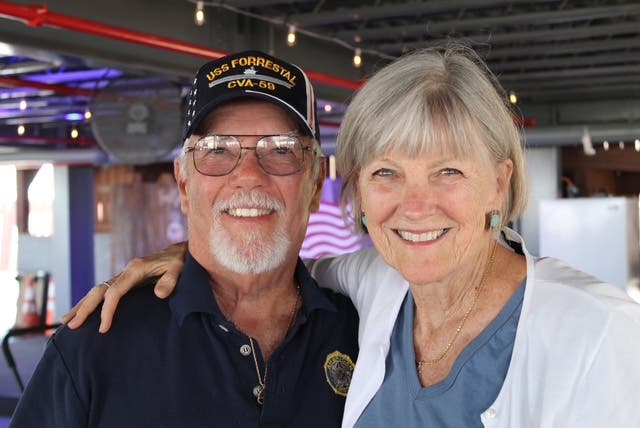
(Roger & Joanne above) For 73-year-old Joanne Dunn, a retired hospice social worker, the phrase “timing is everything” is much more than a cliché—it’s the reason she is alive today.
In 2024, Joanne underwent a major procedure at Riverview Medical Center to remove a third of her left lung due to a severe, aggressive bacterial infection. Later, as she was recovering in her hospital room and eating lunch, the unthinkable happened.
Joanne picked up a cup of coffee and suddenly spilled it all down her front. She began fumbling with her utensils and losing control of her speech. Her husband of 47 years, Roger, was sitting right beside her and instantly knew something was terribly wrong.
“One minute she was fine,” Roger recalled. “Next minute I saw she was drooling a little bit... she was fumbling with her utensil. She was trying to speak but she was mumbling. She got a droop in her chin and her mouth, and she was rapidly losing control of her speech. I jumped up and ran out to tell the nurse, ‘Something’s wrong, you’ve got to come in.’”
A rapid response team was immediately called, and Joanne was rushed to Jersey Shore University Medical Center (JSUMC)—home to world-class neuroscience experts who specialize in complex, life-saving stroke interventions.
The suddenness of the event was a shock to the family, a harrowing reality that Laura Risley, M.D., a vascular neurologist at Hackensack Meridian Neuroscience Institute at JSUMC who is now part of Joanne's care team, sees often.
“Stroke can be traumatic because it’s so sudden,” Dr. Risley noted. “In an instant—one second you’re fine and the next second you’re not. It’s a lot to process for our patients and families.”
At JSUMC, a neurosurgeon immediately performed an emergency thrombectomy, a highly specialized procedure to surgically remove the blood clot from Joanne’s brain. Emergent intervention is needed to restore blood flow and oxygen delivery, preventing brain cell death and minimizing the permanent impact of the stroke.
“Once she got to Jersey Shore, it was amazing how fast they took care of her,” Roger said. Following the successful procedure, the neurosurgeon came out to the waiting room and showed Roger a picture of the nearly inch-long blood clot he had just removed. “He saved her life. Thank God we got her down there as fast as we did.”
Because of the rapid response of her husband and the world-class clinical intervention by the JSUMC neurosurgical team, Joanne’s recovery was nothing short of miraculous. Rather than facing long-term debilitating deficits, Joanne, who lives in Middletown, woke up the very next morning able to walk, talk, and feed herself.
This rapid recovery is the ultimate, if uncommon, best-case scenario for stroke specialists. “Almost all of Joanne’s deficits were resolved after intervention,” said Dr. Risley. “It is unfortunately rare to be able to walk out soon; we approach every stroke patient with the hope that we can give everyone results like Joanne, but time is the enemy with stroke.
“The intervention window is only hours and too many patients don’t get to us fast enough. It is estimated that 2 million brain cells are lost every minute during a stroke; so every second makes a difference.”
HMH’s hospitals are proudly designated as Primary and Comprehensive Stroke Centers, creating a unified network of world-class neurological care. With Primary Stroke sites such as RMC working in lockstep with Comprehensive Stroke Centers like JSUMC, rapid transport and advanced treatments happen in a matter of minutes. HMH stands ready with specialized interventions, expert teams, and seamless protocols in place to take care of you quickly and effectively.
Without that swift action, Joanne’s future would have looked drastically different. “The natural progression of the stroke, if left untreated, would have been left -sided paralysis, visual loss on her left side, facial droop, difficulty with swallowing and possible feeding tube, and living in a nursing home with 24-hour care,” Dr. Risley explained. Instead, just two days after suffering a life-threatening stroke, Joanne was discharged.
“I like to say I have the A-Team at Jersey Shore taking good care of me,” she said. “I am so grateful for my medical team. They are just top-notch, and I wouldn’t consider going anywhere else. They’re not just skilled clinically; they’re such compassionate, empathetic people. I never leave anyone's office there without getting a hug.”
For information, visit hackensackmeridianhealth.org/en/services/neurosciences.