Community Corner
A Father Lost In The Great Atlantic Storm Of 1962
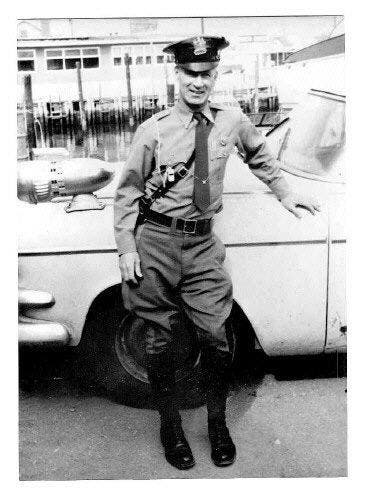
David Leonetti recalls what happened the day Long Beach Township Police Chief Angelo J. Leonetti headed out to evacuate Holgate residents.



by Patricia A. Miller
Early in the morning of March 6, 1962, Long Beach Township Police Chief Angelo J. Leonetti’s mother woke up from a nightmare. She dreamt that her police chief son was in great danger.
“Ang is in trouble,” she told the family. “He’s in the water. He’s laying in water.”
Find out what's happening in Barnegat-Manahawkinfor free with the latest updates from Patch.
She called the police department and was told Leonetti was okay. There were no cell phones on Long Beach Island in 1962.
“No,” Mrs. Leonetti replied. “He’s dead now. It’s too late.”
Find out what's happening in Barnegat-Manahawkinfor free with the latest updates from Patch.
Angelo J. Leonetti was only 45 when he died on a rescue mission in the vicious March 1962 Nor’easter that devastated Long Beach Island. He left behind his wife Mildred and four children.
The youngest was David, who was five. He still remembers the day police came to tell Mrs. Leonetti her husband was gone.
Mrs. Leonetti had asthma. David remembers oxygen tanks being brought into the house after she was given the news. He remembers the pastor from the church across the street giving him a ride on his shoulders through the flood waters.
Don’t go
Mrs. Leonetti didn’t want her huband to go out in the storm that day. He was on vacation.
But he went anyway. He was the police chief.
“My father knew everybody,” David said. “Everybody loved him. He was like Andy of Mayberry.”
For years, David Leonetti said he was troubled by rumors that his father, Long Beach Township Commissioner Robert Osborne and Kenneth Chipman were out on a “joyride” when their four-wheel truck was swamped on the morning of March 6, 1962.
But he later learned his father had made two trips to Holgate the day he died.
Angelo Leonetti was also the township photographer. He had gone down to Holgate shortly after 6 a.m. to take pictures of the U.S.S. Monsson, a destroyer that had beached during the storm. He made it back from the first trip.
Then he set out for Holgate again, to try and evacuate several elderly people. Osborne and Chipman also hopped on for the rescue mission. They never came back.
The truck Leonetti, Chipman and Osborn were riding in sank into a washed-out roadway on the way to Holgate.
“They couldn’t see it,” Dave Leonetti said. “The Boulevard was lower back then. There was a low dune line, maybe three to four feet dunes, not like today.”
The water temperature was 34 degrees. The winds were gale force - blowing between 60 to 70 miles an hour. The air temperature was 31 degrees.
“The March 1962 northeaster was comparable in strength to the most intense hurricanes of historical record, using criteria similar to those used by Saffir and Simpson to rate hurricanes,” according to the U.S. Geological Survey’s website.
The three men tried to head for the Coast Guard station in Holgate, but were overwhelmed by the storm.
“When you step out into water that cold, it immobilizes you,” Leonetti said. You can’t walk. You can’t talk.”
Angelo Leonetti was still alive when rescuer Ralph Parker and several others found him and managed to get him to a nearby oceanfront house to warm him up, his son said.
The sea covered everything. The ocean and the bay were one.
“You could see right out into the ocean,” Dave Leonetti said.
Parker and the other rescuers rubbed the chief’s arms and legs. He began to respond and got some color back in his cheeks. He could understand the instructions they gave him, but could not speak. He moaned. But the hour and a half he had been in the frigid water was too much for him.
Leonetti’s body stiffened. He had a massive heart attack and died. Later in the afternoon, the house Parker and the others had carried the chief to disappeared in the storm.
Kenneth Chipman’s body was found nearly buried in sand at the bay’s edge several weeks later. Osborne’s body was found in a marsh.
The storm lasted three days, from March 6 through March 8. Winds blew at a full gale. High tide after high tide surged over the island. Four other people died, including the ones Leonetti, Chipman and Osborne had tried to save.
“This is the benchmark for all nor’easters when it comes to the coast of New Jersey,” State Climatologist David W. Robinson has said. ”When you are talking storms, you start with ‘62. Long Beach Island was just pummeled.”
A promise kept
Mrs. Leonetti still lives in the Brant Beach house the family has owned since the 1950s. She never remarried. She spent years volunteering, in nursing homes and at Southern Ocean County Hospital. She turned 100 several days ago.
“She volunteered for everything you can imagine,” David said. “She volunteered at Southern Ocean County Hospital from the time it opened in 1972 to 1990.”
She had one request of her children. She asked that they never put her in a nursing home. They have kept their promise.
David, his brother Bob and nephew Jim take care of her, along with the help of some dedicated home health aides.
“They love my mother,” he said. ”They are very loyal to her. There’s something about reaping what you sow.”
Mrs. Leonetti can’t remember her husband these days. She is bedridden and suffers from severe dementia, her son said.
She was doing well up until the time Superstorm Sandy hit. They had to leave the Brant Beach home while repairs were made, David said.
“Right after Sandy, she went downhill,” her son said.
Photo credits: Courtesy of the Leonetti family.
Get more local news delivered straight to your inbox. Sign up for free Patch newsletters and alerts.