Politics & Government
Sherrill’s First 100 Days As NJ Governor: Here’s What She Has Done So Far
Budget battles. Nuclear power. Property taxes. Immigration. Here's what Mikie Sherrill has been up to since taking over as governor.


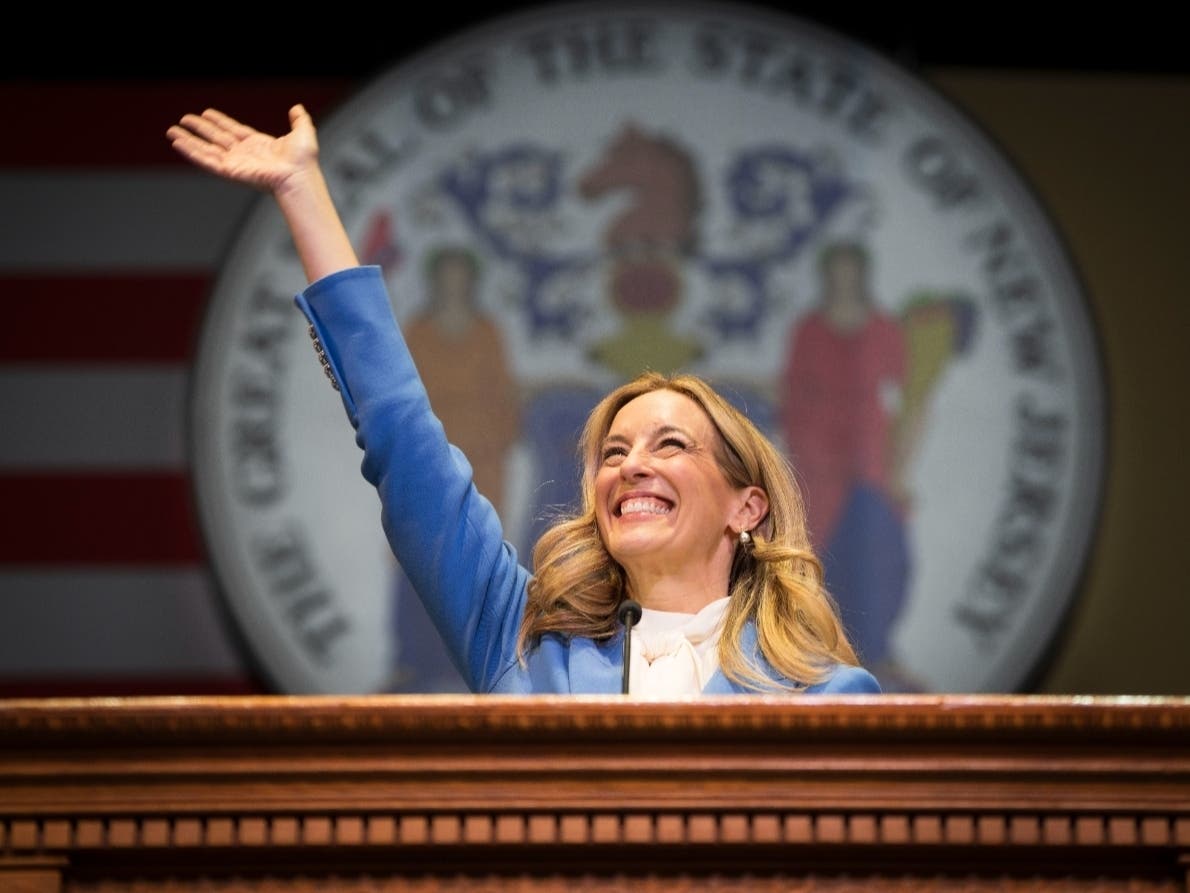
Mikie Sherrill is approaching a new milestone: her 100th day as governor.
Sherrill was sworn in as New Jersey’s 57th governor earlier this year, taking over for two-term Gov. Phil Murphy.
On Wednesday, the governor will reflect on her first months in office during a fireside chat at the New Jersey Performing Arts Center in Newark, where she was inaugurated in January. She is expected to discuss issues such as New Jersey’s budget woes, the cost of living and the 2026 FIFA World Cup. The hourlong event will begin at 7 p.m. and stream on NJ.com’s Facebook and YouTube channels.
Find out what's happening in Newarkfor free with the latest updates from Patch.
Here’s a recap of Sherrill’s first 100 days in office – and a look at what might be coming in the future.
CAMPAIGN PROMISES
Find out what's happening in Newarkfor free with the latest updates from Patch.
Hot-button issues during last year’s governor election included affordability, taxes, schools, transportation and public safety.
Sherrill’s campaign promises included lowering skyrocketing energy bills, reducing health care and grocery costs, protecting reproductive rights, closing tax loopholes for wealthy corporations and increasing the amount of affordable housing.
- Related: Meet NJ’s New Governor: 9 Things To Know About Mikie Sherrill
- Related: 6 Promises Mikie Sherrill Made As NJ's Next Governor
LOWERING ENERGY BILLS
Sherrill declared a state of emergency over the rising cost of electricity in New Jersey on her first day in office. She also gave the New Jersey Board of Public Utilities a green light to roll out a rate freeze.
The former congresswoman has been pitching a plan to massively expand solar, battery storage and nuclear power in an effort to lower electricity bills for residents.
State legislators and Sherrill lifted a decades-long ban on building new nuclear power plants in New Jersey in early April.
“This will help New Jersey secure a stronger, cleaner, more affordable and reliable energy future – while keeping the state at the forefront of innovation, job creation and economic growth,” the governor said.
The Sherrill administration has also made recent moves to boost solar and battery power in New Jersey. In March, the New Jersey Board of Public Utilities approved a massive expansion of its community solar energy program, awarding incentives to boost solar production at three sites in Gloucester and Passaic counties.
BUDGET BATTLE
According to figures from the governor’s office, the state is looking at an estimated $3 billion structural deficit – one of the worst budget gaps in the nation.
In March, Sherrill held a highly anticipated news conference to outline her $60.7 billion spending plan for 2026. She has pitched a two-pronged approach to attacking the budget gap: making spending cuts, and bringing in more cash.
According to Sherrill, her budget proposal includes nearly $2 billion in tough-but-necessary cuts. Meanwhile, she wants to raise more than $700 million in new revenue from “closing corporate tax loopholes.”
Sherill has insisted that her administration is not planning to raise taxes on New Jerseyans. Her administration recently released a policy blueprint that cites a plan to boost revenues without new taxes.
Republican Party leaders held a news conference in response to Sherrill’s budget proposal.
“No one should be taking a victory lap on this budget,” said Assemblyman Christopher DePhillips (NJ-40).
“Overall, this budget is not a win for the people of this state and does not does not improve affordability in New Jersey,” he added.
Assemblyman Brian Rumpf (NJ-9) echoed the sentiment, criticizing the increase in spending and expressing concerns about the state’s shrinking budget surplus.
“New governor, same old song,” he commented.
Article continues below
HOUSING
As part of the plan to balance New Jersey’s budget, Sherrill has proposed a restructuring of the state’s property tax relief programs.
To combat the rising cost of living, the state has been funneling billions into programs like Affordable New Jersey Communities for Homeowners and Renters (ANCHOR). Another property tax program available in New Jersey is the Stay NJ program, which offers benefits to eligible homeowners aged 65 and older. Other aid programs include the “Senior Freeze,” which reimburses eligible senior citizens and disabled persons for property tax or mobile home park site fee increases on their principal residence.
Sherrill said her budget proposal would provide the most property tax relief in state history: nearly $4.2 billion dollars next year. However, some changes might be coming for Stay NJ.
Sherrill’s new plan changes both the Stay NJ benefit amount and who is eligible to receive it. Under the proposed budget, the income requirement is cut in half, meaning that the eligible seniors must have an income below $250,000 – the same eligibility requirement as the ANCHOR program. It also lowers the maximum benefit from $6,500 to $4,000.
The governor says the move is a “fairer, more efficient use of taxpayer money.”
“Stay NJ is a great program – it keeps seniors, so often living on a fixed income, in their homes,” Sherrill said. “But it benefits households that make as much as $500,000 a year. I'm changing that to safeguard Stay NJ for middle-class seniors. If you make $250,000 or less, your tax relief is in this budget. That’s going to save taxpayers hundreds of millions of dollars a year.”
Meanwhile, the Sherrill administration recently moved ahead with efforts to boost the supply of homes in New Jersey – including affordable housing.
Sherrill’s 17th executive order directs state agencies to work together to make housing more available and affordable for residents. The order creates a Housing Governing Council, with a full action plan expected by September.
“With this executive order, we are aligning every tool at our disposal to accelerate housing production and make it easier for families to put down roots in the communities they love,” Sherrill said.
HEALTH CARE
Sherrill’s budget proposal includes $7.2 billion in funding for NJ FamilyCare, the state’s Medicaid program, which provides health care benefits to over 1.8 million New Jerseyans.
Sherrill has floated changes that would increase the burden on corporations that employ people using Medicaid. She is looking to large employers — any company with 50 or more workers who are on Medicaid, such as big-box store chains — to cover their employees or pay a fine.
Sherrill has also proposed reforms for pharmacy benefit managers (PBMs), which she says drive up prescription costs – although industry spokespeople have alleged that her statements are “simply untrue.”
- Related: Sherrill Addresses How NJ Will Respond To Federal Medicaid Challenges
- Related: Governor’s New Affordability Plan For NJ: Who Wins, Loses
IMMIGRATION
In March, the governor signed three bills into law that limit state cooperation with federal immigration authorities.
The package of bills also protects residents' personal data and requires law enforcement officers — including federal agents — to identify themselves during arrests and detentions.
The signing comes as ICE arrests in New Jersey have surged since President Donald Trump returned to the White House in January 2025. ICE arrests in New Jersey increased 110 percent between 2024 and 2025, according to the Deportation Data Project.
- Related: 3 New Laws Sherrill Signed Set To Stymie Trump
- Related: Trump Administration Sues NJ Over Mikie Sherrill’s ‘ICE Ban’
EARLY POLLS
How has Sherrill been polling with New Jersey residents since taking over the hot seat in Trenton? Pretty well, some researchers say – even among some conservatives and MAGA voters.
A Fairleigh Dickinson University poll released in March found that 58 percent of New Jersey voters approve of Sherill’s performance as governor so far. About 34 percent disapprove, and eight percent said they weren’t sure or didn’t answer.
“Sherrill is getting what no politician on the national level gets these days: the benefit of the doubt,” said Dan Cassino, a professor of government and politics at FDU.
Another recent poll carried out by Rutgers-Eagleton found that 44 percent of New Jersey voters have a favorable impression of Sherrill, while 29 percent have an unfavorable one. These favorability ratings mirror her approval ratings as well, with 45 percent approving of the job she is doing so far, 29 percent disapproving and 26 percent unsure.
However, when asked to break down the governor’s performance with a grade from “A” to “F,” voters were more apt to complain about Sherrill, with the governor seeing her highest “F” marks in cost of living (30%), taxes (28%) and government spending (21%).
WILL NJ-11 FLIP AGAIN?
Sherrill’s win last November was the first time New Jersey Democrats have secured three consecutive gubernatorial wins in the state in 65 years. She got 1,896,610 votes in the 2025 election, while her Republican opponent, Jack Ciattarelli, saw 1,417,705 votes.
Before becoming governor, Sherrill served as a U.S. House of Representatives member in the state’s 11th district (Essex, Morris and Passaic counties). Voters in the district recently chose a replacement to fill her unexpired term in Congress, picking the Democrat candidate, Analilia Mejia, over the Republican contender, Joe Hathaway, in a special election.
Another election will take place this November for a full term. A primary election will take place in June.
The 11th district was a Republican stronghold for more than two decades before Sherrill won a seat in Congress in 2018. Former U.S. Rep. Rodney Frelinghuysen occupied the seat for 23 years prior to retiring that year.

Catch up on some of our other recent gubernatorial coverage below (click headline to read article):
- Sherrill Draws Battle Line With FIFA Over $48M World Cup Transit Costs
- 9.6% World Cup Sales Tax Hike Proposed For NJ, GOP Pushes Back
- Sherrill To Move Out Of North Jersey Home This Summer
- Gov. Sherrill Visits South Jersey School To Highlight Kids' Online Safety
- Sherrill Changes How NJ Residents Get Prescriptions
- Gov. Sherrill, DOT Delivers $1.2M To NJ Town Ravaged By Sinkholes
Send local news tips and correction requests to eric.kiefer@patch.com. Learn more about advertising on Patch here. Find out how to post announcements or events to your local Patch site.
Get more local news delivered straight to your inbox. Sign up for free Patch newsletters and alerts.