Politics & Government
Zoning Board Approves Affordable Housing Development Variances
Township's plan to have Walters Group build 94-unit development on Route 9 moves forward

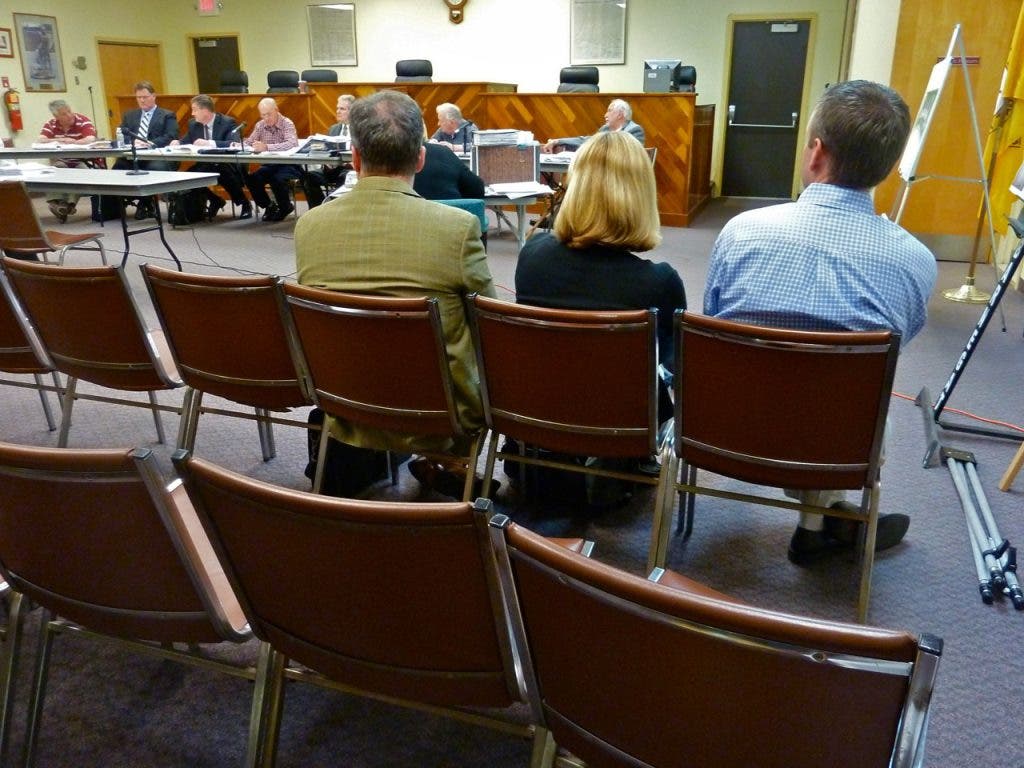


The Barnegat Township Zoning Board put its stamp of approval on the township’s plan to build a 94-unit affordable housing development on Route 9 Tuesday night, approving height and use variances for the project even as some residents raised concerns about fire access and safety.
Contingent on further development approvals form the state, a 6.3-acre site currently home to a former campground and the long-vacant Down the Hatch pub is set to become Laurel Oaks, a development consisting of four three-story buildings with low- and moderate-income units, a maintenance building and parking for 197 vehicles.
Over the course of the three-hour meeting, township attorney Jerry Dasti, affordable housing attorney Andy Bayer and township engineer John Hess laid out their case for the approval of the two required variances – one allowing the construction of buildings three feet higher than the allowed maximum and one granting approval to build the units in an area not currently zoned residential.
Find out what's happening in Barnegat-Manahawkinfor free with the latest updates from Patch.
Barnegat has been waiting to fulfill a 54-unit Round Two affordable housing obligation set forth by the state Council on Affordable Housing since 2001, Dasti said. More units will soon be added to that total when COAH’s Round Three requirements become clear, he said, and though the details of those requirements are still being argued in court, they’ll ultimately result in a bigger affordable housing obligation for Barnegat.
“It’s not a matter of if, it’s a matter of how much,” Dasti told the board. Going ahead with the Laurel Oaks project would settle Barnegat’s Round Two obligation and put the township ahead of the game, he said, an important step to take to avoid a measure called a “builder’s remedy.”
Find out what's happening in Barnegat-Manahawkinfor free with the latest updates from Patch.
That’s when a developer sues for the right to provide the affordable housing that a municipality has failed to build, Bayer explained. The courts could then approve a development plan with no input from the township, and a developer could build a large number of market-rate housing units at the same time.
“They can build what you don’t want where you don’t want it, and a lot more than you want,” Dasti said.
The development will not only satisfy the township’s affordable housing requirements, said Dasti and Bayer, it will get rid of an eyesore, clean up an environmentally degraded site and put unused land back on the tax rolls – all at no cost to Barengat taxpayers, since the project will be paid by the township’s developer-funded Affordable Housing Trust.
“Not one dime of taxpayer funds are going to be used for this,” Dasti said.
With testimony from Hess and representatives from the Walter Group, the developers selected for the project, Dasti answered a long list of questions and concerns from zoning board members, from the tenant selection process to trash pickup.
After adding language requiring the township to meet with the Shade Tree Commission for input on plantings and hold a second meeting with the local fire department, the zoning board ultimately approved the variances with a unanimous vote and one recusal – board member Ken Thomas, who said he has an interest in property within 200 feet of the planned development, removed himself from the discussion.
But some residents present for the meeting expressed concerns about the plans.
“I think for the size and scope and the effect this will have on Barnegat long-term, this seems like a rush to judgment,” said Jake Taylor. “There’s many, many questions residents are concerned about.”
Taylor said he understood the township was required to build affordable housing and was in favor of the location selected for the project, but thought the plan should aim to fulfill just the current 54-unit obligation.
“What happens in the future could change,” he said. “I agree we have an obligation as to these 54 units, and that’s what we should do.” Barnegat should be “carrying out our obligation, not predicting the future.”
Taylor also said he worried about whether the new buildings would impact peoples’ enjoyment of the Barnegat Branch Trail, the linear park that runs behind the site.
“We have a beautiful rail trail, and we don’t want to put something there that’s going to encumber it or make people stop using it,” he said. “This impact on Barnegat goes on a long, long time after we’ll be here. Cut down on the units back there and you’ll have room to get what you wanted.”
Resident Anthony Dimauro, who lives across the trail from the Laurel Oaks site, said he worried about security.
“My back door and my neighbors’ – we’re going to look at this,” he said. “I like to see people get a break. But is lighting going to be on 24 hours a day? Is it going to be safe?”
Dimauro said he was concerned that so many more families in town would be a burden on the school district, and he brought up a worry that a few shared: The plans offer no road access to the rear of the three-story apartment buildings, which could make it difficult for fire trucks to access them in the event of an emergency.
“If they don’t put a fire hydrant back there and you can’t get a fire truck back there, you could have a calamity in this town,” Dimauro said.
Several members of the Barnegat American Legion said they wanted a bigger buffer between the development and their own property, which borders the site to the north.
“We have all our events here,” said member Rich Corcoran. With residences going in so close to their property, the American Legion would likely be bombarded by complaints, he said. “The cops will be there all the time. We were here first. We should have at least 50 feet of solid trees.”
But Dasti said he felt the township’s testimony demonstrated the “need and legitimacy” of the housing development.
“It will be a tremendous benefit to the people who need this,” he said. “It will be a well-run project,” Dasti said.
Details on the design, construction and operations of the Laurel Oaks development provided during testimony included the following:
- Residents from a three-county radius will be allowed to apply for housing in the development, COAH attorney Andy Bayer said.
- In order to be accepted as tenants, applicants must prove their need by providing detailed financial information and submit to criminal background checks, said Walters representative Melissa Giarratano. The information is then verified by the state, she said, and if tenants commit a crime, they face eviction.
- The 94 apartment units will include 18 one-bedroom units, 47 two-bedroom units and 29 three-bedroom units, according to a breakdown provided by township engineer John Hess. One of the apartments will belong to a super.
- A maximum of two residents will be allowed per bedroom, said Giarratano, meaning no more than 188 people will live in the development at any given time.
- Parking spaces will be numbered and assigned to residents based on the bedroom count of their apartments. For every resident-reserved spot, one half of one parking space will be devoted to guest parking.
- The development is modeled after the Walters Group's Stafford Park Apartments complex in Stafford Township, a more than year-old development that the group says has been successful and has not seen any elevated level of disturbances or police calls.
Get more local news delivered straight to your inbox. Sign up for free Patch newsletters and alerts.