Crime & Safety
2 Ways New Jersey Isn't Ready For 'Disaster,' Disease, Bad Storms Or Bioterrorism, Study Says
A study says New Jersey isn't quite ready to handle the effects of a major disaster, a disease outbreak or bioterrorism.


A study says there are two ways New Jersey isn't fully prepared to handle the effects of a major disaster, a disease outbreak or bioterrorism.
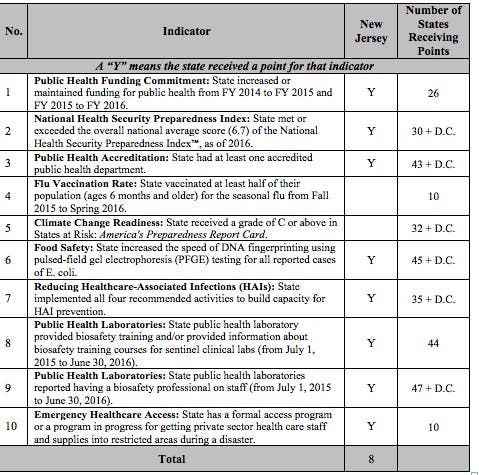
A report released Tuesday by Trust for America’s Health, a group of researchers and policy advisers from the University of Texas and elsewhere, finds New Jersey scored eight out of 10 on key indicators of public health preparedness.
Compared to other states, New Jersey fares well. The study, called "Ready or Not? Protecting the Public from Diseases, Disasters and Bioterrorism," says 26 states and Washington, D.C. scored a six or lower.
Find out what's happening in Basking Ridgefor free with the latest updates from Patch.
Alaska and Idaho scored lowest at 3 out of 10, while Massachusetts scored the highest at 10 out of 10, with North Carolina and Washington state scoring 9s.
Efforts to obtain comment from state officials, specifically the state Department of Homeland Security, were not immediately successful.
Find out what's happening in Basking Ridgefor free with the latest updates from Patch.
But the report found that New Jersey, as well as the rest of the nation, is often caught off guard when a new threat arises, such as flooding, or a Zika or Ebola outbreak or bioterrorist threat, which then requires diverting attention and resources away from other priorities.
“Health emergencies can quickly disrupt, derail and divert resources from other ongoing priorities and efforts from across the government,” Rich Hamburg, interim president and CEO, TFAH, said in a news release. “Many areas of progress that were made after 9/11 and the anthrax attacks to improve health security have been undercut. We aren’t adequately maintaining a strong and steady defense, leaving us unnecessarily vulnerable when new threats arise.”
"Ready or Not?" examines the nation’s ability to respond to public health emergencies, tracks progress and vulnerabilities, and includes a review of state and federal public health preparedness policies.
Some key New Jersey findings show that the state falls short in dealing with flu vaccination and also dealing with the effects of climate change, which some say could lead to flooding along the Jersey Shore and elsewhere.
Read more: Storms, Flooding In N.J. To Get 'A Lot Worse' In Near Future: Report
Here are the findings:
The report examined trends in public health preparedness over the past 15 years, finding successes and ongoing concerns.
- One-third of funds for health security and half of funds for healthcare system preparedness have been cut: Health emergency preparedness funding for states has been cut from $940 million in fiscal year 2002 to $660 million in FY 2016; and healthcare system preparedness funding for states has been cut by more than half since FY 2005 – down to $255 million.
- Some major areas of accomplishment: Improved emergency operations, communication and coordination; support for the Strategic National Stockpile and the ability to distribute medicines and vaccines during crises; major upgrades in public health labs and foodborne illness detection capabilities; and improvements in legal and liability protections during emergencies.
- Some major ongoing gaps: Lack of a coordinated, interoperable, near real-time biosurveillance system; insufficient support for research and development of new medicines, vaccines and medical equipment to keep pace with modern threats; gaps in the ability of the healthcare system to care for a mass influx of patients during a major outbreak or attack; and cuts to the public health workforce across states.
The Ready or Not? report provides a series of recommendations that address many of the major gaps in emergency health preparedness, including:
- Requiring strong, consistent baseline public health foundational capabilities in regions, states and communities — so that everyone is protected.
- Ensuring stable, sufficient health emergency preparedness funding to maintain a standing set of foundational capabilities alongside a complementary Public Health Emergency Fund which would provide immediate surge funding during an emergency.
- Improving federal leadership before, during and after disasters – including at the White House level.
- Recruiting and training a next generation public health workforce with expert scientific abilities to harness and use technological advances along with critical thinking and management skills to serve as the chief health strategist for a community.
- Reconsidering health system preparedness for new threats and mass outbreaks by developing stronger coalitions and partnerships among providers, hospitals, insurance providers, pharmaceutical and health equipment businesses, emergency management, and public health agencies.
- Prioritizing efforts to address one of the most serious threats to human health by expanding efforts to stop superbugs and antibiotic resistance.
- Improving rates of vaccinations for children and adults – which are one of the most effective public health tools against many infectious diseases.
Ready or Not? was released annually from 2003-2012, and more recently, TFAH has released Outbreaks: Protecting Americans from Infectious Diseases, from 2013-2015. The report was supported by a grant from the Robert Wood Johnson Foundation and is available on TFAH’s website at www.healthyamericans.org.
The full report can be found here.
Photo courtesy of Tuesday by Trust for America’s Health
Get more local news delivered straight to your inbox. Sign up for free Patch newsletters and alerts.