Community Corner
A Lesson About Basking Ridge's Oldest Inhabitant: The Old Oak
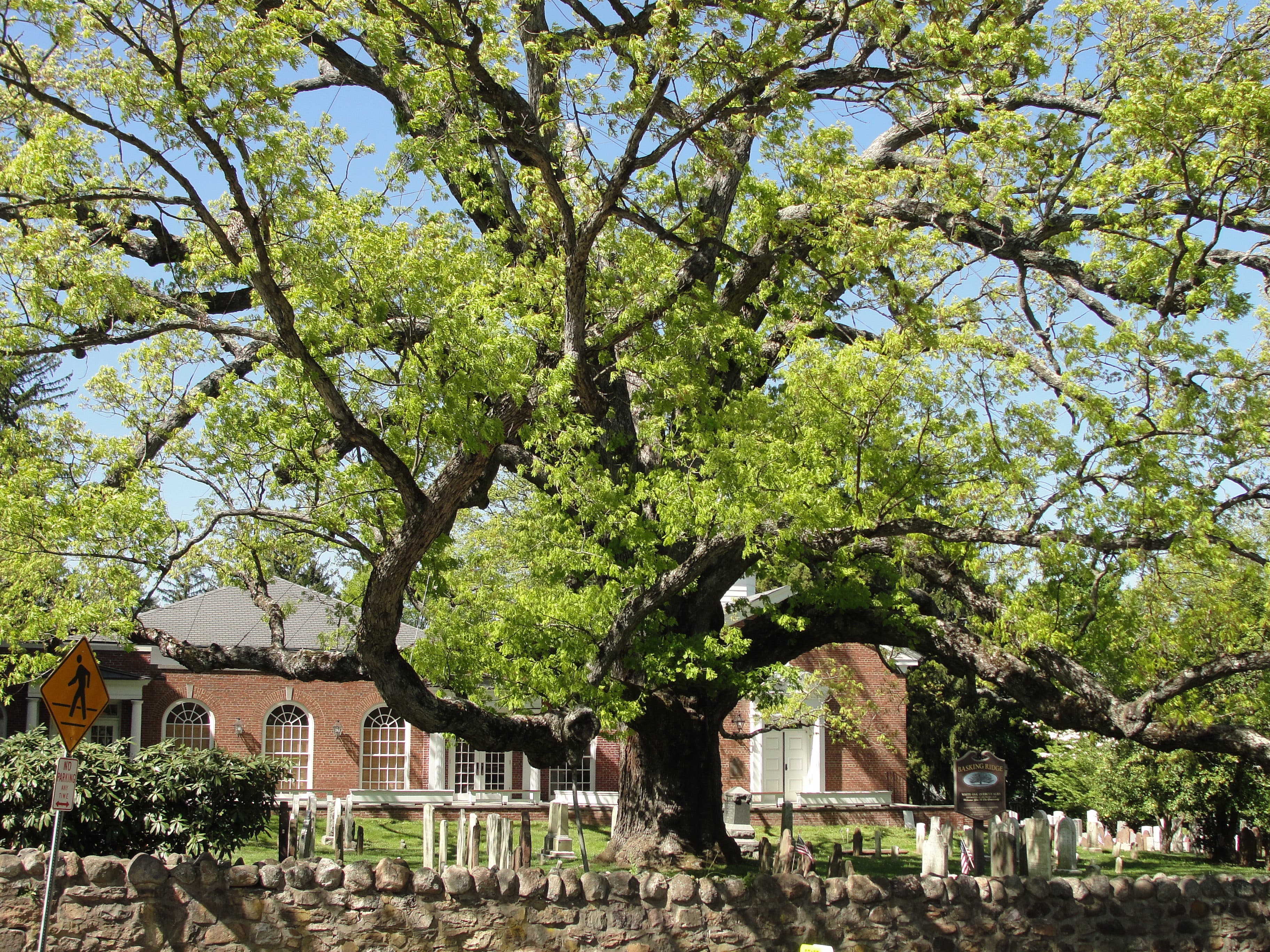
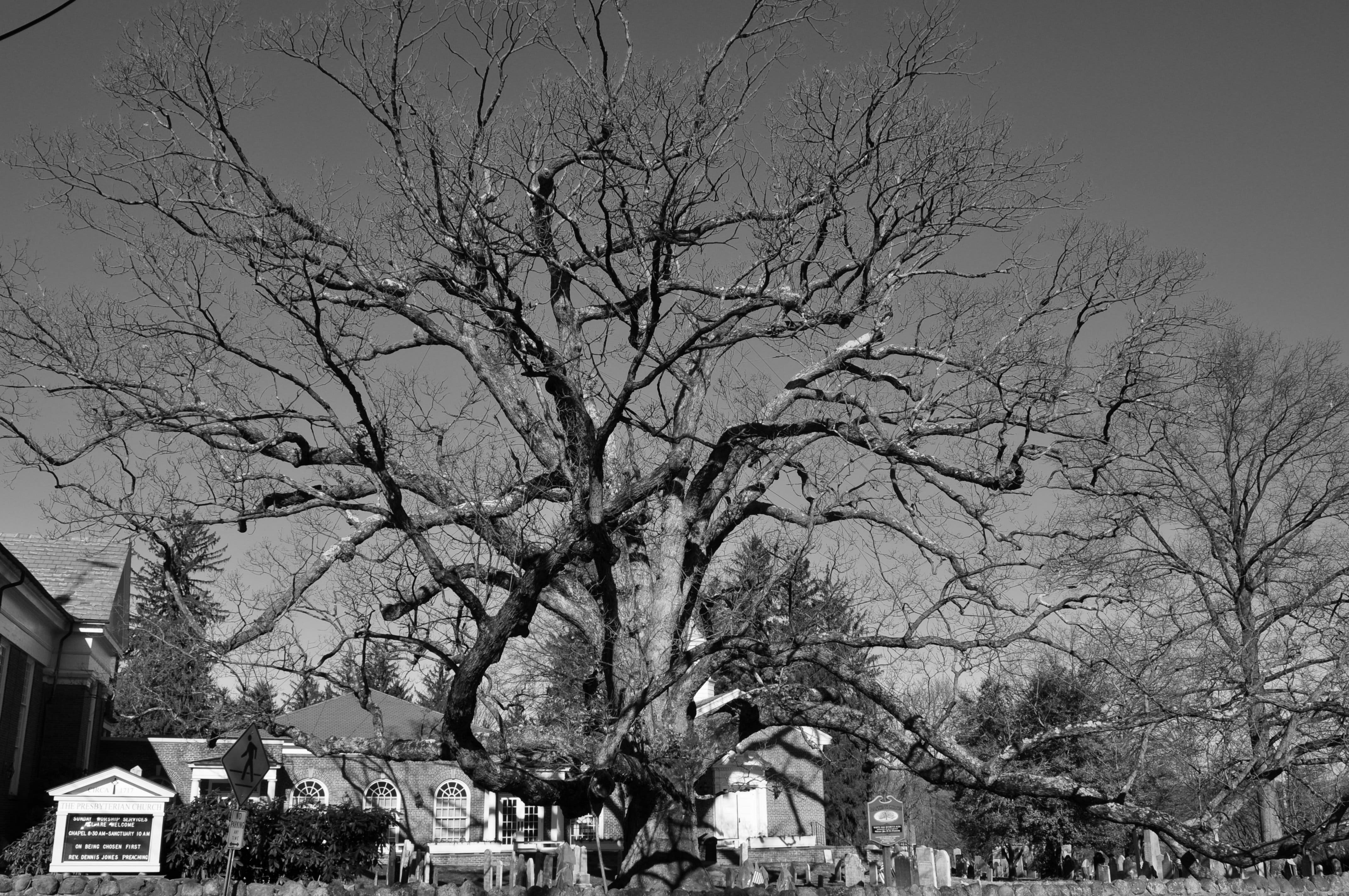
The elusive Old Oak of Basking Ridge is still around to celebrate another Arbor Day.

"Do not fear death the way everybody embraces life."
English Evangelist and Reverend George Whitefield shouted these words to 3,000 people from the base of the Old Oak tree in front of the Presbyterian Church of Basking Ridge in the mid-1740s.
It was these words during the Great Awakening that forever changed the art that appears on tombstones. Ghosts and demonic figures were soon replaced by charming carvings of baby animals, trees, hearts and cherubs.
Find out what's happening in Basking Ridgefor free with the latest updates from Patch.
This story is one of many that is connected with the Old Oak tree of Basking Ridge. The tree was first mentioned in letters dating back to the early colonial times, and it was referenced as an towering, expansive tree even then.
Ecology
Find out what's happening in Basking Ridgefor free with the latest updates from Patch.
There are over 600 species of oak trees on the planet, of the deciduous and evergreen variety. While oaks are found only in the northern hemisphere, they live in both cold and tropical regions.
In the mid-atlantic region there are 22 species of oak that make up the forests, and nearly all of them are deciduous. The Old Oak of Basking Ridge is a member of the White Oak species. The White Oak, or Quercus alba, is found along rivers, dry hillsides, and in sandy areas.
A typical White Oak is 90 feet tall with a trunk diameter of 3 feet and 6 inches--which is equivalent to a circumference of around 11 feet. When the trees are crowded in a forest the branch width is small, but when in the open the branches are wide-spreading. It is not uncommon for White Oaks in an open space to grow as wide as they are tall. And the branches can be large and hefty.
The Old Oak of Basking Ridge is 98 feet tall (46 feet shorter than the tallest white oak) with a circumference of 18 feet and a branch spread of 138 feet!
"It's possibly the largest and oldest living White Oak tree in the Western Hemisphere," Basking Ridge historian June Kennedy tells me.
History
More remarkable than the tree's stature are the events that have occurred beside it and the people buried at its feet.
"Indians camped under it's branches, colonial troops practiced their drill steps and George Washington, and his friend Lafayette, had an impromptu picnic during the American Revolution, prepared by the ladies of the church," Kennedy explains.
The cemetery underneath the tree contains the remains of 59 soldiers from various wars, beginning with the Indian Wars. Of the 59 deceased, 35 are veterans of the Revolutionary War. However, these soldiers were not killed in battle, but went on to live successfully after the war. They later were buried underneath the oak tree, as that was their wish. Three former pastors of the Presbyterian Church also rest in peace beneath the oak's branches.
One of the most debated rumors about the graveyard is that Betsy Ross is buried there.
Kennedy explains that "tradition still persists that Betsy Ross was buried under the oak tree because in 1876 there was a noted speaker who gave a speech on the 100th anniversary of our country--July 4, 1876. There was a huge celebration, a huge picnic, and he was an orator, his name was E.M Pennington."
Pennington told the crowd that day: "Beneath our feet are the mortal remains of the woman who sewed our first stars and stripes." Everyone was amazed at these words and cheered enthusiastically.
Kennedy has a newspaper clipping from 1902 about how Betsy Ross' tombstone was stolen, and another clipping from the 1940s says that Ross is presumably buried underneath the Old Oak.
"We have no proof of this because every time the church was enlarged they had to disturb tombstones so probably some of the church is buried over old graves," Kennedy clarifies.
Conservation
In 1924, the tree became very sick and the "Friends of the Old Oak Tree" raised $2,400 to engage tree experts to take care of it. Once the rotten trunk of tree was removed, there was room for four men to stand inside the tree cavity. After they got out, the men poured three tons of concrete into the cavity. The concrete cannot be seen anymore because the bark has since grown over it. Additionally, cables were later installed to support the weight of the huge branches.
Every year since then, the tree has been cared for with funds from the Basking Ridge Presbyterian Church.
When there was a drought in town during the 1970s, the water company still supplied water for the tree. "And if at any time we have another drought and people are told they can't water their lawns, they can't fill their swimming pools," Kennedy asserts, "--there will always be water for this tree."
Significance
The Old Oak tree is not just revered because of it's age and size--but it is because of it's great presence and maturity that it is the symbol of our town. Travelers were welcomed to Basking Ridge by the sight of the Old Oak, and it was a prominent landmark that was utilized in old letters, maps, and directions.
The two oak leaves on the Bernards township seal are representative of Basking Ridge and Liberty Corner. And no better emblem than a White Oak leaf could encapsulate the history, strength, and community that Basking Ridge represents.
Get more local news delivered straight to your inbox. Sign up for free Patch newsletters and alerts.