Health & Fitness
Famous Belleville Citizens You Should Know
Flying Billie Walsh; Belleville's famous pioneer aviatrix, was a Spanish teacher at Belleville High School.
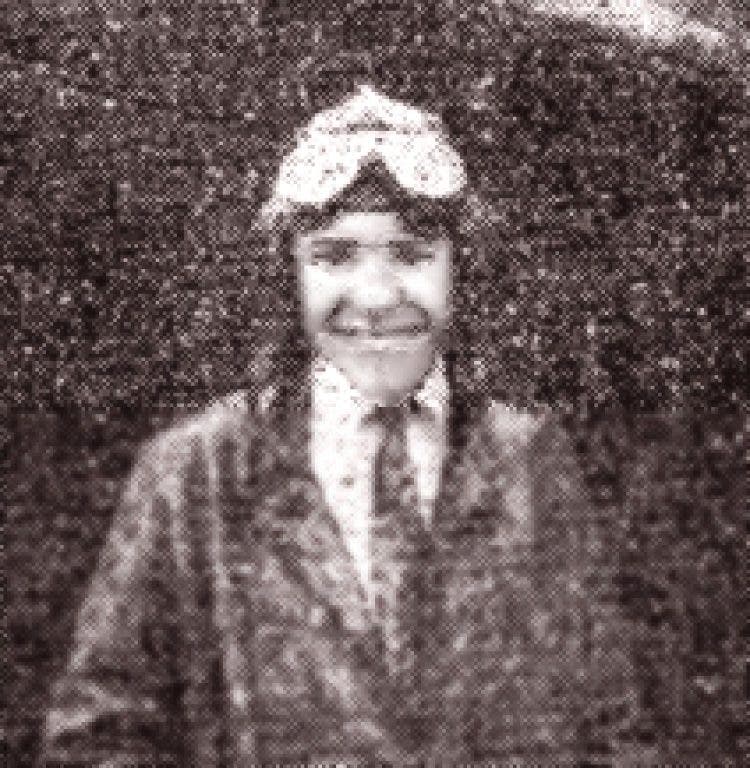
Flying "Billie" Walsh
It should be that every town has a folk hero of whom it can be proud, someone of good character and real accomplishment, a role model for the children, a measure of what the town culture can produce. Belleville, however, is such an odd place in that regard, odd because we have hundreds of them. There must be something in the air or water or, perhaps good vibrations rising up out of the ground that has caused a disproportionately large number of our townspeople to become outstanding achievers and even folk heroes. Perhaps the powers that be will lend me a bit of cyberspace here from time to time and I will tell you a few of these tales. Mothers, tell your children of these special people whose home was Belleville. Visitors who may want to move here be warned, this could happen to you. Let's start with this one.
Forward, then forward again; such is the mindset of those fearless, never to be intimidated, free spirits known as Belleville Girls. More than one favorite folk hero from our colorful past is a lovely girl who had fire in her heart. A heart on fire with a love of adventure was what set Flying "Billie" Walsh apart from the ordinary.
Miss Wilma Walsh, known to her friends as "Billie", resident of Van Houten Street, was a Spanish teacher at Belleville High School back in the '20s. Miss Walsh was a bit different from other teachers. She had among her credentials one paper which was not common in the teaching profession, she had a pilot's license. Earning a pilot's license in the 1920s required more than a little appetite for adventure, these were the pioneer days of aviation. Soaring through the sky in an open cockpit biplane was not for the timid. Operating those old flying machines required astute attention to detail and overwhelming self-confidence. Navigational instruments were a bare minimum, reading the ground beneath you like a road map was an essential skill. A thorough knowledge of local geography was surely one of Billie's strong points, enabling her to always return to her starting point after two or three hours of sailing across the region.
Find out what's happening in Belleville-Nutleyfor free with the latest updates from Patch.
Wilma Walsh was one of a very few. There were only about 117 licensed women pilots nationwide. There were no rules or regulations to oppose women fliers, it's just that there were not so many young ladies who would rather spend their days in the clouds instead of in the kitchen and who were willing to work hard to learn how to do it.
Miss Walsh was regarded by her contemporaries as "a very pretty aviatrix". The truth of this was confirmed by newsprint photos of the time. We know that all Belleville girls are pretty and Billie was stunning. Billie, however, was never content with being just another pretty girl, her ambitions were high in the sky. She earned her wings, her coveted pilot's license, recorded as license number 4272, after long training sessions with a private instructor and 60 hours of solo flying time in her logbook. Her aviation home base was old Roosevelt Field in Garden City, Long Island. Roosevelt Field, named in honor of President Theodore Roosevelt's son, Quentin Roosevelt, a fighter pilot who was killed in air combat during World War I, was also the home base, at that time, of other pioneering aviators including Amelia Earhart and Wiley Post as well as the starting point for Charles Lindbergh's 1927 solo transatlantic flight. Billie was flying in good company.
Find out what's happening in Belleville-Nutleyfor free with the latest updates from Patch.
In an age when women pilots tended to look for sensationalism, barnstorming, wing walking, racing their aircraft, Billie was no mere recreational pilot, preferring instead to hone her flying skills and explore the limits of aviation. Billie believed that amphibian aircraft were practical. She learned to pilot "flying boats" and, to her credit, was the first pilot to successfully land a seaplane at the marine base at Newark Metropolitan Airport.
There were still other contributions that Belleville's Miss Walsh would make to aviation history. In November of 1929, she, together with Amelia Earhart and 24 other lady pilots, gathered in a hanger at Curtiss Field in Valley Stream, New York for what would be the organizational meeting of "The Ninety-Nine", an association for women pilots which would become international as it grew. Miss Walsh, a charter member of this elite group, served as the group's treasurer at this organizational gathering, collecting the one dollar membership fee.
In the Summer of '29, Billie, still eager to learn more, had traveled to Europe to learn about the fledgling commercial airline industry developing there. She traveled, as a passenger, from London to Amsterdam on the newly formed Imperial English Airways and from Amsterdam to Brussels via Royal Dutch Airways. These commercial aircraft were among the first passenger airliners, able to carry but 18 passengers. She reported back that, while American airmail service was superior, the English and Dutch passenger service was far more advanced.
Miss Walsh's personal aircraft was a high-powered, sporty, Brunner-Winkle "Bird CK", an open cockpit, three passenger biplane. It had a top speed of 110 miles per hour. Folks, that was fast flying in 1929! It is not at all difficult for us today to see Flying Billie Walsh in our mind's eye, her goggles pulled down, scarf whipping in the wind, waving to us as she soars by in that racy looking sport plane, making us ever more proud of the fine people this town has produced.
* * *