Community Corner
‘Give Me The Gift Of Life’: NJ Nurse Searches For Kidney Donor
A Belleville wife and mother who works at a hospital in Montclair is desperately searching for the kindness of a stranger.


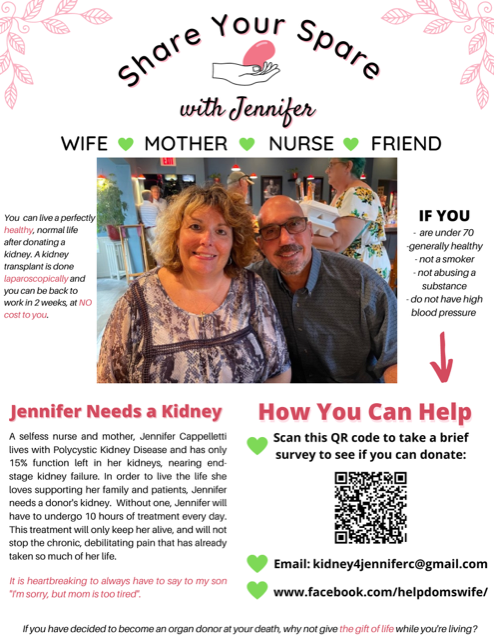
ESSEX COUNTY, NJ — For decades, Jennifer Cappelletti has worked at Hackensack UMC Mountainside in Montclair as a registered nurse, helping patients to treat life-threatening kidney diseases. Now, the Belleville resident is in search of a kidney herself. And she’s hoping for the kindness of a stranger to help her through one of the toughest battles of her life.
Cappelletti, 55, recently reached out to Patch to speak more about her experience with polycystic kidney disease (PKD), a hereditary, incurable condition that has been part of her life since 2002 – the year she met her husband, Dominick.
“I’ve learned to live with it, push through the pain, endure endless fatigue and just keep going,” said Cappelletti, who also suffers from hypertension due to the disease.
Find out what's happening in Belleville-Nutleyfor free with the latest updates from Patch.
The drive to “keep going” is a crucial motivator for the veteran nurse, who has a son attending Belleville High School, and who – ironically – works in her hospital’s chronic hemodialysis unit. For decades, her kidney function was normal. But about three years ago, Cappelletti’s condition took a turn for the worse.
Here’s the problem, she told Patch:
Find out what's happening in Belleville-Nutleyfor free with the latest updates from Patch.
“PKD is defined as a disorder in which clusters of cysts develop primarily within your kidneys, causing your kidneys to enlarge and lose function over time. The disease can cause serious complications, including high blood pressure, and, ultimately, kidney failure. Both of my kidneys are enlarged to twice the size of normal, measuring 10 inches each, which you can imagine is causing constant pressure and discomfort. I am exhausted and I am in pain. I’m also experiencing shortness of breath, nausea, and am having trouble focusing. Napping daily was part of my day – some days all I could do was work and sleep.”
Cappelletti said that people ask her all the time how she keeps going. Her reply? “I don’t know … I just do.”
“My goal was to have a preemptive transplant before reaching end stage,” Cappelletti said. “Unfortunately, I needed to start treatment, as my function was declining and down to 12 percent.”
In May, Cappelletti had a catheter placed in her peritoneal cavity in preparation to start peritoneal dialysis. Here’s what came next, she said:
“Once healed, I began training to do peritoneal dialysis (PD) at home. My treatments are usually at night, seven hours/six nights a week. I was able to get one night off due to some residual kidney function. I connect to a machine ‘cycler’ – simple enough, just sleep during your treatment. In theory, that’s the way. Since starting PD in June, I feel better, have more energy and have decreased nausea. But now I have trouble with sleep due to machine alarms, which happen for various reasons, added to restless leg syndrome.”
“Interrupted sleep is tough,” she added. “There’s some nights that I sleep three hours total.”
Cappelletti says she’s now facing a sobering reality: she needs a donor kidney. Without one, she will have to undergo 10 hours of treatment every day simply to stay alive. And that doesn’t even speak to the “chronic, debilitating pain” that has already dominated so much of her life.
When she tells people about her struggle with PKD, Cappelletti says that she often gets a big question: “How often does she have to stay on her treatment?” And according to Cappelletti, people are usually surprised to learn the answer: forever.
Or at least until she’s able to get a transplant, that is.
“You cannot live without kidneys functioning, however, you can live a perfectly good life with one kidney,” the health care professional said.
So far, several people have been evaluated as possible donors. But none of them have been a match, Cappelletti said.
“I’ve dedicated my life to taking care of others, but now the time has come for me to ask for help,” she said. “So I ask, would you share your spare for me and give me the gift of life?”
HOW CAN I HELP?
Cappelletti told Patch she is listed for donations at Cooperman Barnabas Medical Center in Livingston, which has a long history of successful kidney transplants. Read More: 29 Strangers Donate Kidneys To Each Other In Essex County
She is seeking a living kidney donation, which typically lasts longer and has better function. Understandably, some people are afraid about the surgery and what living with one kidney will mean for them. But here’s some basic information about those concerns, Cappelletti pointed out:
- “You only need one kidney to live a healthy, long life.”
- “Most donor surgery is done laparoscopically, meaning through tiny incisions.”
- “The recuperation period is usually fairly quick, generally two weeks.”
- “The cost of your evaluation and surgery will be covered by my insurance. The hospital can give you extensive information on this.”
- “You will have a separate team of health care professionals to evaluate you as a living donor. Their job is to help you understand the risks and benefits and look out for YOUR best interests.”
Cappelletti recommended that people learn more about living donation on the National Kidney Foundation website. People can also reach out to the foundation’s free, confidential helpline at 855-653-2273 or email nkfcares@kidney.org.
Think that you may have what it takes to be a donor? Cappelletti said people can contact her transplant center online here. They can also reach out directly to her at kidney4jenniferc@gmail.com.
“I know living donation may not be right for everyone, but you can still help,” Cappelletti said. “Consider being an organ donor after death and also, help me by sharing my story with everyone you know.”
“At the very least I want to bring awareness to kidney disease and living donation,” the Belleville resident added. “I’m hopeful my efforts will help me receive a kidney sooner and encourage others to consider helping the many people on the wait list.”
For now, she’ll continue to remain hopeful. But it isn’t always easy, Cappelletti says.
“It is heartbreaking to always have to say to my son, ‘I’m sorry – but mom is too tired,’” she said.
Send local news tips and correction requests to eric.kiefer@patch.com. Learn more about advertising on Patch here. Find out how to post announcements or events to your local Patch site. Don’t forget to visit the Patch Belleville-Nutley Facebook page.
Get more local news delivered straight to your inbox. Sign up for free Patch newsletters and alerts.