Politics & Government
NRC: Studying Cancer Risks In Populations Near Nuclear Plants 'Impractical'
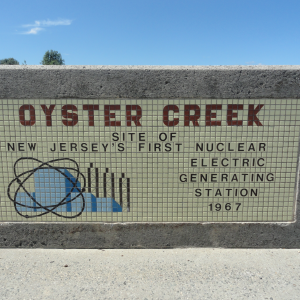
The Oyster Creek Nuclear Generating Station in Lacey Township was included in two pilot studies.

by Patricia A. Miller
The federal Nuclear Regulatory Commission has abandoned a National Academy of Sciences pilot study of cancer risks in people who live near nuclear plants in the United States, including the Oyster Creek Nuclear Generating Station in Lacey Township,
“The NRC determined that continuing the work was impractical, given the significant amount of time and resources needed and the agency’s current budget constraints,” according to an NRC release.
Find out what's happening in Berkeleyfor free with the latest updates from Patch.
The NRC and state agencies routinely test environmental samples from near the nuclear plants, the NRC said.
“These analyses show the releases, when they occur, are too small to cause observable increases in cancer risk near the facilities,” according to the NRC. ”We’re balancing the desire to provide updated answers on cancer risk with our responsibility to use Congressionally-provided funds as wisely as possible.”
Find out what's happening in Berkeleyfor free with the latest updates from Patch.
But Janet Tauro - chair of Clean Ocean Action and a founding member of Grandmothers, Mothers and More for Energy Safety - is outraged at the NRC’s decision.
“We really think they (NRC) are petrified by the results,” Tauro said today. ”There is no safe dose of continuous radiation. This is what we’ve been talking about. It’s cumulative. It’s a cocktail of radioactive release contributions and it gets into the environment.”
The National Cancer Institute began an investigation of cancer risks in populations near 52 commercial nuclear power plants and 10 federal nuclear facilities back in the late 1980s.
The investigation compared cancer mortality rates in counties with nuclear facilities and counties without nuclear facilities. The counties in the study were similar in population size, income, education and other socioeconomic factors.
“The USNRC has been using the results of this NCI investigation as a primary resource for communicating with the public about cancer risks near the nuclear facilities that it regulates,” the release states. “However, this study is now over 20 years old. There have been substantial demographic shifts in populations around some of these facilities, and the facility inventory itself has changed; some facilities have shut down and new facilities have started up.
So far, the NRC has spent $1.5 million on the National Academy of Sciences study; $1 million for Phase 1 and $500,000 for Phase 2 Pilot Study Planning, NRC spokesman Neil A. Sheehan said
“The remaining work on the pilot study was projected to take 39 months and cost $8 million,” he said. ”The National Academy of Sciences estimated it might take it 8 to 10 years to complete the pilot study and subsequent nationwide studies before the NRC had final cancer risks to share with the public. That would possibly prolong the study to 2025 – 15 years after the start of the project with the National Academy.”
But Tauro said the study should be completed, no matter how long it takes and how much it costs.
“Big deal,” she said. ”They should have spent more and sent the bill to Exelon (Oyster Creek’s owner) and other nuclear facilities. This is outrageous.”
The idea behind the study was to update available information on cancer risks near U.S. nuclear power facilities. The last such study was done by the National Cancer Institute (NCI) and was issued in 1990.
In Phase 1, the National Academy explored the feasibility of conducting an updated study by using more modern methods to perform the analysis. In Phase 2, the National Academy proposed to conduct pilot studies to determine the ability to practically apply the Phase 1 methods at seven sites recommended by the NAS committee, Sheehan said.
The Phase 2 pilot planning report identified several challenges to completing the study, including that the work “may not have adequate statistical power to detect the presumed small increases in cancer risks arising from … monitored and reported releases” from U.S. nuclear power facilities,” he said.
The NRC has found previously that the off-site dose to the highest exposed member of the public living near a U.S. nuclear power plant is generally less than 1 percent of the amount of radiation the average citizen receives in a year from all background and medical sources.
Oyster Creek is the oldest nuclear plant in the United States. It went online on Dec. 23, 1969.
Get more local news delivered straight to your inbox. Sign up for free Patch newsletters and alerts.