Community Corner
'Stop The Sting' To Expand Locations In Barnegat Bay
Berkeley Township Underwater Search and Rescue announced that they will expand their operation to reduce stinging bay nettles.


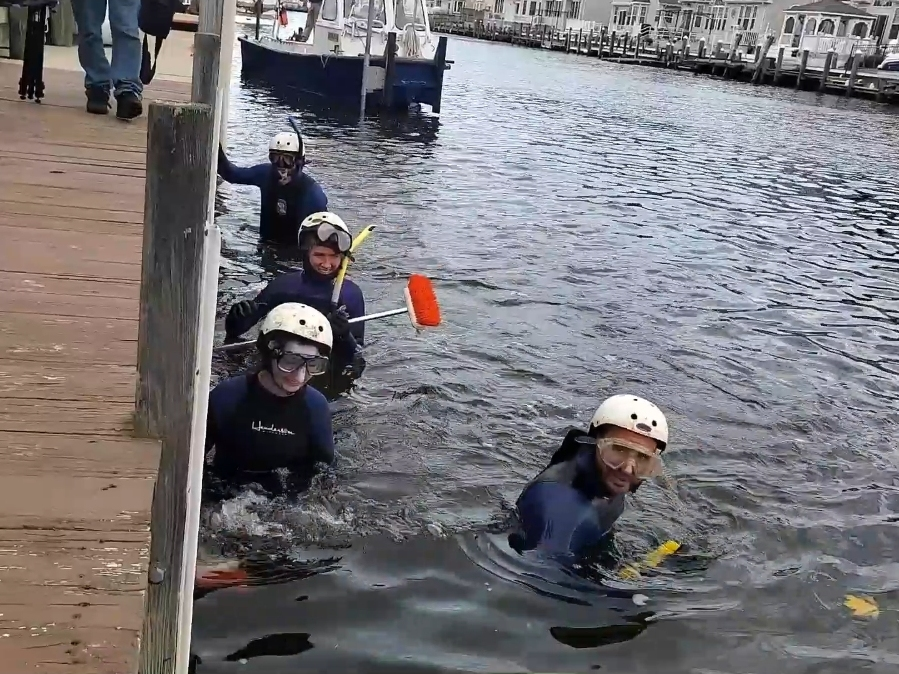
BERKELEY, NJ — Following the conclusion of a 42-month New Jersey Department of Environmental Protection study, the Berkeley Township Underwater Search and Rescue (BTUSAR) has announced they will expand their "Stop the Sting" operation to more Barnegat Bay locations.
While the full report - done in conjunction with Save Barnegat Bay, Montclair State University and Marine Academy of Technology and Environmental Science - will not be published for another month, BTUSAR said that they will expand to more areas that could benefit from their scientifically-proven "scrubbing" method. This method was refined over the course of said study.
The project scrubbed bulkheads in certain lagoon communities to study whether the effort could interrupt the reproduction cycle of bay nettles to reduce their populations in the bay, which in turn could reduce the threat of stings at children’s swimming beaches on the bay.
Find out what's happening in Berkeleyfor free with the latest updates from Patch.
Montclair's Paul Bologna has concluded “that reductions in ephyrae did occur at locations that had scrubbing” and Anthony Tamberelli recommended in his Montclair thesis “that the breadth of abatement efforts be expanded,” according to BTUSAR.
In the expansion, BTUSAR will enhance their mobile app they built to automate the publication of the Stop the Sting map. It currently shows where they've scrubbed in Berkeley, Brick and Toms River.
Find out what's happening in Berkeleyfor free with the latest updates from Patch.
Taking the suggestion of Save Barnegat Bay's Britta Forsberg, the expansion will provide community advisories “when bay nettles are reproducing” and “when it is time to scrub” to increase participation.
Additionally, BTUSAR will invite citizen scientists, who are yacht club members and marina users, to help educate their communities understand “how not to incubate a top predator.”
“Bay nettles are becoming a greater threat and being able to address these threats have been an outstanding experience for our students and the community overall,” said John Wnek, supervisor at MATES.
Get more local news delivered straight to your inbox. Sign up for free Patch newsletters and alerts.