Crime & Safety
Storms, Flooding In Ocean County To Get 'A Lot Worse' In Near Future: Report
Coastal flooding could possibly shoot up "several hundredfold" because of cyclones and other tropical changes.


New Jersey storms and flooding will probably get “a lot worse” in the not-too-distant future, according to researchers.
The new study quantifies how the storms could interact to produce alarming spikes in the combined height and duration of flooding. It projects that coastal flooding could possibly shoot up “several hundredfold” within this century, according to the Earth Institute at Columbia University.
The study appears this week in the journal Nature Climate Change.
Find out what's happening in Berkeleyfor free with the latest updates from Patch.
“When you look at hazards separately, it’s bad enough, but when you consider the joint effects of two hazards together, you can get some surprises,” Radley Horton, a climate scientist at Columbia University’s Earth Institute and study coauthor, said in the Columbia report. “Sometimes, 1 plus 1 can equal 3.”
Over the past century, the East Coast has seen sea-level rise far above the 8-inch global average, and up to a foot in much of the Mid-Atlantic and Northeast, including New Jersey, according to the Columbia report.
Find out what's happening in Berkeleyfor free with the latest updates from Patch.
More from Barnegat-Manahawkin Patch
- ‘Mega Million’ Heroin Killing N.J. Residents: State Police
- Ocean County Man, Father Stole $175,000 From Elderly Widow
- Who Has The $1 Million N.J. Lottery Ticket?
- Patch Localstream: Barnegat-Manahawkin
- Patch Localstream: lbi_region
Global rise is being driven mainly by melting of ice and expansion of seawater as the ocean warms. In this region, sinking land and currents that chronically drive water coastward have worsened matters. Most projections call for a further 2- to 4-foot rise within this century, and some go as high as 6 feet, according to the Columbia report.
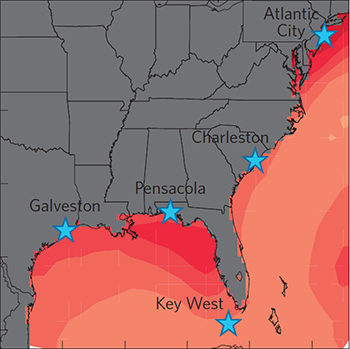
The new study shows analyzed 15 climate models at five locations: Atlantic City; Charleston, S.C.; Key West, Fla.; Pensacola, Fla.; and Galveston, Tex. The Asbury Park Press, assessing the report’s findings, said that storms and flooding, as a result, could get “a lot worse.”
The study’s authors make two projections for the 21st century: one if the world greatly reduces emissions of greenhouse gases, and one if the current trajectory continues, according to the Columbia report. The reduced-emissions calculations suggest a 4- to 75-fold increase in the flood index—the combined heights and durations of expected floods—across the five locations. With status quo, the flood index might go up 35 to 350 times, according to the Columbia report.
“It’s an aggregate number over a big area—not a specific prediction for any one place,” said lead author Christopher Little of Atmospheric and Environmental Research, a company that performs weather and climate research, and related risk assessments, in the Columbia report. “But these projections help lay the groundwork for more specific research that will be valuable for adapting to climate change.” The paper adds to the scientific basis for ongoing risk assessments such as those of the New York City Panel on Climate Change, to which both Little and Horton have contributed.
The authors of the study also include Robert Kopp of Rutgers University; Michael Oppenheimer of Princeton University; Gabriel Vecchi of the National Oceanic and Atmospheric Administration; and Gabriele Villarini of the University of Iowa.
Get more local news delivered straight to your inbox. Sign up for free Patch newsletters and alerts.