Arts & Entertainment
Mayumi Lehr's Extraordinary Life as a Musician, Photographer and Essayist
Suffering is a natural part of the musical learning curve, according to the classical pianist

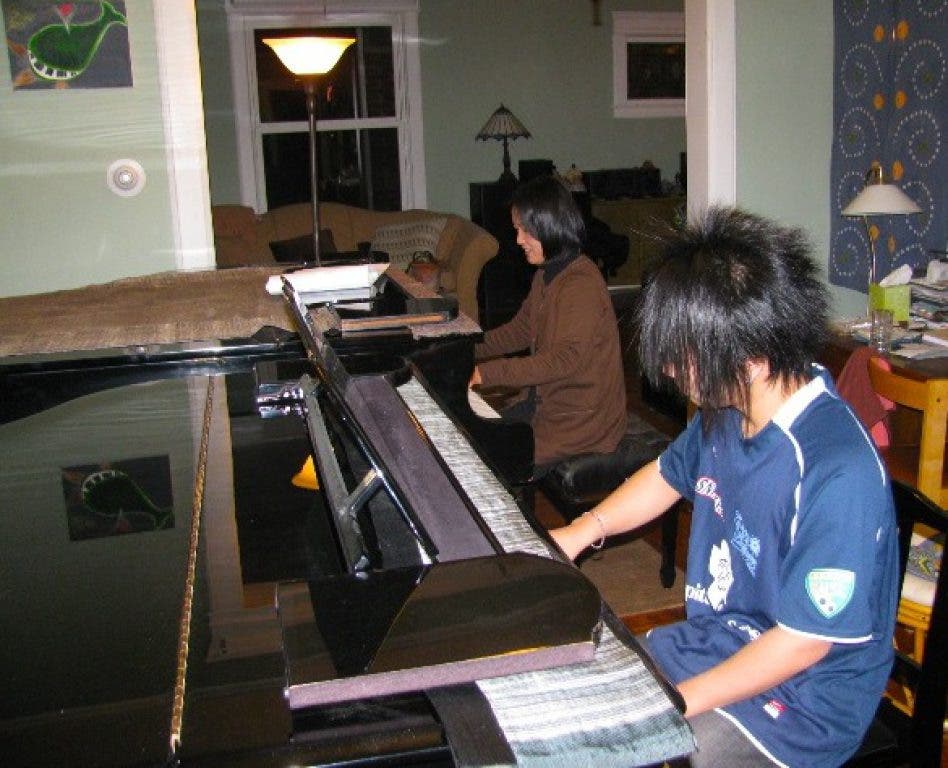





At times, the life of Mayumi Lehr, musician and mother of two, has been nothing short of extraordinary.
Guided by an unyielding determination and a powerful love of music, Lehr embarked on an early training regimen strict enough to appall music teachers of today. But her stranger-than-fiction story is not just one of endurance. Mayumi Lehr, a Bloomfield resident, is a triumphant survivor, both as a person and as an artist. In fact, she has survived experiences most people can scarcely imagine.
“When I was three years old, my parents gave me a list of five things to learn,” Lehr remembers. A native of Japan who moved to the U.S. in 2000, Lehr can still clearly recall these five towering goals: to play a Japanese stringed musical instrument called Koto; to learn to paint; to dance classical ballet; to go to church (and learn English, the Bible, and Bingo); and to learn music at the Yamaha Music School.
Find out what's happening in Bloomfieldfor free with the latest updates from Patch.
Incredibly, the three-year-old pursued all five goals for the next four years. Then, right before her seventh birthday, “My parents called me into the living room and said, ‘You are seven tomorrow. You have to choose one thing. After you choose, we’ll get you the best training possible.’”
To all this, they added a final requirement: “You have to become a professional [in that field], and pay us back [for your training] when you grow up.”
Find out what's happening in Bloomfieldfor free with the latest updates from Patch.
Even today, Lehr can recall how she came to choose a musical career over her other choices.
“That night I was thinking very serious. I had to be professional and make money. I loved Koto at that time. I had perfect pitch. My teacher loved me. But I didn’t think professional Koto made money. And I knew painters don’t make money. Classical ballet—no way. That class had a mirror. I knew my legs were too short. So it was only church or music. I thought music was the best possibility. So I chose that.”
From that day on, Lehr strove to become the best musician possible. A combination of gratitude—“My parents gave me beautiful, special training at a music school. It taught piano, voice and solfège, everything"—competition, criticism from her instructors, and a desire to please her parents ensured that the young musician did succeed—but at a considerable internal cost.
“There was big pressure on me,” she realizes now, looking back on those early years. “My mother was really, really strict. My parents didn’t tell me to practice—they didn’t have to. I thought, ‘If I practice a lot, my mother will love me. If I get good at piano, she will be proud of me.’”
It wasn’t only her parents who were strict, however. “I had three teachers, all really, really, strict. I didn’t love them,” she admits. “My teachers hit me or poked my arm with a pencil if I didn’t do it right.”
Nowadays, some of the methods used by Lehr’s early teachers would surely be viewed as inappropriate. “My first teacher told me every lesson, ‘Please quit.’ She said, ‘Your fingers aren’t for the piano. You’ll never make it. It’s impossible.’ I was eight years old. My fingers [had been] trained for Koto, so I couldn’t make the right shape for piano.” Still, Lehr continued to believe that “someday, I will get it"—though she didn’t dare say so. Already this teacher rebuked her for her continued effort: "'You are such a stubborn student’.”
Lehr laughs, remembering.
“I am friends with her now. She thought I was incredibly optimistic. Or crazy.”
But at the time, encouragement from any quarter was hard to come by. “My mother was proud of me but she wouldn’t say so. Even if I played well in competition she would say, ‘Of course. You go to a good school’.”
By the time Lehr was thirteen, she was practicing piano five or six hours a day. She loved the instrument more than ever and had high hopes of becoming a professional pianist. But unexpectedly, her musical education came to an abrupt halt. Her parents decided to divorce. There was no longer money for her training.
This was a dark time for Lehr and her family. Even as she continued practicing on her own, she began to doubt her prospects as a musician. Following her parents’ divorce, her father remarried multiple times and fell deeply into debt. As a result, her family’s possessions were confiscated … including her beloved piano.
Then came something even worse: a freak accident in which Lehr, then fifteen, slipped and fell down a long staircase into a cement basement two floors below.
“I remember thinking as I fell that I had to try land on my left side because I needed my right side for the piano,” she says.
Lehr’s doctors were certain she wouldn’t survive. But her fierce determination helped her once again, and three years later she was able to walk and even resume playing music—not her beloved piano, but the clarinet.
Eventually she did indeed resume her piano studies. Though she never fully realized her dream of becoming a professional classical pianist, she still dearly loved to play. Rather than performing exclusively as she had once hoped, she began composing music as a young adult and took up teaching. After several years, she was promoted to Head Teacher at the Yamaha Music Foundation.
Lehr married and had two sons, Takuto and Kyohei, now 24 and 22. In 2000, she and her sons moved to the United States with her second husband, American-born acupuncturist Bill Lehr. They chose to settle in Montclair because of its proximity to New York City.
“My first day in Montclair I felt a really nice feng shui,” she smiles.
While her sons, then aged 11 and 13, attended the Montclair public schools, Lehr concentrated on learning English and acquiring new piano students. As had been true of so many things in her life, getting started wasn’t easy.
“I was a really bad at English,” she admits. (Even as a child in Japan, she says, she was a poor language student: “I’d sleep through the class. I had horrible test scores.”) But as always, Lehr persevered. She eventually learned English and slowly built a new life.
Then, a year after she arrived, her world was shaken once again. The date? September 11, 2001.
As a passenger on a bus headed into New York, she recalls, “Overlooking the Lincoln Tunnel, I witnessed both planes hit.” Only two of the passengers on that bus arrived in New York that day, choosing instead to turn back; but Lehr, characteristically, pressed on.
“I saw the chaos of the city. Everything was sad. I saw an orange explosion, many people dying. I saw it. People were making lines to give blood. I didn’t notice I was in shock. But suddenly I couldn’t stand up. I just fell down,” she remembers.
Lehr still has a yellow rose that a stranger gave her that day. Now a soft shade of mossy brown, it is displayed in her music room along with her family mementos.
“Montclair had free therapy after 9-11, but I couldn’t speak English well enough to talk about the things I was thinking,” says Lehr. Instead, she began to write.
“People can die for weird reasons—very easily,” she realized. “I decided to write a farewell letter to my kids. It was my [auto]biography.”
Once she began to write, she found she couldn’t stop. “I wrote from morning until midnight. I wrote 1,000 pages. It healed me a lot. I didn’t panic any more. I didn’t feel sad any more. I felt normal again.”
A friend posted a few pages from her life story on the Internet and, just like that, Mayumi Lehr had a blog.
Nowadays the blog has a Japanese-language following of 200 readers worldwide. Lehr says, “I write essays about life, music, piano,” and accompanies them with her own beautiful images. An entirely self-taught photographer, Lehr uses “a very old digital camera” to capture memorable images of wildlife and nature.
Not surprisingly, Lehr’s dedication to music has remained a constant in her life. She plays the piano every day and now has many loyal music students.
“I have thirty students from age five to 58,” she says proudly. Despite her own success as a musician, however, Lehr does not necessarily adhere to the strict musical training of her own childhood.
“I don’t force kids to play the piano,” she says asserts. “They have to want it.”
Still, she inadvertently adds her voice to the current “Tiger Mother” debate (Lehr says she has never heard of Amy Chua) when she states that “too many American mothers think about happiness” when it comes to teaching children music.
“If a student has a difficult piece to learn, the mother thinks, ‘Oh, my child looks miserable.’ They tell me, ‘Stop it. Having fun is the most important thing.’ They don’t want their children to suffer.” But Lehr maintains that “suffering” is a natural part of the musical learning curve.
“Right after the horrible, exhausting part is when the good part comes,” she promises, excitement making her voice lilt. “I try to tell my students, ‘If you make a better effort and try to get it, you will be proud of yourself.’ Right before that (breakthrough), many people give up.
“Progressing is not without effort or frustration. Or suffering. No way,” she insists. “If you want to have any progress, there is no escape.”
Still, Lehr maintains that even children as young as six or seven can handle rigorous training and will take satisfaction in their own progress. “That is bigger than just ‘having fun'," she says sagely. “Pleasure and ‘having fun’ are two different things.”
Experience has taught her to advise parents to seek a professional music teacher for their children, rather than attempting to do it themselves—a practice her sons thank her for today, she says. When hearing a description of the teaching methods of Amy Chua, the so-called “Tiger Mother,” Lehr smiles faintly.
“That,” she says, “is a different kind of suffering.
Mayumi Lehr currently teaches students voice, composition and solfeggio. Her students perform annual piano and vocal recitals once a year at the Montclair Art Museum auditorium or the Glen Ridge Church.
Lehr is one of the directors of the New York-based Amateur Classical Musicians Association. Her next performance with the ACMA is a Gershwin concerto on April 2 at the Turtle Bay Music School in Manhattan. The annual ACMA concert will take place in October at Carnegie Hall.
Get more local news delivered straight to your inbox. Sign up for free Patch newsletters and alerts.