Schools
Brick Bus Drivers Await Fate Of Layoff Proposal
Interim superintendent says privatization isn't the plan, despite firm's report urging district to do just that.


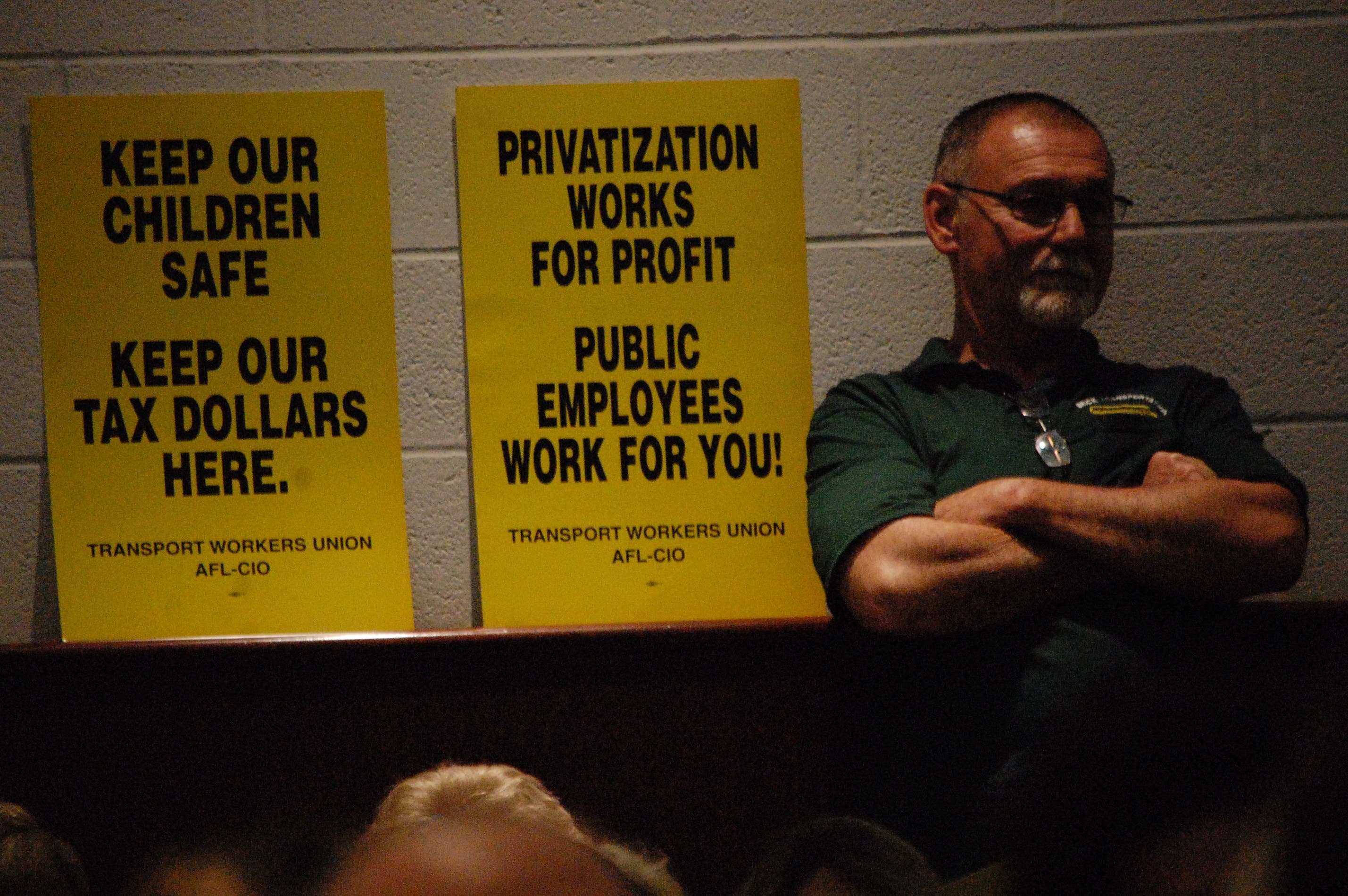


Two weeks ago, by the end of a very long Brick Township Board of Education meeting, a handful of people were still sitting in the auditorium at Brick Township High School, listening to comments about a proposal to cut 31 full-time bus drivers’ positions.
It was a meeting were more questions were raised than answered about the district’s transportation department and about the decision-making that led to the proposal in the first place.
The board voted that night to delay sending the district’s plan to cut those 31 jobs to the state Civil Service Commission. But whether the delay will result in a tangible change to the plan was unclear.
Find out what's happening in Brickfor free with the latest updates from Patch.
Not cutting the positions means a savings factored into the 2015-16 school budget won’t be realized. Cutting the jobs will affect dozens beyond just the drivers themselves.
And the added tension caused by the proposal is more than likely having a negative impact on negotiations between the school board and the Transport Workers Union -- which represents the drivers as well as other staff in the district -- on a new contract.
Find out what's happening in Brickfor free with the latest updates from Patch.
Some indication of the district’s direction should come on Monday, when the board has scheduled a special meeting for 7 p.m. at Veterans Memorial Middle School. That meeting is preceded by an executive session at 6:30 p.m., according to the district’s website.
The one thing that was clear at the May 28 meeting was that a disconnect exists between the information the board was receiving and what the rank-and-file school district employees feel is the real situation.
Board President Sharon Cantillo and board member Michael Conti -- who served on the finance committee that reviewed the district’s proposed budget for the 2015-16 school year -- said they were aware the budget included a proposal to lay off drivers. Karyn Cusanelli is the third member of the finance committee.
Board members Susan Suter and John Barton both expressed frustration that they were not explicitly told that the proposed budget included the plan to lay off the drivers. Suter -- who repeatedly butted heads with suspended Superintendent Walter Uszenski over information she sought on various topics -- abstained from the budget vote because she felt she did not know what she was voting on. The complete document, available on the district website, is nearly 1,000 pages long and includes the salaries of every district employee.
The information and suggestion for the layoffs came from the Transportation Department, Cantillo said, and she said it was based in part on information presented that said there is a problem of chronic absenteeism among the drivers. A specific example cited, she said, was that 73 drivers were absent on the first day of school in September.
The district has 114 full-time drivers and 20 part-time, to covers a total of 621 bus runs -- 492 regular runs and 129 “cover” runs, district business administrator James Edwards said by email. There more than 9,000 students in the district, but not every student is bused to school. Some live close enough to walk to school, others drive or are transported by family or friends. (Editor’s note: The number of part-time and full-time drivers was incorrect and has been updated.)
Gregory Cohen, the local representative for the district’s Transport Workers Union, said the information that had been provided was inaccurate.
“There’s no way, with less than half of the drivers, that we could have gotten all those (school bus) runs done,” Cohen said. The district struggles now with almost-daily problems of getting students to school late on days where far fewer drivers are absent, he and several others said, with drivers doubling and even tripling up to get students to school.
So how was the number of 73 absences reached? More importantly, who was involved in the construction of the plan to lay off the drivers -- a plan, Cohen said, impacts 20 part-time drivers in addition to the 31 full-time positions.
District officials are not saying.
Drivers and others who spoke on condition of anonymity point their fingers at one man -- Joseph Sangiovanni, the district’s transportation manager.
Sangiovanni, who was hired by the district in May 2007, reportedly has not been at work for more than a month. District officials would not say why he is out, calling it a personnel matter. Sangiovanni, a former township councilman, had owned a private trucking company that went out of business, a result he blamed on economic challenges during the 2013 mayoral campaign in town.
Sangiovanni -- though he wasn’t mentioned by name during the board meeting -- was repeatedly criticized by those in attendance for treating the transportation of students as though it was no different than transporting produce or inanimate objects.
Drivers and others also believe Sangiovanni was the sole source consulted when Transportation Advisory Services updated a review of the district’s transportation department this school year. TAS had conducted an in-depth analysis of Brick’s school transportation in 2006, meeting with employees as well as management in formulating its 2007 report.
One district official said Sangiovanni was not the only one TAS representatives spoke with for the followup, but that official did not say who was involved.
Cohen, the union representative, said it is the TAS reports that are the reason the union believes the layoff proposal is part of a plan by the district to eventually privatize all its busing -- something interim Superintendent Richard Caldes is not true.
“We are not outsourcing any routes,” Caldes said at the May 28 board meeting, where drivers carrying signs urging the board to reject privatization filled the auditorium.
A look at the 2007 TAS analysis, as well as the follow-up report sent to the district in January, shows why that concern exists.
In both cases, TAS urges the district to privatize at least part of its operations, if not all of them.
The 2007 report, under the section titled ”Management,” stated the district “should strongly consider the complete or partial outsourcing of transportation,” adding it was a recommendation TAS “does not take ... lightly.” The reason for outsourcing transportation was “there are so many concerns and problems ... that we do not believe the District will be able to achieve the changes that are necessary.”
Among those changes recommended in 2007 were changes to the labor agreement to cut what TAS described as relatively high absenteeism with drivers using sick days as “paid days off from work.”
That privatization recommendation is even stronger in the report TAS issued on Jan. 16.
“The labor agreement itself appears designed to create as much work as possible – regular and overtime hours – with as many benefits as possible, for the members,” the report summary says. “This is not a criticism of the employees, as they pay their dues and expect the union to negotiate a contract that is to their benefit. The union has done just that.
“Having said that, it has become a contract that is unaffordable, unmanageable, and in conflict with the District’s goal of providing the highest level of educational services for the students, in the most efficient manner,” the summary says. “As we review school district labor agreements in general, we find that many of the terms and conditions stem from a time when public sector wages were low, benefits were generous and less expensive than today, and state aid was plentiful. Unfortunately, that is no longer the case.”
The summary of the 2014 report said further: “Although full privatization is possible, I suggest that partial privatization be considered. Keeping part of the program in-house serves as a balance for the contracted portion, and enables you to get back into the program without extensive costs. You have the ability to turn to your local commission – MOESC – and request prices for Special Education (29 buses) and Non-public (24 buses) transportation services.”
At the same time, in the 2007 report, TAS said that even as it made the privatization recommendation, it couldn’t say with certainty that doing so would save the Brick school district significant amounts of money: “We are not recommending outsourcing of transportation in an effort to significantly reduce the current operating costs. We do not know if that will occur. However, if the incremental capital and operating expenses that we have recommended in this report are included in the cost of transportation, the District-operated costs increase significantly.”
The more recent report suggested the district would save upwards of $1 million per year through a partial privatization.
Bus drivers who spoke privately bristled at the suggestion that wages and benefits were too high. They said the drivers with the least seniority -- and those who will be the first ones out the door -- make less than $15 per hour and work longer than an eight-hour day, with the hours between the primary bus runs to and from school occupied by runs transporting students to the county’s vocational schools and elsewhere. They also pointed out that unlike in the past, bus drivers -- along with other public sector employees -- now pay share in the cost of the premiums for their health insurance.
“We are the lowest paid drivers in Ocean County,” one driver told the board at the May 28 meeting.
The drivers who spoke at the May 28 meeting also said the view of the drivers’ absenteeism fails to note how many are out for legitimate reasons, including those who are out due to injuries suffered on the job. Two speakers said state law prevents drivers who are wearing a walking boot for an ankle injury or who have an immobilizing injury to their hand, wrist or arm from driving for safety reasons.
And while the more recent TAS review says the district disciplined drivers for excessive absenteeism, the summary takes a swipe at the district’s human resources manager, criticizing the overturning of many of those disciplinary actions, ”further exacerbating the situation.”
The labor decisions that were overturned, sources said, were situations where Sangiovanni had sought to have drivers punished for absences that were for legitimate reasons, such as work-related injuries, or for being on family leave, which is protected by federal statute.
Cantillo said -- and Edwards confirmed -- that the ability to bus students more efficiently while cutting 31 full-time drivers hinges on the expectation that all of the remaining drivers do not miss work. It is an expectation, Edwards said, that has inherent risks if the district is unable to get enough substitute bus drivers to fill in for absent drivers.
The district’s plan to reconfigure the bus runs would reduce its primary runs from 492 to 402, while eliminating all of the 129 cover runs that currently exist.
Edwards also said the projected savings to the district is dependent on getting the plan submitted to the Civil Service Commission for its review, because nothing can be done until the plan is approved. Because the budget approved by the board factored in the anticipated savings created by the layoffs, the delay in sending the plan already is reducing the savings and impacting the budget, he said.
If the board rescinds the plan for the layoffs, the district will have to find the money to make up the difference elsewhere in the budget, Edwards said.
”We are in this mess because somewhere leadership failed,” Conti said.
(Bus drivers and their supporters express their sentiments with signs at the May 28 Brick Board of Education meeting. Gregory Cohen, the local TWU representative, says the board was given bad information. Credits: Karen Wall)
Get more local news delivered straight to your inbox. Sign up for free Patch newsletters and alerts.